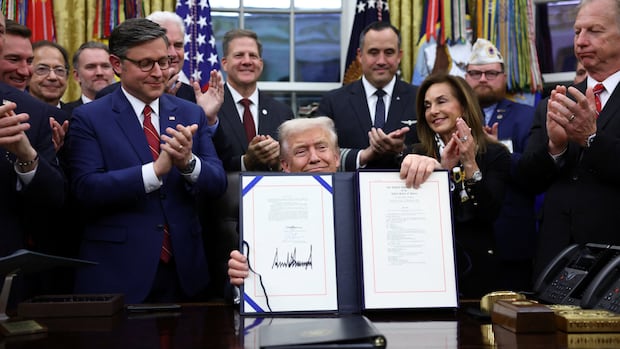
The U.S. shutdown is over: Trump signs bill ending over 6 weeks of government paralysis
CBC
The U.S. House of Representatives passed a bill Wednesday to end the nation's longest government shutdown, which President Donald Trump signed later in the evening.
It marks the end of a historic 43-day funding lapse that saw federal workers go without multiple paycheques, travellers stranded at airports, and people lining up at food banks to get a meal for their families.
House lawmakers made their long-awaited return to Washington, D.C., this week after nearly eight weeks away, with Republicans using their slight majority to get the bill over the finish line by a vote of 222-209.
The Senate has already passed the measure.
Trump's signature draws to a close the second government shutdown he's overseen in the White House, one that magnified partisan divisions in Washington as his administration took unprecedented unilateral actions — including cancelling projects and trying to fire federal workers — to pressure Democrats into relenting on their demands.
Democrats wanted to extend an enhanced tax credit expiring at the end of the year that lowers the cost of health coverage obtained through Affordable Care Act marketplaces. They refused to go along with a short-term spending bill that did not include that priority.
But Republicans said that was a separate policy fight to be held at another time.
"We told you 43 days ago from bitter experience that government shutdowns don't work," said Rep. Tom Cole, the Republican chairman of the House Appropriations Committee.
"They never achieve the objective that you announce. And guess what? You haven't achieved that objective yet, and you're not going to."
The shutdown magnified the stark partisan divisions within Congress, and that split was reflected when lawmakers debated the measure on the House floor.
Republicans said Democrats sought to use the pain generated by the shutdown to prevail in a policy dispute.
"They knew it would cause pain and they did it anyway," U.S. House Speaker Mike Johnson said.
Democrats said Republicans raced to pass tax breaks earlier this year that they say will mostly benefit the wealthy, but the bill before the House on Wednesday "leaves families twisting in the wind with zero guarantee there will ever, ever be a vote to extend tax credits to help everyday people pay for their health care," said Rep. Jim McGovern, a Democrat from Massachusetts.
Democratic House Leader Hakeem Jeffries said Democrats would not give up on the subsidy extension even if the vote did not go their way.


In a resounding victory that is guaranteed to reshape Nepal's politics, rapper-turned-politician Balendra Shah appeared headed for a landslide win in the South Asian country's first polls since youth-led protests toppled the previous government last fall.

China’s latest blueprint for driving growth in its economy was largely written before the U.S. and Israel instigated the most far-reaching war in the Middle East in decades.

U.S. President Donald Trump's firing of Homeland Security Secretary Kristi Noem on Thursday overshadowed the announcement of his plans to nominate Republican Sen. Markwayne Mullin as her successor.

The truck carrying Nepali prime ministerial candidate Balendra Shah was swarmed by cheering supporters in the capital, Kathmandu, on Saturday, unable to inch forward as the former rapper, wearing sunglasses and a sleek black suit, danced on top of the roof.

Israel sent troops into southern Lebanon on Tuesday and warned residents of more than 80 villages to evacuate as the Iran-backed militant Hezbollah group said it was ready for an "open war" with Israel in the wake of the U.S.-Israeli war with Iran.

U.S. President Donald Trump has given Americans a short list of his objectives in attacking Iran, but when it comes to the justification for launching the war and how the conflict is expected to play out, he and his team are sending mixed messages.

Omid Golabkesh dragged his suitcase down a long hallway marking the exit of the Kapikoy border crossing in eastern Turkey. He had nearly reached the end of an exhausting journey that included a 12-hour drive to the checkpoint from his home in Tehran.