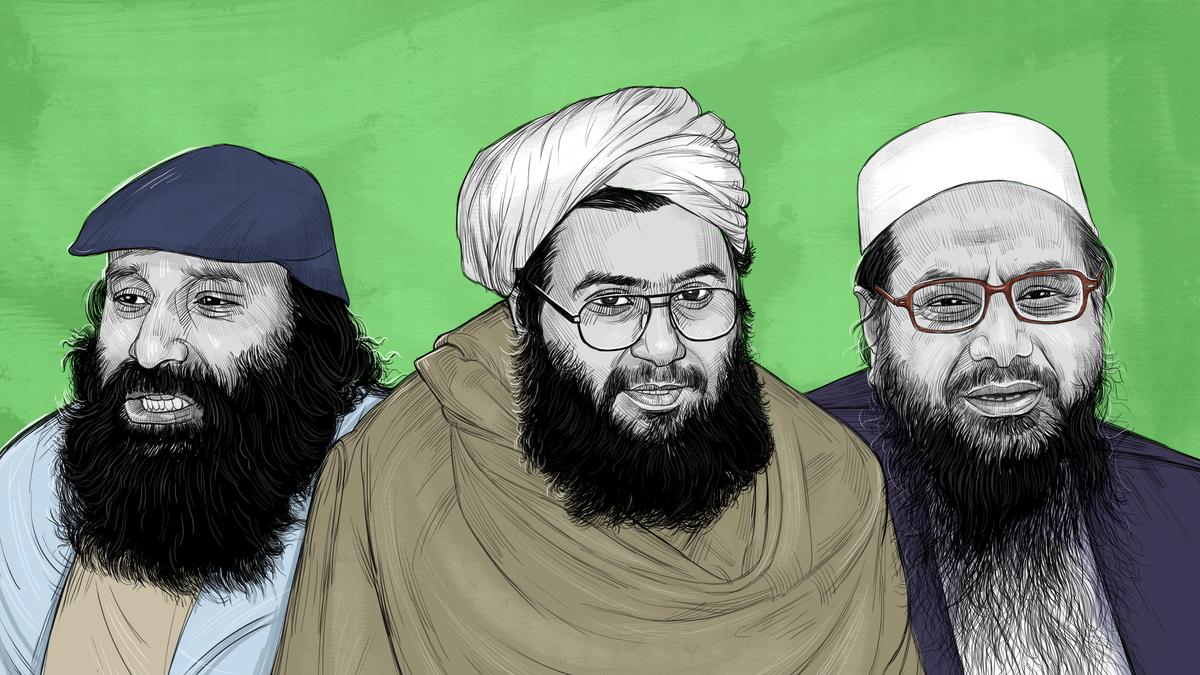
The terror trio of Pakistan | Hizb-ul-Mujahideen, LeT and JeM Premium
The Hindu
The Hindu’s profile on the terror trio of Pakistan - Hizb-ul-Mujahideen, LeT and JeM
Flanked by top Pakistani military officials, Abdur Rauf, a local cleric and a U.S.-designated terrorist, led prayers for those killed on May 7 by Indian attacks, inside Lashkar-e-Taiba’s (LeT) headquarters in Muridke, Punjab. Wrapped in Pakistan’s ‘Star and Cresent’ flag, the slain were awarded ‘state honours’, and wreaths were reportedly laid by Pakistani Army Chief Gen. Asim Munir and Punjab Chief Minister Maryam Nawaz on their remains.
Indian security officials confirmed on May 10 that five high-profile terrorists were killed during ‘Operation Sindoor’. India said it hit nine terror camps of Jaish-e-Mohammad (JeM), LeT and Hizb-ul-Mujahideen in Pakistan-occupied Kashmir (PoK) and Pakistan. Hafiz Muhammad Jameel and Mohammad Yusuf Azhar, two brothers-in-law of JeM founder Maulana Masood Azhar, LeT commanders Mudassar Khadian, Khalid and JeM’s Mohammad Hassan Khan were among the dead.
For more than three decades, these three outfits have been responsible for attacks across India, including the 2001 Parliament attack, the 2008 Mumbai attack and the recent (April 22) Pahalgam massacre. Here’s a look at each of these outfits, which are backed by Pakistan’s security establishment.
Founded in 1989, Hizb-ul-Mujahideen started operating in PoK’s Muzaffarabad with the aim of integrating Jammu and Kashmir with Pakistan. As a militant wing of Pakistan’s Islamist organisation Jamaat-e-Islami (JeI), Hizb was set up at the behest of the Inter Services Intelligence (ISI), the Pakistani spy agency. The group has a cadre strength of over 1,500, and its chief is Mohammed Yusuf Shah, also known as Syed Salahuddin. It operates in five divisions, targeting Srinagar, Kupwara, Bandipora, Baramulla, Anantnag, Pulwama, Doda, Rajouri, Poonch and Udhampur. While its headquarters are in PoK, Hizbul has units in both Islamabad and Rawalpindi to communicate with the military and the government.
Born at the peak of insurgency in Kashmir, Hizb saw an internal tussle over ideology, leading to a split with Salahuddin heading one faction and Hilal Ahmed Mir the other. In 1993, India’s counter-terrorist attacks peaked, wiping out several top leaders, including Mir. Through the years, Hizb has clashed with Jammu Kashmir Liberation Front (JKLF) — another ISI-funded group, which advocates for Kashmir’s independence.
In July 2000, Salahuddin made a conditional offer of ceasefire to India, in a press conference in Islamabad, leading to a meeting between the group’s chief commander Abdul Majeed Dar and a high-level Indian official team at Srinagar. However, facing pressure from other terrorist outfits in Pakistan, Salahuddin retracted his offer within days after the meeting. Dar, who played a significant role in the indoctrination, recruitment, launching and training of cadres, was killed in 2003 by unknown gunmen in Sopore. The attack was reportedly carried out by a splinter group of Hizb, after he had fallen out of favour with Salahuddin.
Through the years, the group has been responsible for numerous attacks on elected leaders in J&K, grenade attacks on J&K police stations, bomb attacks on military personnel and the Delhi High Court blast of 2011. Top leaders such as Ahsan Dar, Ashraf Dar, Maqbool Alla, Burhan Wani, Riyaz Naikoo, Sabzar Bhat have been killed by Indian security forces. It was designated a terrorist organisation by the U.S. in 2017.


Norway's Crown Princess Mette-Marit regrets her friendship with Epstein, claiming she was 'manipulated and deceived' amid scandal.

A fire at a South Korean auto parts factory injures at least 50, prompting a large-scale firefighting response.

IEA suggests working from home and avoiding air travel to mitigate rising energy prices amid the U.S.-Israel conflict with Iran.

NTSB investigates a near-collision between Alaska Airlines and FedEx jets at Newark, raising safety concerns in air traffic control.

Vietnam accelerates its shift to ethanol fuel as rising energy prices from the Iran war impact its economy.

Teenagers sue Musk's xAI, alleging its image-generator created explicit images of them as minors, sparking concerns over AI safety.

Shorts News:Watch: Netanyahu: Israel ‘acted alone’ in Iranian gas field attack

Indonesian billionaire Michael Bambang Hartono, co-founder of Djarum Group, has died at 86, leaving a significant legacy.

European nations, Japan, and Canada unite to ensure safe passage through the Strait of Hormuz and stabilize energy markets.

Some of the estimated 20 billion yuan ($2.9 billion) worth of equipment, including screen-printing production lines, will require export approval from Chinese regulators, according to the people. It wasn't immediately clear how much of the equipment would require approval or how long it would take.

Three men, including a Super Micro VP, charged with smuggling U.S. AI technology to China, threatening national security.

Trump compares U.S. strikes on Iran to Pearl Harbor in meeting with Japan's PM, highlighting the element of surprise.

Iran-Israel war: Follow the latest updates from The Hindu on the West Asia conflict on March 20, 2026