The people who bear the weight of a divided history
The Hindu
Rising tensions between India and Pakistan post-terror attack impact families, trade, and daily life at Attari-Wagah border.
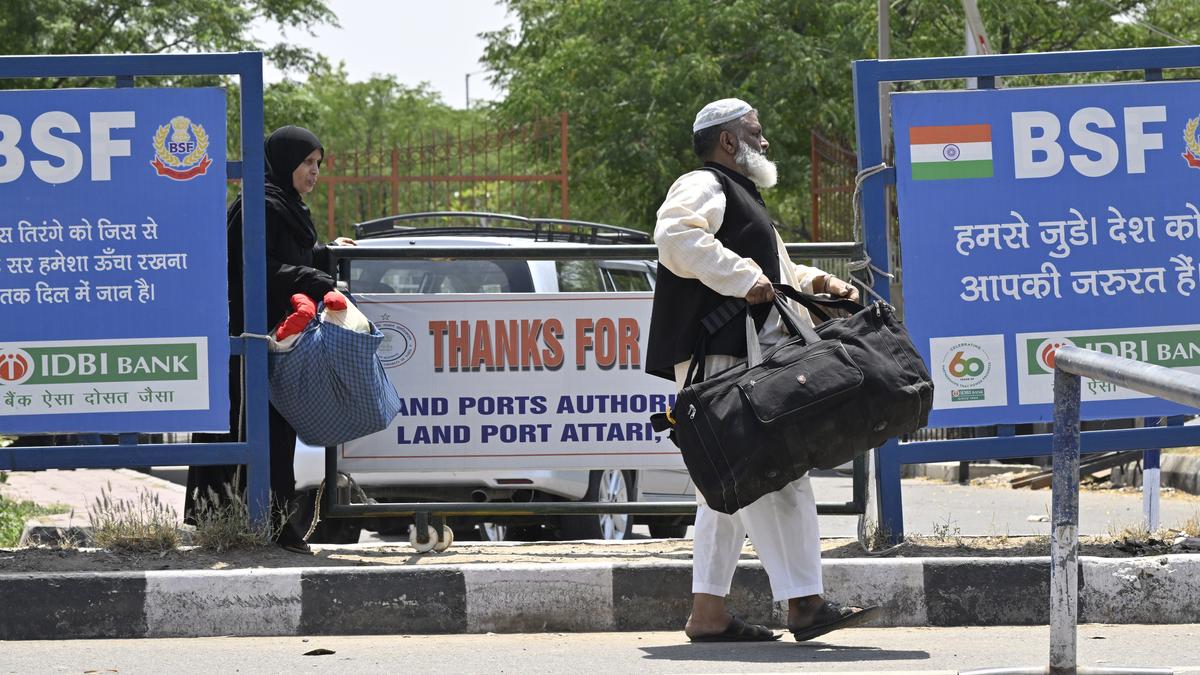
Ripples of rising hostility between India and Pakistan after the recent terror attack in Jammu and Kashmir’s Pahalgam are strikingly noticeable at Attari-Wagah, the international border between the two countries. Anguish, dismay, uncertainty, and resilience are all palpable in Punjab’s Amritsar and its border villages, even as tensions between the nuclear-armed nations and temperatures of the scorching summer continue to soar.
At Baisaran meadow, near Pahalgam in Anantnag district of Jammu and Kashmir, 26 people, all but one of whom were tourists, were killed by terrorists on April 22. A day later, India, in protest against the attack, which it attributes to Pakistan, announced a series of diplomatic measures, including the closure of the Attari border. It asked almost all Pakistani nationals to leave India. In response, Pakistan suspended trade with India and visas issued to Indian nationals. This forced several nationals from both countries to cut short their trips and return to their home country.
The deadline for Pakistani citizens on visas — excluding those on medical, diplomatic, and long-term visas — to leave India was April 27. Several people, including women and children, lined up at Attari to cross over to Pakistan. Emotions ran high with many taking unexpected and tearful leave from relatives and friends. From the Pakistani side, several Indians made their way to India. Many families with mixed nationalities are staring at separation with no end date.
“My wife Savita has a Pakistani passport, but my two kids are Indian. They had gone to Pakistan to meet her family a few days ago. We have been married for 13 years and she has visited Pakistan on different occasions and returned. This time she is being held back. The authorities in Pakistan are allowing only our children to return,” says Rishi Kumar from Maharashtra’s Kolhapur. He reached Attari on April 24 and stood waiting outside the Integrated Check Post (ICP).
“Why are we being separated? I don’t know what to do now. What happened in Pahalgam is condemnable beyond words, but I hope and pray the situation doesn’t deteriorate between the two countries. Peace should prevail,” says Kumar, who spent three days trying to find a way to reunite with his family. After five days of turmoil, on April 29, he heaved a sigh of relief when Pakistani authorities allowed his wife and children to cross over to India.
As many as 537 Pakistani citizens left India between April 24 and 27, when the first deadline came to an end, while 850 Indians arrived from Pakistan. On April 28 and 29, as many as 249 Pakistanis left India via the ICP, while 527 Indians returned to the country
.Over the years, families and communities that were split at the time of Partition have attempted to stay in touch via the trans-boundary connect. But whenever bilateral relations are strained, people suffer. Despite the creation of India and Pakistan as separate countries in 1947 — a time that was marred by violence and bloodshed — a sense of shared cultural identity across the border has remained intact for years.


Perundurai's industrial growth faces challenges of pollution, water scarcity, and healthcare, impacting residents ahead of the 2026 elections.

The Travancore Devaswom Board asserts that courts should respect community beliefs in its Supreme Court submission on Sabarimala's entry issue.

Karnataka cancels Deendayal Upadhyay event at KSOU due to protocol violations, citing inconsistency with university objectives.

Illegal pickle unit busted in Hyderabad, one arrested; unhygienic stock worth ₹3 lakh seized

Karnataka has entered a state of demographic transition where a large working-age population will no longer be enough to drive economic growth, and future gains will depend on how productively people are employed, the ‘State of Working India 2026’ report said.

Key demands in Sulur Assembly constituency include reviving the powerloom sector, addressing farmers' needs, and protecting River Noyyal.

Kodihalli urges Karnataka CM to allocate ₹10,000 crore revolving fund for seamless procurement of farm products under MSP scheme.

Kerala's political parties continue to marginalize women candidates, highlighting a troubling disconnect between gender demographics and representation.

The High Court of Karnataka on Tuesday ordered the issue of a notice to the State government on a PIL petition, which had complained about disturbances caused to people residing in the localities around the National Public School situated in Rajajinagar 5th block due to use of loudspeakers with high volume in the school and parking of school buses in residential areas.

China is extensively mapping ocean floors to enhance submarine warfare capabilities against the U.S. and allies across key oceans.

AIADMK's 2026 manifesto promises free rations, women's benefits, education reforms, and economic growth initiatives for Tamil Nadu.

The vehicle towing drive will soon resume in the city to ease traffic congestion. The Bengaluru Traffic Police (BTP), in coordination with the Greater Bengaluru Authority (GBA), is set to relaunch the vehicle towing drive across the city shortly to tackle traffic congestion and illegal parking.

Panic buying, not shortage, is leading to long queues at Hyderabad petrol pumps.