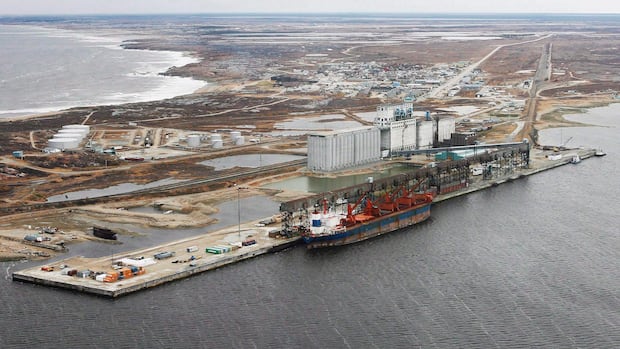
The journey toward an expanded Port of Churchill has only just begun
CBC
Compared to other major projects granted "national importance" status by Mark Carney’s Liberal government, the proposed expansion of the Port of Churchill is still a very fuzzy idea.
It’s relatively easy to wrap your brain around what it means to expand a liquefied natural gas terminal in Kitimat, B.C. or build a new copper mine at McIlvenna Bay, Sask., to name two major projects already in the works.
Manitoba’s megaproject involves five components, most of which remain entirely conceptual at this point and can not be defined before a series of economic, engineering and environmental questions are answered.
According to Premier Wab Kinew’s office, the project involves a port expansion of some sort, an upgraded Hudson Bay Railway, an all-weather road to Churchill and perhaps other northern Manitoba destinations, the presence of icebreakers in Hudson Bay, and an "energy corridor" that could involve the transport or transmission of liquefied natural gas, crude oil, natural gas, electricity or hydrogen, the latter most likely in form of ammonia.
Kinew said Thursday "it’s going to take some time" to better define the scope of the project, let alone come up with a projected cost. The province is spending $750,000 this winter to study what would be required in terms of icebreaking to allow all-season shipping through Hudson Bay, he said.
The list of what needs to be determined beyond that is long for Arctic Gateway Group, the Indigenous-led company that owns the railway to Churchill and the port in the northern Manitoba town.
It must determine the economic case for the increased shipping of commodities through Canada’s coldest rail-accessible deepwater port, the environmental feasibility of including fossil fuels among those commodities and the geographic placement of an expanded port — if such an expanded port is even possible, given the climate and geography of Hudson Bay.
Trevor Heaver, professor emeritus in transportation and logistics at the University of British Columbia, said he doesn’t believe there will be a purely economic case for expanding the Port of Churchill — but says Canada should still pursue the project, anyway.
Heaver said he cannot conceive of a single commodity — not potash, not minerals and not even fossil fuels — that makes more sense to ship through Churchill than through Canada’s existing coastal seaports.
"I can't see this being financially feasible. There's not going to be a positive economic return there," Heaver said Thursday in an interview.
"But you've got to view these things from a national perspective, and that is present in this route."
Heaver said Canada ought to consider the Port of Churchill as an insurance policy against another flood at the Port of Vancouver, another labour disruption there or at the Port of Montreal, or potential shipping obstacles through the United States.
By definition, insurance comes with a cost.
"But it's surprising how often a high-cost alternative will become a useful niche," Heaver said.


An RCMP-led corruption investigation is underway into at least one current Calgary city councillor as well as a business, CBC News has learned.

Much of Newfoundland is digging out of a blustery and messy day as another storm slams into the island.

Timiskaming—Cochrane MPP John Vanthof recalls the meeting in Thunder Bay earlier this month. He was part of the nine-day road trip along Highways 11 and 17 with other NDP MPPs.

A bill before the Nova Scotia Legislature is proposing raising the age limit for support for young people who have been in the foster care or group home system to 26.

The Fredericton Police Force has reallocated funds so new staff can be hired this year to better manage evidence after a police error upended murder cases against five people.

One of two pilots killed in a plane crash at New York's LaGuardia Airport Sunday earned his wings at an Ontario college, CBC News has learned.

Air Canada passengers who were aboard Flight 8646 when the CRJ-900 aircraft struck a fire truck upon landing at New York's LaGuardia Airport on Sunday evening say the collision was sudden and forceful, and they may owe their lives to the pilots who died in the incident.

Cardiac services are set to expand at a Winnipeg hospital once regarded as one of the best in Canada for heart care.

A 26-second TikTok video has ignited a larger conversation about vulnerable populations, theft and content creation.

Some family doctors and emergency room physicians working in Edmonton hospitals warn that an April 1 end to stipend pay arrangements could put patient care at risk and increase suffering.

An Auditor General of Canada report has found that B.C. saw drastically fewer international students than was forecast ever since wide-ranging federal immigration cuts began in 2024.

Six years after e-learning became a mandatory requirement to get an Ontario high school diploma, students don't appear to be taking online school to diversify their course selection as the province had intended, according to a CBC News analysis of provincial enrolment data.

Sarnia City Council will hold a special meeting Tuesday morning to respond to social media comments made by Coun. Bill Dennis, who criticized city spending on a new mural by Indigenous artist Kennady Osborne as “virtue signalling by woke politicians” — then made a series of comments in response to a reply from Aamjiwnaang Chief Janelle Nahmabin that some have characterized as unprofessional and aggressive.