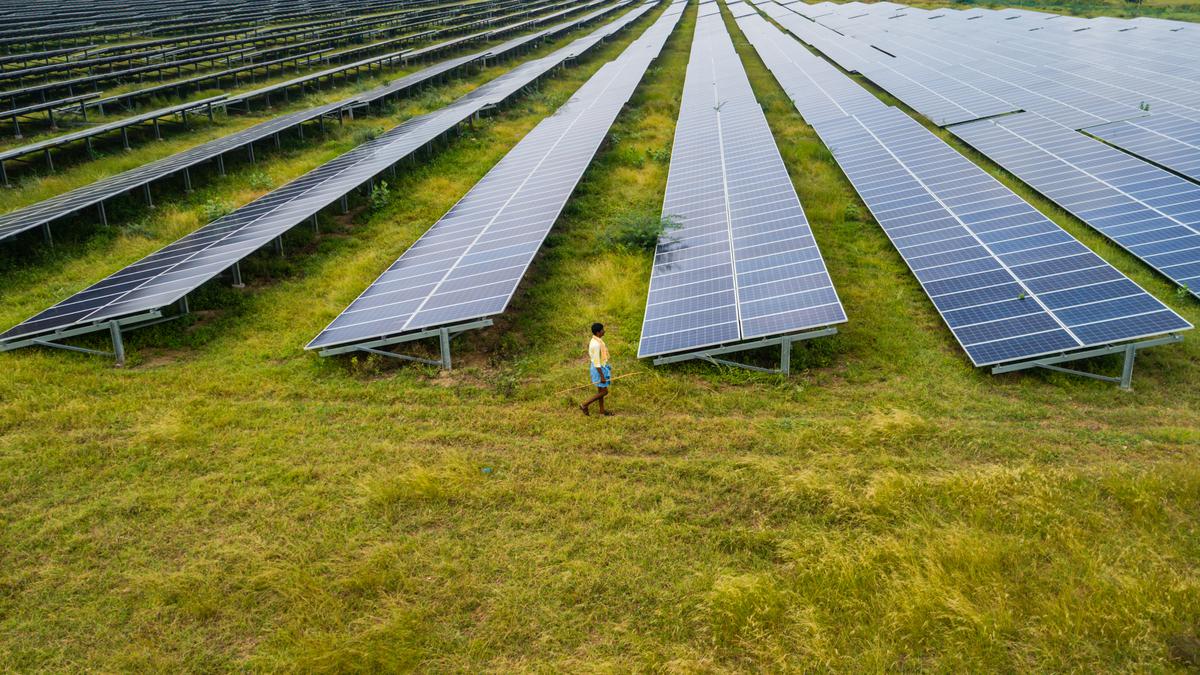
The ‘import restrictions’ on solar PV cells | Explained
The Hindu
Government orders aim to boost local solar manufacturing, not restrict imports, to meet India's renewable energy goals.
The story so far: Recent government orders on attempts to increase local sourcing of solar modules to support India’s renewables manufacturing ecosystem has been widely reported in the media as ‘import restrictions’. This follows the Ministry of New and Renewable Energy’s (MNRE), March 29 order to re-implement its 2021 notification of an ‘Approved List of Models and Manufacturers of Solar Photovoltaic [PV] Modules’, also called the ALMM list.
This list consists of manufacturers who “are eligible for use in Government Projects/Government assisted projects/ projects under Government schemes & programmes.... including projects set up for sale of electricity to the Central and State Governments.” However, this notification was “kept in abeyance” two years after it was issued, for the past financial year. While the government did not give an explicit reason for this, it has been reported that it stems from concerns and demands of renewable power producers who had secured sale contracts with the government before these rules were issued, when solar modules and cells were overwhelmingly imported from China at highly competitive rates. India’s domestic renewables sector, at the time, was unlikely to meet the spike in demand for solar power production equipment at rates offered by Chinese manufacturers.
The government’s re-introduction of this rule has been premised on the estimation that following measures, such as the Production Linked Incentive (PLI) scheme, India’s domestic sector has boosted its production capacities and bettered price competitiveness to meet local demand. This is an import substitution effort, and not an attempt to restrict imports.
India is overwhelmingly import dependent to meet its demand for solar cells and modules — with China and Vietnam being the country’s major suppliers. According to a reply by the Minister for New and Renewable Energy in Parliament in February last year, India imported about $11.17 billion worth solar cells and modules in the past five years. This is worth 0.4% of India’s total exports in the same period. And until January of 2023-24, data from the Ministry of Commerce’s Import-Export showed that China accounted for 53% of India’s solar cell imports, and 63% of solar PV modules. Ratings agency ICRA estimates that China commands more than 80% share of the manufacturing capacity across polysilicon, wafer, cell and modules. “In comparison, the manufacturing capacity in India is relatively low and is largely restricted to the last manufacturing stage,” ICRA stated in its November 2023 report, adding that the PLI scheme is expected to change this, with integrated module units expected to come up in India over the next 2-3 years.
To address this over dependence, India made three significant efforts over the past five years. It began with the notification of the ALMM order in January 2019. But the issue attained centre stage in the wake of severe global supply chain disruptions during the COVID-19 pandemic. Finance Minister Nirmala Sitharaman proposed the ₹19,500 crore PLI scheme in the Union Budget of 2022-23. This was to scale domestic manufacturing of the entire solar supply chain — from polysilicon to solar modules. The government also introduced a steep 40% customs duty on PV modules and 25% on PV cells. These duties were halved as solar capacity additions slowed and as Reuters had reported, developers had quoted “aggressively low tariffs” to win power purchase contracts based on imports of Chinese equipment that put cost pressure on about 30 GW capacity worth projects.
In a July 2022 report, the International Energy Agency (IEA) noted that China was the most cost-competitive location to manufacture all components of the solar PV supply chains. This is mainly because of the lower cost of power supplied to the industry, the agency observed, as electricity accounts for more than 40% of production costs for polysilicon and almost 20% for ingots and wafers. The IEA also observed that ‘Chinese government policies prioritised solar PV as a strategic sector, and growing domestic demand enabled economies of scale and supported continuous innovation throughout the supply chain.’”
The government’s ambitious target of 500 GW of installed capacity from non-fossil fuels by 2030 is the main driver to scale solar power in India. India also accounts for the fastest rate of growth for demand of electricity through 2026 among major economies, according to the IEA. This is because of strong economic activity and expanding consumption of products to mitigate extreme weather. Solar power accounted for about one-third of all energy generated from renewables between April last year and February this year. “The country has an estimated solar power potential of 748.99 GW. Hence, the potential of solar energy is not fully tapped, so far. The government is making efforts to harness the available potential through various schemes & programs,” MNRE Minister R.K. Singh said in Parliament last year.


The Thane police have arrested two co-founders of cryptocurrency exchange platform CoinDCX in connection with an alleged fraud of Rs 71.6 lakh, officials said

Meta Chief Executive Mark Zuckerberg is building a CEO agent to help him do his job, the Wall Street Journal reported

Insurance penetration and density are often misunderstood and do not reveal how many families are insured or whether they would be financially secure if the main earning member were to die. The real issue is not reach but adequacy, as households may have life insurance but not enough cover to replace lost income, leaving them financially vulnerable.

Five top firms lose ₹1 lakh crore in market value, with HDFC Bank experiencing the largest decline of ₹56,124.48 crore.

L&T confirms 95% of its West Asia project sites are safe, while addressing logistics challenges amid ongoing regional conflicts.

Mines Ministry to auction 19 critical mineral blocks on March 23, expanding strategic resources for clean energy and technology sectors.

Mines Ministry to auction 19 critical mineral blocks on March 23, expanding strategic resources for clean energy and technology sectors.

Five top firms lose ₹1 lakh crore in market value, with HDFC Bank experiencing the largest decline of ₹56,124.48 crore.

HDFC Bank terminates three senior officials over client onboarding issues at its DIFC branch amid ethical concerns following chairman's resignation.

Air India CEO warns of potential flight cuts and reduced travel demand due to rising fuel costs amid ongoing Gulf conflict.

Options are widely used by retail traders to speculate on the value of the stock for immediate gains and such behaviour in large scale can distort the market

India achieves 1 billion tonne coal production for the second consecutive year, ensuring stable energy supply and economic growth.

Generic drugmakers in India launch affordable Semaglutide versions, targeting a $1 billion diabetes and weight loss market.