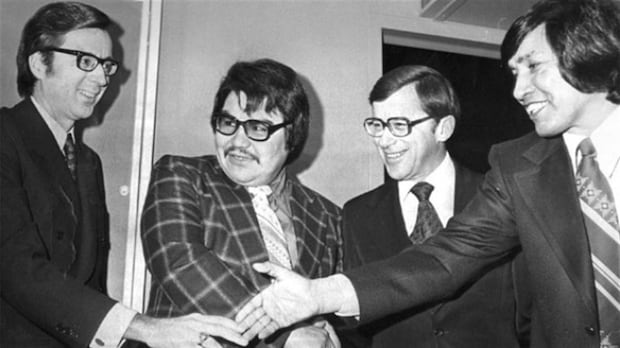
The fight to be heard: 50 years of the James Bay and Northern Quebec Agreement
CBC
This is part one of a three-part series from Radio-Canada about the 50th anniversary of the James Bay and Northern Quebec Agreement.
In April 1971, four years before signing the James Bay and Northern Quebec Agreement (JBNQA), Quebec’s premier Robert Bourassa unveiled his “project of the century” — a plan to harness the huge hydroelectric potential of the province’s northern region as a means to both boost the economy and keep up with growing demand.
The project proposed building 11 hydroelectric dams, including eight on the La Grande river, which stretches from the heart of the province all the way to James Bay, 900 kilometres to the west.
Three other rivers, the Eastmain, Opinaca, and Caniapiscau, would be diverted to fill massive man-made reservoirs, which would submerge 11,500 square-kilometres of forest underwater — about 30 times the size of the Island of Montreal.
The scale of the project is unparalleled in the province’s history, and would take 40 years to complete. Today, it generates 17,000 megawatts of power — half of Quebec's current production.
Thousands of workers were needed to make that happen. From engineers to cooks, the equivalent of a small village was sent to a remote worksite more than a thousand kilometres away from Montreal as the crow flies. While crews were preparing to build an access road, a crucial step had been overlooked: the province hadn’t consulted with Cree and Inuit communities, whose territory was about to be forever changed by a development project of unprecedented size.
Charlie Watt sits with a cup of tea in hand as he stares out the window at the Koksoak River, which flows into Ungava Bay, 50 kilometres to the north. It’s July in Kuujjuaq and the wildflowers have only just begun to bloom — a sign that salmon have returned, according to the longtime Inuit political leader.
As has been a lifelong tradition, soon he’ll head down to the river and retrieve his nets, and hopefully a few fish.
Today, though, the river is much lower than when Watt was growing up, a vestige of it being diverted to feed the James Bay dams, and ultimately, half of the province's electrical outlets. Nostalgia takes over as he remembers a time he could easily go caribou hunting upriver. But it’s so low now that very few people venture out that way by boat, due to the risk of hitting a shoal and breaking their motor.
Watt also clearly recalls when he’d first noticed the Quebec government’s interest in developing the region and its rivers.
“Prospectors had been around here for quite a number of years, identifying rivers and so on, what potential they have,” he said. “We knew sooner or later this was coming.”
With no community consultation, Watt says he only learned about Bourassa’s “project of the century” by coincidence during a visit to the post office. While waiting around, he scanned the bulletin board and saw a notice about the premier “wanting to develop the economy of the North for the purpose of bringing the electricity down south.”
He said he and many others were shocked to learn about the project and felt it would threaten their traditional way of life.
“Block it, stall it somehow. That’s the response I got,” said Watt.


On Hollywood's biggest night, newly crowned Oscar winner Tamara Deverell used her time in the spotlight to condemn the Nova Scotia government for cutting millions of dollars of support to the province's arts sector in this year's budget.

A campaign to convince the 17,000 New Brunswick households that have refused the installation of a smart meter to change their minds will likely be launched in June, the utility's ongoing rate hearing was told on Monday.

The City of Montreal is scrapping a plan to remove trash cans from La Fontaine Park this summer.

Manitoba Premier Wab Kinew is no longer offering a timeline for the opening of a supervised consumption site in Winnipeg, emphasizing the province wants it to be done properly rather than quickly.

A faulty e-bike battery caused Friday night's blaze in Saskatoon's North Industrial area, a fire investigator has determined.

Premier Scott Moe called on NDP Leader Carla Beck to fire newly-appointed campaign manager Jeremy Nolais after he sent what Moe called a "dangerous" fundraising email to NDP members over the weekend.

Five months ago, Dr. Anne Herdman Royal began a new job in Canada. Driven out of the United States by a shifting political landscape and a mass shooting at the hospital where she worked in Tulsa, Okla., it had become a country she no longer wanted to call home.

Alberta's government — along with the Rural Municipalities of Alberta, and the province’s energy regulator — say they want to crack down on oil and gas companies that don’t pay their property taxes.

Ottawa will now allow rural businesses to employ more temporary foreign workers to help supplement the local workforce, a move Restaurants Canada says will help some restaurants on P.E.I. keep their doors open.

The City of Calgary is reminding people to save water after a recent spike in usage.

The number of visitors to food banks in Mississauga has nearly doubled since the height of the pandemic, says the city's largest food security organization.

After three weeks on the road in Yellowknife doing Inuvialuktun translation for the Northwest Territories legislative assembly, Lillian Elias says she's tired and ready to go home to Inuvik.

Metrolinx is reporting "significant" delays to several GO train lines late Monday afternoon due to a police investigation.