The Doomsday Clock shows the danger, but not a way-out for the world Premium
The Hindu
The Doomsday Clock has transformed existential threats into a simple, universally understood symbol that sets the agenda, but constant high alert has led to psychic numbing, normalised danger, and failed to overcome the political gridlock that drives global catastrophe
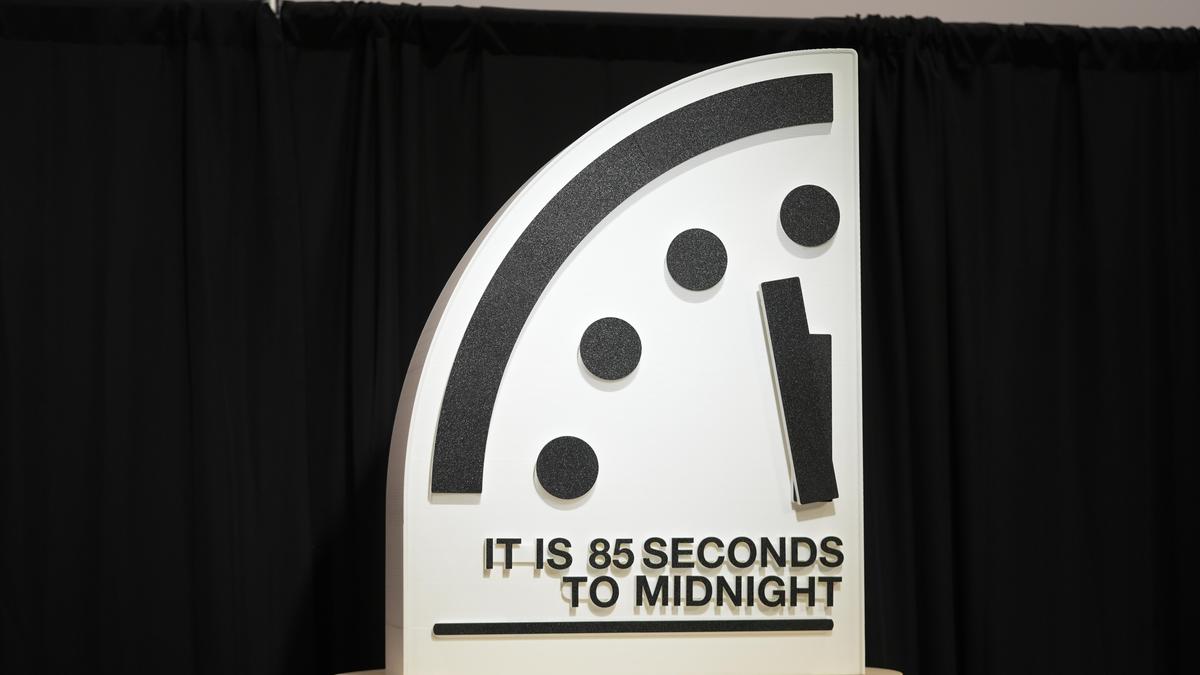
On January 27, the Bulletin of the Atomic Scientists moved its Doomsday Clock to 85 seconds to midnight, the closest it has been to the metaphorical point of global catastrophe. The Doomsday Clock is historically significant because it transformed the abstract, technical threat of nuclear war into a universally understood symbol of urgency. Since the so-called Chicago group of scientists involved in the Manhattan Project created it in 1947, the clock has bridged the gap between scientific experts and the general public, forcing the world to confront the reality of potential self-destruction through a simple visual metaphor.
As the Bulletin has moved the clock’s hands back and forth, but mostly forth, their movements have validated major arms control treaties or condemned dangerous escalations like the hydrogen bomb. And in the last eight decades it has become a cornerstone of the cultural framework that treats nuclear weapons and climate change as existential, rather than just political, problems.
But for all the ease with which the clock has raised alarms — thanks in no small part to its iconic design by the American artist Martyl Langsdorf — the clock has also failed to put out the fires. This is because the clock banks on the idea that if you show people a sufficiently frightening picture of their future, they will demand change. But history is clear that this strategy is flawed: while the clock has successfully branded the apocalypse, it has failed to overcome the political gridlock that actually drives the arms race.
That said, perhaps its most significant achievement is to set the agenda. Before the clock, nuclear strategy was a secret language spoken only by generals and physicists. The Bulletin changed that by creating a symbol everyone could understand, one of the number of minutes to midnight. This was clever because it forced the media to talk about nuclear risk every single year. It turned abstract scientific ideas into a story about time running out. When the U.S. and the Soviet Union signed major arms control treaties in the late 1980s and when the Copenhagen Summit concluded in 2009 with the 2º C climate goal, the clock moved backwards, giving people a clear way to see that diplomacy was working.
Unfortunately for the clock, constant fear often leads to paralysis, an effect psychologists call psychic numbing. When the clock stayed at two minutes to midnight for decades or hovered at 90 seconds as it did recently, its shock value wore off. Instead of rushing to fix the problem, people get used to living on the edge of destruction. Keeping the alert level so high for so long unintentionally normalised the very danger the Bulletin wished to eliminate. It’s understandable: if it’s always the end of the world, people stop believing the end is actually coming.
Equally understandably, the clock hasn’t been able to change the behaviour of national governments. The scientists behind the clock have appealed to securing the safety of the human race — what could be more important? — but governments have increasingly cared only about the safety of their own borders. And these goals often clash. For instance when India and Pakistan tested nuclear weapons in 1998, the Clock moved forward to condemn them, yet that condemnation meant nothing to the leaders in New Delhi or Islamabad, who believed they needed the weapons to survive. Even the current setting of 85 seconds to midnight is proof of this restriction: the fact that we’re closer to doom now than at any point in the Cold War suggests the people with the power to launch the missiles have ignored the clock’s warnings.


Trump accuses Iran of weaponising AI for disinformation, citing misleading claims about military successes and public support rallies.

Myanmar's Parliament convenes under military control, following a controversial election that reinforces the Army's grip on power.

Trump urges allies to secure the Strait of Hormuz, but Japan and Australia refuse to send naval support amid rising tensions.

AI-created videos circulating on Elon Musk's X depict American soldiers captured by Iran, an Israeli city in ruins, and US embassies ablaze; a surge of lifelike deepfakes despite a policy crackdown to curb wartime disinformation.

Explore the implications of "no quarter" in warfare, its legal prohibitions, and recent controversial remarks by U.S. officials.

Iran-Israel war: Follow live updates from The HIndu on the West Asia conflict on Marh 16, 2026

Trump warns NATO's future is at risk if allies don't assist in opening the Strait of Hormuz amid rising oil prices.

Nilufer Koc critiques U.S. colonial mindset on Kurdish issues, emphasizing the need for Kurdish rights in Iran's future political landscape.

Taiwan reports a resurgence of Chinese military flights, with 26 aircraft detected near the island after a recent decline.

Israel's Foreign Minister dismisses reports of imminent Lebanon talks, reaffirming alignment with the U.S. in the Iran conflict.

Sri Lanka implements a QR code system to ration fuel sales amid global supply challenges, limiting weekly quotas for vehicles.

Iran's Foreign Minister claims war with the U.S. and Israel will end only when assurances against future attacks are guaranteed.

Jaishankar's Brussels visit aims to strengthen India-EU ties post Free Trade Agreement, focusing on strategic partnership and regional issues.