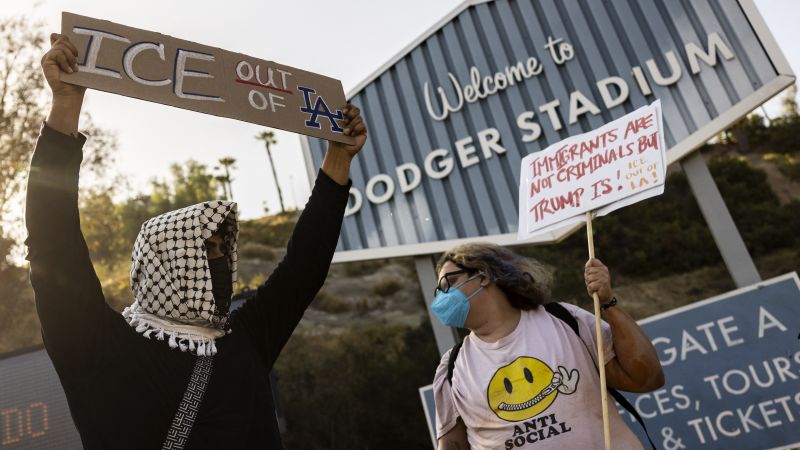
The Dodgers had been silent as Trump’s immigration crackdown roiled LA. Then federal agents arrived outside their parking lot
CNN
In times of crisis, teams like the Dodgers are usually a rallying point in Southern California – a unifying force in times of struggle. But over the last few weeks, as major protests popped up in Los Angeles, the Dodgers became a target of local ire.
As one of the City of Angels’ first major professional sports teams, the Dodgers are a cornerstone of Southern California culture. Their interlocking LA logo is as iconic as the Hollywood sign, recognized around the world and worn as a symbol of pride by millions of Angelenos. In times of crisis, teams like the Dodgers are usually a rallying point – a unifying force in moments of struggle. But over the last few weeks, as major protests popped up in Los Angeles in response to increased immigration raids by the Trump administration in the Southern California area, the Dodgers became a target of local ire. It was a tough demotion from being the subject of local adoration just months ago during a World Series championship parade. On June 6, raids outside a Home Depot and an apparel warehouse in Los Angeles set off days of protests and, on some nights, clashes between demonstrators and law enforcement. President Donald Trump on June 7 deployed National Guard troops to the city to “temporarily protect ICE” – the US Immigration and Customs Enforcement – “and other United States Government personnel who are performing Federal functions” and to protect federal property, according to a memo – overriding California Gov. Gavin Newsom, who called the move a “brazen abuse of power.” Families have been split, people were arrested by plain-clothes agents wearing masks and hats and Trump and his administration reveled in the chance to clash with Democratic politicians. As fear spread throughout Los Angeles, many of the city’s institutions spoke up to defend the undocumented immigrants and asylum seekers who were being picked up by the federal government. But not the Dodgers. The team – whose stadium itself is part of the long story of the Latino experience in Los Angeles, given that the land on which it sits was once home to a Mexican-American neighborhood that fought for years against being displaced – was publicly quiet about the tension gripping its city. That silence infuriated many members of the fanbase, who felt abandoned by their team.


Team USA avoided a World Baseball Classic disaster on Wednesday when Italy pulverized Mexico, ensuring the Americans advanced to the quarterfinals.

Cinderella is a funny girl when her glass slippers are Nike issued. We are amused by her as a lead-up to the ball, love her if earns a party-crashing admittance and then goes on to trash the place in the first weekend. But not everyone is so eager to hand her one of the coveted 37 extra tickets held in reserve.

New York Giants co-owner Steve Tisch is requesting his ownership stake in the team be transferred to his children, according to an internal NFL memo.

Team USA is on the verge of one of the most embarrassing exits in World Baseball Classic history and, at this point, there’s nothing they can do about it.

Rick Barnes has been a head coach for 48 years. Won 857 games, been to the NCAA Tournament 29 times. He is not a man who needs to explain or even create a culture around his team. It sort of just exudes from him at this point.

Seven members of the Iranian women’s soccer team have remained in Australia, while the rest of the squad has now left the country for Iran, a source has told CNN Sports.

After their final defeat in the AFC Women’s Asian Cup on Sunday, supporters of the Iranian women’s football team crowded around their bus shouting at police to “save our girls” as it pulled away.

The Iran women’s national soccer team was forced to salute and sing its anthem on Thursday ahead of its Women’s Asian Cup group stage match against host Australia, sources close to the team tell CNN Sports, just days after the squad refused to do so in its tournament opener.

Lou Holtz, the College Football Hall of Fame coach who led Notre Dame to the 1988 national championship and won 249 games over 33 seasons at six schools, has died. He was 89.

North Carolina runner Molly Born won the USA Track & Field (USATF) women’s half marathon championship by a slim margin of just over four seconds on Sunday in Atlanta – but the result is only half the story.

It’s now 100 days until the FIFA World Cup is set to begin in North America, and the intensifying war in the Middle East has raised further questions around what is already a controversial tournament.

When American golfer Brooks Koepka left the PGA Tour in 2022, he didn’t seem all that sorry about it.

Arsenal star Bukayo Saka has exclusively told CNN Sports that his side has “the opportunity to make history” after the 24-year-old committed his long-term future to the current Premier League leaders.