Targeting a Dravidian icon Premium
The Hindu
Tamil nationalists are trying to weaken Dravidian parties by targeting Periyar
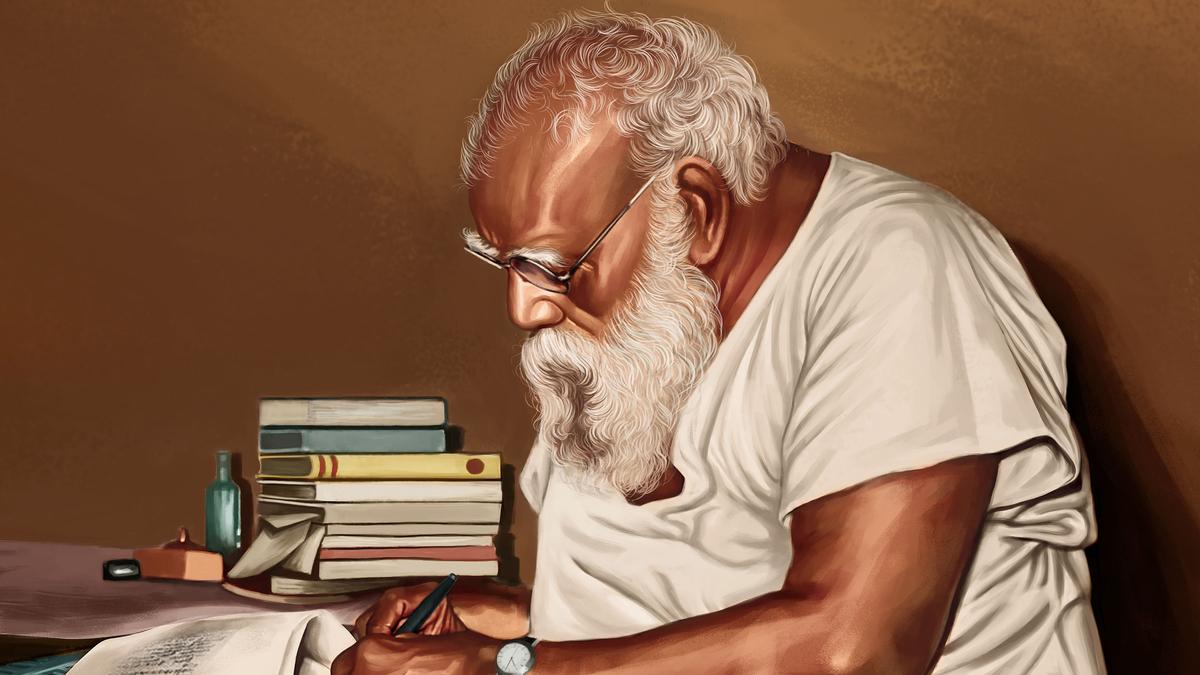
Periyar E.V. Ramasamy, social reformer and founder of the Dravidar Kazhagam, remains the central point of political discourse in Tamil Nadu decades after his passing in 1973. It has become difficult to eliminate Periyar from the ideological spectrum — so much so that even one of Tamil cinema’s biggest stars, C. Joseph Vijay, declared him one of the guiding lights of his fledgling party, Tamilaga Vettri Kazhagam. The followers of Periyar insist that but for him and his reformist movement, Tamil Nadu would not have made strides in various fields.
However, in recent weeks, Seeman, the chief coordinator of Naam Tamilar Katchi, a Tamil nationalist party that polled over 8% of the votes in the 2024 Lok Sabha elections, has made Periyar the main target of his attack. Mr. Seeman has selectively resurrected Periyar’s long-forgotten comments against Tamil language, literature, and culture to portray him as “anti-Tamil”.
Tamil nationalists seeking to replace the Dravidian movement have begun to blame Periyar and his ideology as the root cause of what they call the “evils ravaging Tamil society.” They reject the term “Dravida” to collectively address the people of Tamil Nadu, Kerala, Andhra Pradesh, and Karnataka, and are highly critical of Periyar’s comments that “Tamil is a barbaric language.” They often say that Periyar’s so-called hatred for Tamil language and culture stems from his origin as a Kannada Naicker. They are in fact more vocal about their criticism of Periyar than Brahmins, who were consigned to the margins in the wake of the emergence of the Dravidian movement.
Periyar was never consistent with his views. He reconsidered them according to the changing circumstances, with good intention. “His five decades of public life have seen several political storms and shifting stands. But through all this he has remained unswerving in his fierce determination to ‘liberate’ Tamilians from the shackles of superstition, religion and God,” wrote the communist leader, Mythili Sivaraman, in her article, ‘The Relevance of Periyar: Caste or Class Struggle’, which is part of the book Haunted by Fire: Essays on Caste, Class, Exploitation, and Emancipation.
As an iconoclast, wedded to the idea of rationalism, Periyar rejected all ideas that were incompatible with science and denigrated human dignity. He launched scathing attacks against Tamil literary works, including the Kambaramayam, Silapathikaram, and even the Tirukkural, idolised by his disciples C.N. Annadurai, M. Karunanidhi, and others. He was furious when a Tamil scholar in Pachaiyappa’s College justified the decision of Kovalan, the hero of Silappathikaram, to leave his wife Kannagi “because she was not attractive”. Sivaraman wrote, “Periyar... championed the cause of widow marriage, marriage based on consent, women’s right to divorce to property, abortion and birth control. He... exposed the male superiority inherent in the concepts of chastity like karpu and pathivirathi that apply to women.”
Though Annadurai left Periyar to launch the Dravida Munnetra Kazhagam (DMK) as an antidote to the hardcore atheism preached by his mentor, Periyar’s principles remained a guiding force for Dravidian parties. Both Annadurai and Karunanidhi were at one point highly critical of Periyar and lampooned him through their writings and cartoons, but they could not fully eschew his ideology.
Periyar believed that Tamil society could not be liberated without breaking the backbone of Brahminsim, rooted in the concept of caste hierarchy by birth. The Bharatiya Janata Party could not make substantial progress in Tamil Nadu despite its campaign against Dravidian parties since humanism is the bedrock of Dravidianism. Mr. Seeman, who has an unmatched talent for stirring controversies, has targeted Periyar even though he was once his admirer. Tamil nationalists seem to think that they can weaken Dravidian parties only by undermining Periyar’s principles.


Vaccination policies must prioritize saving human lives over individual choice amid rising vaccine skepticism, asserts scientist Dr. Virander Singh Chauhan.

Seven Indian fishermen from Rameswaram arrested by Sri Lankan Navy, sparking protests and calls for government intervention.

Kerala cyber police file a case against X for an AI video allegedly defaming PM Modi and the Election Commission.

iKure and Izawa Co. partner to combat avoidable blindness by integrating innovative eye care technology into rural healthcare networks.

Thousand Lights MLA from the DMK N. Ezhilan, in an interview to The Hindu, observes that any popular personality entering politics will attract the limelight. But only a structured party machinery combined with popularity can ensure success. In this interview, he speaks about his tenure as first-time MLA from Thousand Lights Assembly constituency in Chennai, Vijay’s political entry shaping the 2026 elections, redressal of key grievances and more.

Abhishek Banerjee challenges BJP's Suvendu Adhikari in Nandigram, pledging community health initiatives if Trinamool Congress wins.

Rising LPG shortages in Karnataka boost firewood demand, reviving an informal market as households and hotels seek alternatives.

Against the backdrop of intense poll activity, a 400-metre stretch of an arterial road in the outskirts of Chennai (technically in Madurapakkam panchayat under Tambaram assembly constituency) presents a salute to the idea of res publica, which underpins India’s system of governance, where citizens have a say, at least before a government is securely ensconced in the seat of power. A Republic Day initiative shines bright every night

Fadnavis claims zero FIR in Ajit Pawar crash is a defamation attempt by Karnataka against Maharashtra's investigation efforts.

Set to unfold as a one-day pop-up on April 5, the Easter Sadya brings together both vegetarian and non-vegetarian menus, offering a peek into the food traditions of the Syrian Christian (Nasrani) community. While the traditional Sadya is often associated with dishes such as sambar, avial, and rice, this version expands to include community-specific festive dishes.

BJP nominates mother of R.G. Kar victim Abhaya to contest from Panihati in West Bengal Assembly elections.

Veteran Malayalam actor-director E.A. Rajendran passes away at 71, leaving behind a rich legacy in the film industry.

Dakshina Kannada Zilla Panchayat has rolled out digital mode of water bill generation and collection in 23 gram panchayats on a pilot basis for the first time in Karnataka. This is set to be extended to the remaining 200 panchayats shortly, according to the Zilla Panchayat Chief Executive Officer Narwade Vinayak Karbhari.