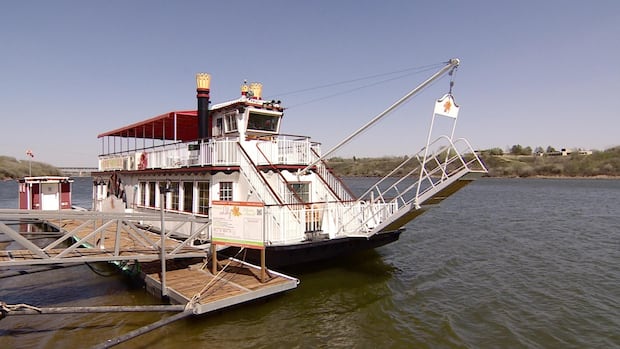
Saskatoon riverboat Prairie Lily docked due to low water levels, sandbars
CBC
The Prairie Lily river boat has run aground after over a decade of sailing the South Saskatchewan River.
On Wednesday, owners of the Saskatoon riverboat said the water level is so low that they can't cruise the ship.
"For the first time in our 13 years of sailing this ship, the sandbars have increased to the point where we no longer have a navigation channel," Mike Steckhan, captain and co-owner of the Prairie Lily, said in an interview.
The economic impact will be huge for his business, which has stopped bookings and has been cancelling cruises getting into the season.
Unless action is taken to increase the water levels, the Prairie Lily will be forced to cancel its season, he said.
"There's no place that's deep enough for this ship. It's so low that there isn't a navigation channel for us to do our cruises safely, so we've had to cancel," said Steckhan.
Sandbanks form when the silt carried by the river accumulates, and over the last few years, there hasn't been enough water running through to flush them out, he said.
He's calling for the Water Security Agency, which controls the flow of water out of the Gardiner Dam, to increase the flow to remove the sandbars.
"We're not asking for all the water in the lake. We're only asking the WSA to provide a volume of flow that allows safe operation on the river," he said.
Water Security Agency president and CEO Shawn Jaques said that as of now, there are no plans to open the spill gates or significantly increase the flow of water out of the Gardiner Dam for now.
He said that the current water level of the river flowing through Saskatoon is about 70 cubic centimetres per second (cms), which is equal to the amount of water flowing into Lake Diefenbaker — the reservoir formed by the creation of the Gardiner and Qu'Appelle River dams — from the west.
"To put it into perspective, the median or the annual average flow typically is 145 cubic meters per second. So we're sitting at 50 per cent of what we normally would get," Jaques said in an interview.
Steckhan said he wants to see 900 cms per second for 72 hours, or 400 cms for a number of days to mitigate the problem.
Jaques said there have been dry conditions across Western Canada over the last three years, and the snowpack in the Rocky Mountains is also well below normal right now.


Mayoral-hopeful Coun. Brad Bradford is calling for a host of safety measures across Toronto’s subway system, including a specific focus on platform edge doors, with a motion before city council this week.

When the one-star reviews first began to appear on his restaurant's Google page, owner Damon Ataei swung into action, trying to contact each reviewer.

The Mounties called it the "Native extremism program." Today, it sounds like a spy novel.

A judge is expected to rule in June on a proposed settlement for a class-action lawsuit involving a crash landing of an Air Canada flight in Halifax more than a decade ago.

An inmate who was on the loose after escaping a jail in Shediac has been caught, New Brunswick RCMP said in a press release late Monday afternoon.

Premier Wab Kinew draped the Manitoba flag over an empty seat as politicians from across the aisle said goodbye to one of their own in an emotional tribute at the legislature on Monday.

Saskatoon police have identified the driver of a vehicle that struck a railway overpass above Circle Drive on Sunday — the third such collision in the city this month.

People who live near Lac Pelletier say effluent from a nearby cattle feedlot has spilled off the site and into a ditch that feeds into the lake downstream.

A man charged in a pair of stabbings in central Edmonton seven years ago has been found guilty of manslaughter.

Police in Metro Vancouver are warning drivers to remain attentive, even in a self-driving vehicle, after ticketing a woman who "appeared to be literally asleep at the wheel" on Highway 1.

Some century-old churches on P.E.I. are renovating to become more accessible, which includes updates to accommodate many different kinds of needs.

Toronto police headed to school zones Monday as part of a safety blitz following March Break.

WARNING: This story details experiences at residential schools.