Rolf von Bueren of Lotus Arts de Vivre on his relationship with Asia and its rich art history
The Hindu
Rolf von Bueren, an avid collector of exotic art and jewellery for 40 years, brings the focus back to Asia’s rich pool of resources through his brand
The familiar walls of Chennai’s Apparao Galleries are opulent today; a treat to the aesthete’s eye.
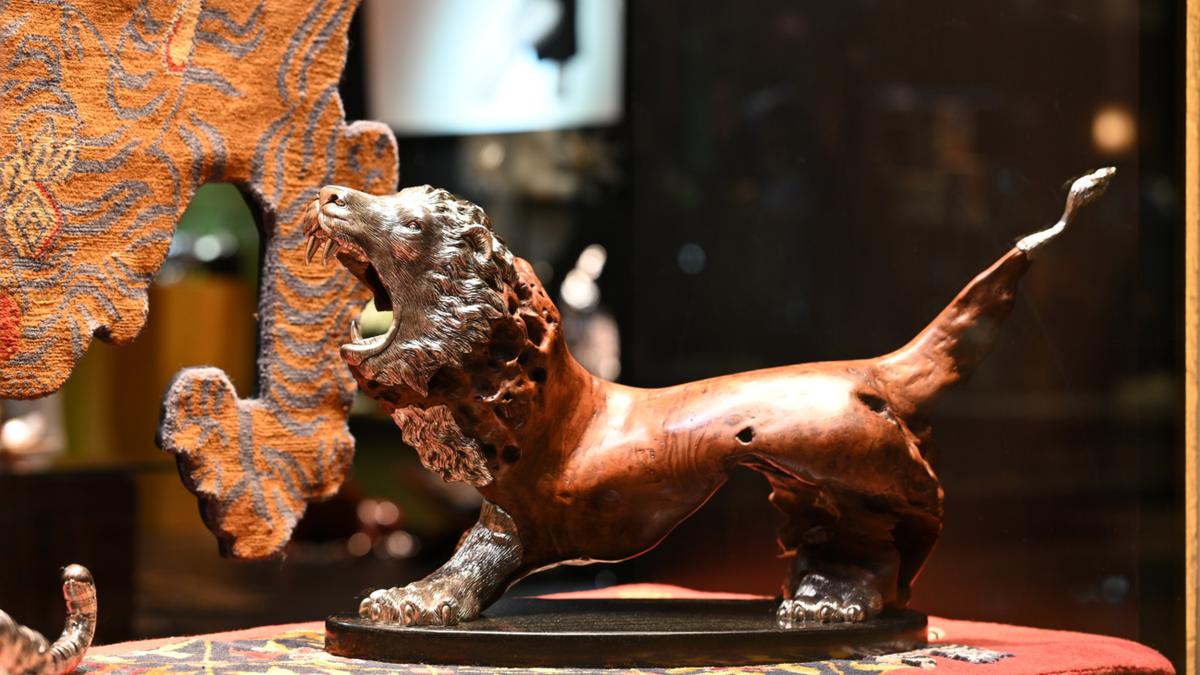
Look to the right, and you find a floating alligator of pure sterling silver, its head, torso and tail, each a separate piece. To the left you find an eclectic jewellery set — earrings and necklaces — made entirely with the forewings of naturally expired scarab beetles found in abundance in the tamarind trees of Thailand. Its green-blue metallic sheen traces one’s eyeline: a collector’s piece, no doubt. A lion sculpture made of a sandalwood piece by retaining its natural shape, and completed with sterling silver has unmistakable Asian influences.
At Thailand-based home decor, jewellery and accessories brand Lotus Arts de Vivre’s first-ever solo exhibit in the city, titled Tales of Asia, held in collaboration with Heeramaneck & Son and Apparao, each piece is a collectable as envisioned by the brand’s founder Rolf von Bueren, who immigrated to Thailand from Germany in the 1960s and called the Asian nation home ever since.
It is common knowledge that Rolf is a treasure trove of stories. A well travelled and avid art collector, Rolf’s love for Thailand is anchored by the nation’s impeccable craftsmanship and its appreciation for art. “There is nothing more luxurious than what we cannot have, what seems out of reach” — this realisation is what led to the inception of Lotus.
The von Bueren family’s beginnings were rather humble. After the Second World War, when they emigrated to Thailand from Germany in 1962, they were only armed with appreciation for skilled craftsmanship. It is this aspiration to covet what seems unreachable that slowly led to Lotus, which started as merely a hobby business. The brand owes its success to Thailand’s natural resources, craftsmanship, traditions and customs, and the people of the country.
Over a Zoom call from Bangkok, Rolf says, “The West has contributed very little to civilisation — wine, bread, opera, classical music… While all the good things, like silk, pearls, rubies, come from the East. In medieval times, after the West discovered the route to eastern countries like India, all courts in Europe collected things they didn’t have themselves, like fossilised shark teeth thinking they were claws of dragons. They were called the ‘miraculous chambers of wonders’. This was the basis of all Western museums.”
Rolf who has been collecting art, jewellery and functional pieces for the past 40 years, doesn’t miss an opportunity to remind the world of Asia’s vast pool of resources, craftsmanship and beautiful art.


CERN's Large Hadron Collider discovers the Xi-cc-plus particle, enhancing understanding of quantum mechanics and baryon behavior.

Vibha Batra’s latest book, Spotless (Hachette India) is a novel in verse for young adults

In its first edition, the Madras Art Salon spotlights the works of journalist and artist Narayan Lakshman at The Botanical Club, a social space in the British Deputy High Commission, Chennai

Cholesterol enhances melanoma cell invasion by making nuclei squishier, revealing a potential treatment target in cancer progression.

The designers reinterpret the Swedish artist’s symbolic forms and colour energy through contemporary resortwear silhouettes

Discover the inspiring legacy of Bibha Chowdhuri, a pioneering woman in physics and a trailblazer in STEM history.

Discover the inspiring legacy of Bibha Chowdhuri, a pioneering woman in physics and a trailblazer in STEM history.

Ashdeen’s Spring 2026 collection features saris inspired by the designer’s Parsi gara archive

Red ochre burials, ritual markings and myths across cultures show that red repeatedly marks liminal thresholds such as puberty, sacrifice and death; anthropologists argue that the colour functions as a technology of collective ritual and value, binding communities through shared symbolic acts

India approves 23 institutions for quantum labs under the National Quantum Mission, aiming to advance quantum technology and research.

India approves 23 institutions for quantum labs under the National Quantum Mission, aiming to advance quantum technology and research.

The Gaza conflict exacerbates environmental damage, emitting millions of tonnes of CO2 and threatening climate stability in West Asia.

Chefs and cookery experts share smart kitchen hacks, hybrid cooking methods and appliance tips to help households reduce LPG use without compromising on food