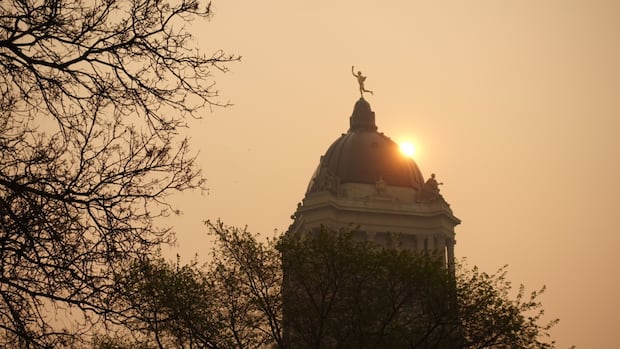
Revamp of Manitoba's air quality monitoring infrastructure needed for 'smokier future,' says expert
CBC
Manitoba is looking to expand the infrastructure it has to monitor air quality, a step experts say is important to better map pollution and its long-term health effects worsened by smoke billowing from wildfires.
"This isn't a problem that's going away," said Christopher Pascoe, a University of Manitoba associate professor whose research focuses on the impact of wildfire smoke on chronic respiratory diseases.
Thousands of people have been forced out of their homes by wildfires in Manitoba since May. It has been a record-breaking season where the province has been put under a state of emergency twice to address the influx of people fleeing from their home — some from worsening air quality.
Manitoba operates four air quality monitoring stations — two in Winnipeg, one each in Brandon and Flin Flon — that collect the dirt out of the air and measure the concentration of health-harming particles lingering in the environment.
Environment and Climate Change Canada said it draws data from those stations to forecast air quality. The department also pulls in information about contaminants in the air from low-cost sensors that have been installed independently by residents and communities through the province.
But Sarah Henderson, a scientific director of environmental health services at the British Columbia Centre for Disease Control, said there's an opportunity to better map pollution drifting from wildfire in the long-term by expanding the infrastructure Manitoba has to monitor air quality.
"Wildfires are highly episodic, highly unpredictable," Henderson said. "Four monitors doesn't tell the full story of what's going on when you're having wildfire smoke impacts."
Most of the infrastructure Environment Canada uses to forecast air quality in Manitoba is clustered in the southern part of the province.
According to an independently created map, which Environment Canada said shows the monitors meteorologists use to forecast air quality, there are roughly 10 stations or sensors north of Dauphin, Man., a city about 250 kilometres northwest of Winnipeg.
And all but at least two of these stations in northern Manitoba are in Flin Flon,Thompson and Churchill.
In remote or fly-in communities without sensors, Environment Canada said it relies on forecast models, weather observers in airports and satellite imaging to track wildfire smoke and predict its impact to air quality.
"But it would be even more accurate if we had an air quality monitor in the community," Henderson said.
"Smoke is really dynamic," she said. "Even within a couple of kilometres, the concentrations can be really different."
For instance, it is not rare for the two air quality stations in Winnipeg — which are less than four kilometres apart — to show different concentrations of air pollutants from wildfire smoke, said Pascoe.


The Swale Watchers plan to keep watching.

In a smaller city like Prince Albert, Ramadan can feel different.

About 125 people came out for a town hall meeting on health care in Charlottetown Monday night.

This is the second of two-part CBC News report on Taser use by Edmonton police. To read the previous story, click here.

A Merritt, B.C., father is urging parents to be on the lookout for ticks while the weather warms up, after his six-year-old son was partially paralyzed by a tick bite last week.

About that heartbreaking loss to the U.S. at the 2026 Olympic women's hockey final last month, Sarah Nurse says, “that was the most fun I’ve had in a hockey game in a very long time.”

The U.S. government on Monday said electric vehicle (EV) maker Tesla and South Korea's LG Energy Solution had signed a supply agreement to build a $4.3 billion lithium iron phosphate (LFP) prismatic battery cell manufacturing facility in Lansing, Mich., with an expected production launch in 2027.

In one small town in Alberta, the assistant principal says teachers almost never meet alone with parents anymore.

Tens of thousands of customers are without power and four parts of Highway 401 are closed Tuesday morning as blasts of blowing snow hit the Ottawa-Gatineau area.

Melody Macsemchuk says volunteers at Grace Place in Thunder Bay, Ont., serve between 300 and 350 meals a day.

Groups of volunteers continue to search alongside police for a man who went missing in late January near Owen Sound, Ont., covering land on foot, and using drones for a view of the conservation area where his car was found.

Jessica Hay says her daughter Charlie loves to be included in everything — and a new accessible shopping cart at her local grocery store in Cornwall makes it possible for Charlie to come along for the ride.

The N.W.T. cabinet says it will review whether or not the territory needs an independent child and youth advocate after a motion by Range Lake MLA Kieron Testart calling on it to establish such a position was carried in the legislative assembly.