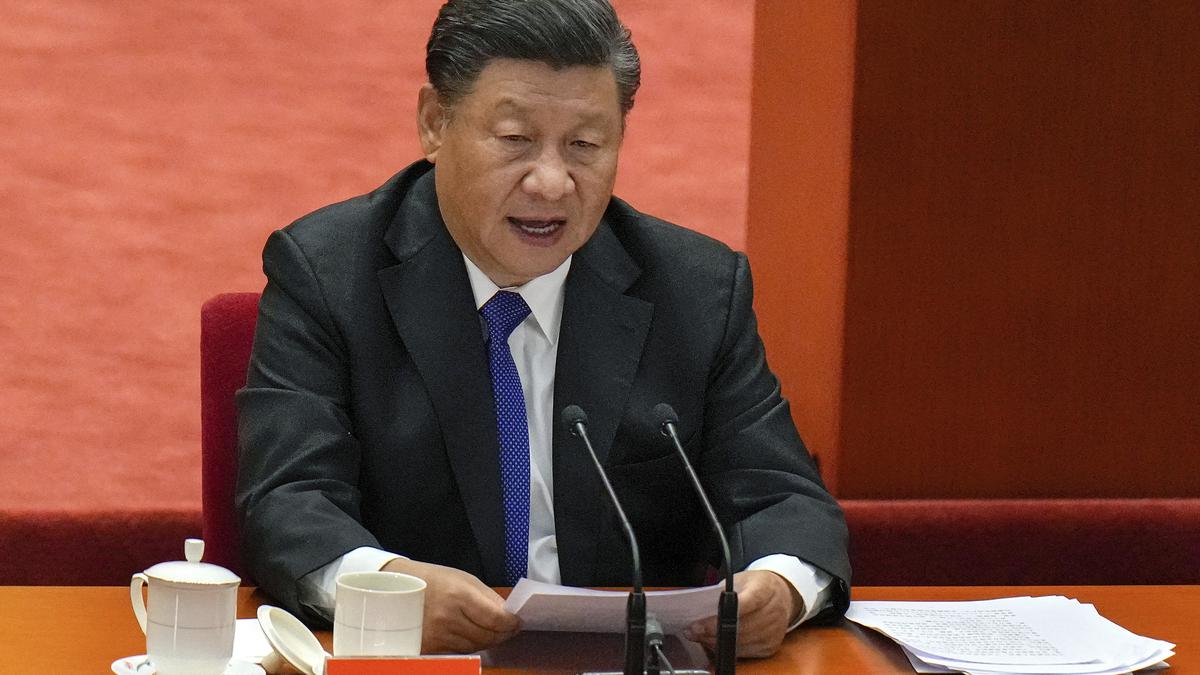
President Xi meets Pak PM Kakar, seeks 'effective measures' for Chinese personnel working for CPEC projects
The Hindu
Chinese President Xi Jinping on Thursday proposed to upgrade the USD 60 billion CPEC during a meeting with Pakistan’s caretaker Prime Minister Anwar-ul-Haq Kakar here but sought “effective measures” to ensure security for hundreds of Chinese workers who faced frequent attacks from militants in the country.
Chinese President Xi Jinping on Thursday proposed to upgrade the USD 60 billion CPEC during a meeting with Pakistan's caretaker Prime Minister Anwar-ul-Haq Kakar here but sought "effective measures" to ensure security for hundreds of Chinese workers who faced frequent attacks from militants in the country.
Mr. Kakar along with Sri Lankan President Ranil Wickramasinghe is here to attend the third Belt and Road Forum for International Cooperation being hosted by Xi.
Xi assured Kakkar that China will continue to support Pakistan in safeguarding national sovereignty, independence, and territorial integrity.
In his speech at the concluding session of the meeting on Wednesday, Xi promised that two Chinese-backed development banks – the China Development Bank and the Export–Import Bank of China – will each set up 350 billion yuan (USD 47.9 billion) financing windows. An additional 80 billion yuan (USD11 billion) will be invested in Beijing’s Silk Road Fund to support BRI projects.
Pakistan is the largest recipient of BRI funding for the China-Pakistan Economic Corridor (CPEC). India, which boycotted the BRI Forum meeting, has protested against the project as it is being laid through Pakistan-occupied Kashmir.
In his meeting with Kakar, Xi said that China and Pakistan are all-weather strategic cooperative partners and ironclad friends, noting that successive Pakistani governments have actively supported and participated in the Belt and Road Initiative cooperation.
He said over the past 10 years, the CPEC has achieved fruitful results, effectively promoting Pakistan's economic and social development, and becoming an important signature project of the Belt and Road cooperation.


Shorts News:Watch: Cuba right now in ‘very bad shape’: Trump

As political loyalties shift, Vice President Vance navigates the turbulent MAGA landscape amidst Trump's new war strategy.

Oil prices drop over $2 as Iraq and Kurdish authorities finalize an export deal, easing supply concerns amid ongoing conflict.

Marco Rubio denies U.S. efforts to oust Cuba's President, calling a New York Times article "fake" and misleading.

Shooting at Holloman Air Force Base in New Mexico leaves one dead and another wounded; lockdown lifted, base declared safe.

The U.S. offers undocumented migrants $2,600 and free flights to voluntarily self-deport through a new DHS program.

Israeli strikes in central Beirut reportedly kill six, escalating tensions amid ongoing conflict with Hezbollah and regional instability.

Few people realise that the ocean floor beneath the Persian Gulf and Red Sea is crisscrossed with thousands of kilometres of fibre-optic cable.

Ali Larijani, Iran's influential politician, played a key role in both security policy and the violent suppression of protests.

Shooting at a Georgia VA clinic leaves one employee hospitalized and the gunman dead, prompting investigations by authorities.

UNICEF reports 100,000 flee South Sudan's Akobo due to escalating conflict, worsening conditions for displaced populations in Ethiopia.

Cuba restores electricity to two-thirds of the country after a nationwide blackout amid ongoing economic challenges and U.S. sanctions.

U.S. President Donald Trump declares the U.S. no longer needs ally support in Iran conflict amid rising tensions and global energy concerns.