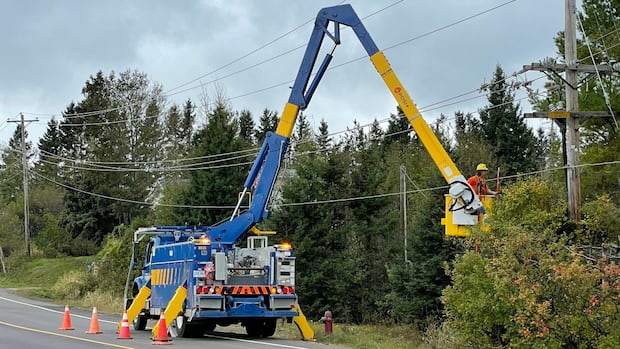
P.E.I.'s Fiona-hit electrical grid remains at risk due to 'legislative restrictions': consultant
CBC
More than two and a half years after post-tropical storm Fiona wreaked havoc on Prince Edward Island's electric grid, limitations on how trees can be trimmed along power lines continue to put the system at risk during extremely high winds, a consultant's report warns.
The reason the issue continues to be flagged as a potential risk is the apparent inaction by the province in expanding access for Maritime Electric to trim trees beyond the current right-of-way, a concern initially raised as far back as October 2022, the month after Fiona struck.
The Island Regulatory and Appeals Commission hired U.K.-based consulting firm EA Technology to assess Maritime Electric's Fiona response, as the commission assessed the company's application to raise electricity rates to recoup the costs associated with that response.
The consultant concluded a lack of vegetation management by Maritime Electric during the lead-up to Fiona led to "increased rates of system damage caused by preventable tree contacts," which in turn led to outages on such a wide scale it "significantly extended customer's restoration times," which in some cases were longer than three weeks.
EA said an increase in vegetation management efforts by Maritime Electric since Fiona is "expected to improve overall electrical system performance on blue-sky days.
"However, due to current legislative restrictions and limitations, these programs are unlikely to prevent future windfall tree contacts during high-wind weather events."
When Liberal MLA Robert Henderson questioned him on the topic in the provincial legislature on Friday, P.E.I.'s Minister of Environment and Energy Gilles Arsenault had this to say: "We are moving forward with Maritime Electric. We are looking at the vegetation management plan. We do have a few items that we need to change in our regulations."
"Regulatory changes can happen on any given Tuesday," Henderson responded, referring to the practice of regulatory changes being implemented at weekly government cabinet meetings.
"As I look at the docket here for our legislation, if it's a legislative change, there's nothing on the docket on that either. So, I'm just wondering what the delay is on this?"
A spokesperson for the Department of Environment, Energy and Climate Action noted in an email to CBC News that P.E.I.'s Electric Power Act "currently has provisions related to entering land without permission for the purposes of surveying and planning vegetation management work, but currently the [act] does not grant the authority to perform vegetation management work without permission of the property owner."
The spokesperson said a number of potential legislative changes are being reviewed as the province develops a new energy strategy.
Maritime Electric told CBC News that amending the act to include something called "power of entry" for utilities "would grant the utility authority to enter property and perform maintenance on its infrastructure, including vegetation management, when necessary for safety or reliability purposes.
"This legislation is not uncommon across the country and in fact exists in several provinces," the utility noted.
In any case, the company said it would also ask permission first before doing work on private land.


Premier Scott Moe has said there are no "cancellations or delays" to school projects as a result of the provincial budget introduced last week.

An 18-year-old man has been charged with second-degree murder in a deadly daytime shooting on a highway south of Edmonton.

More than a month after the deadly mass shooting in Tumbler Ridge, stories of bravery during the tragedy are being shared.

Just over six months after the University of Prince Edward Island's medical program began, the dean of the faculty says things are “going wonderfully.”

One person has been found dead after a large fire gutted a home in Mississauga on Monday night, officials say.

The Northwest Territories government says it has found elevated levels of lead in drinking water at the Chief Jimmy Bruneau school in Behchokǫ̀.

Public Safety Minister Gary Anandasangaree faced pointed questions Tuesday about why the federal government has deported one Iranian official, despite longstanding concerns about how the regime operates in Canada and abroad.

An RCMP-led corruption investigation is underway and search warrants were executed on a number of properties including the homes of former mayor Jyoti Gondek, former councillor Sean Chu and sitting councillor Andre Chabot.

Toronto police say they are creating a counter-terrorism unit and a specialized task force that will see officers with semi-automatic rifles stationed at key locations in the city.

ATCO Ltd. says it's taking a 40 per cent ownership stake in the company building the Grays Bay Road and Port project.

Justice Minister Sean Fraser says he has no plans to change how judges are appointed in Canada despite four premiers writing to Prime Minister Mark Carney to ask for more of a say in the process.

An RCMP-led corruption investigation is underway and at least one current and one former Calgary city councillor, as well as a business were subject to search warrants executed last week, CBC News has learned.

Ontario’s education minister is telling school boards to ensure their upcoming graduation ceremonies don’t express any “political views” or “engage in divisive or contentious issues of any kind,” according to an internal memo obtained by CBC News.