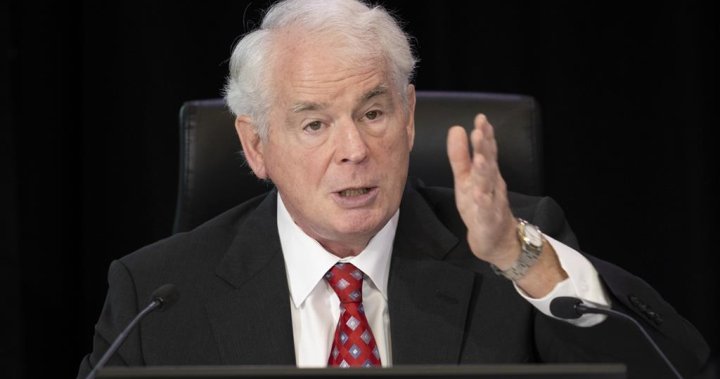
Ottawa can present some Emergencies Act inquiry evidence without public: commissioner
Global News
The federal government's request argued that the disclosure of the evidence to the public "would be injurious to national security."
The federal government can present some of its evidence to the public inquiry examining the use of the Emergencies Act without the presence of the public for national security reasons, a judge ruled on Wednesday.
Public Order Emergency Commission commissioner Justice Paul Rouleau ruled that part of the evidence and witnesses from the Canadian Security Intelligence Service (CSIS) and the Integrated Terrorism Assessment Centre (ITAC) can be heard behind closed doors, or in camera.
The evidence includes a classified version of one of the institutional reports submitted by the Government of Canada pertaining to the role of the CSIS in its response to the so-called “Freedom Convoy” protests. In addition, the CSIS witness and a witness from ITAC will be examined on the classified version of the report in the absence of the public and the other parties, Rouleau ruled.
In the Canadian government’s request to the commissioner, it says that the disclosure of this evidence “would be injurious to national security.”
The government argued that presenting the evidence and witnesses at a public hearing would pose risk to CSIS’s past or present investigations; its methods of operation and investigative techniques; its relationships with other police, security and intelligence agencies; its members and telecommunications systems; and persons who provided information to CSIS.
Rouleau said he will decide whether the evidence must remain confidential after he has heard it.
“I may decide that some or all of the evidence can be made public, for example in a summary that describes the evidence without disclosing information that must remain confidential,” said Rouleau.
The six-week public hearings on the government’s invocation of the never-before-used Emergencies Act began on Oct. 13 in Ottawa and are expected to run to the end of November, according to the commission.


With more rain in the forecast, crews continue to deal with a mudslide earlier this week that covered a road in Coquitlam in debris, posing risk to Metro Vancouver's water supply.

A former BC Ferries CEO says the Queen of the North sinking remains ‘disturbing’ 20 years later. The ferry struck an island in Wright Sound on March 22, 2006. Two people died.

The 2026 Kraft Hockeyville top two contestants have been named. The winner receives $250,000 for ice rink upgrades, and the runner-up will receive a prize worth about $100,000.

The Office of the Parliamentary Budget Officer scrutinizes federal spending decisions and helps to cost out campaign proposals during elections.

Man’s best friend is proving to be a true lifeline. All across Saskatchewan, service dogs are providing essential, life-changing support every day.

Two days after the first day of spring, parts of Atlantic Canada and Quebec will see another blast of winter with Environment Canada forecasting several centimetres of snow.

UNESCO recognized several Maritime historical groups including the executive director of the Black Loyalist Heritage Centre for their work on the Black Loyalist archive.

Aid shipments are beginning to arrive in Cuba and a Russian oil delivery is expected this month, but fuel shortages remain critical.

Tensions flared as CAQ leadership rivals clashed over Quebec’s “third link” project in the first debate to replace Premier François Legault.

Toronto police have charged a 60-year-old man with second-degree murder in connection with the death of Xian Wei Shao, whose remains were discovered in a north end home last week.

Finance Minister François-Philippe Champagne says the government has found ways to cut spending by $60 billion but cautions that published spending cuts require important context.

Three Canadians from Quebec who were stranded in the Persian Gulf since Feb. 28 have returned home following a coordinated repatriation effort.

Federal departments announced that they plan to cut more than 12,000 jobs over three years as part of the Carney government’s spending review plan.