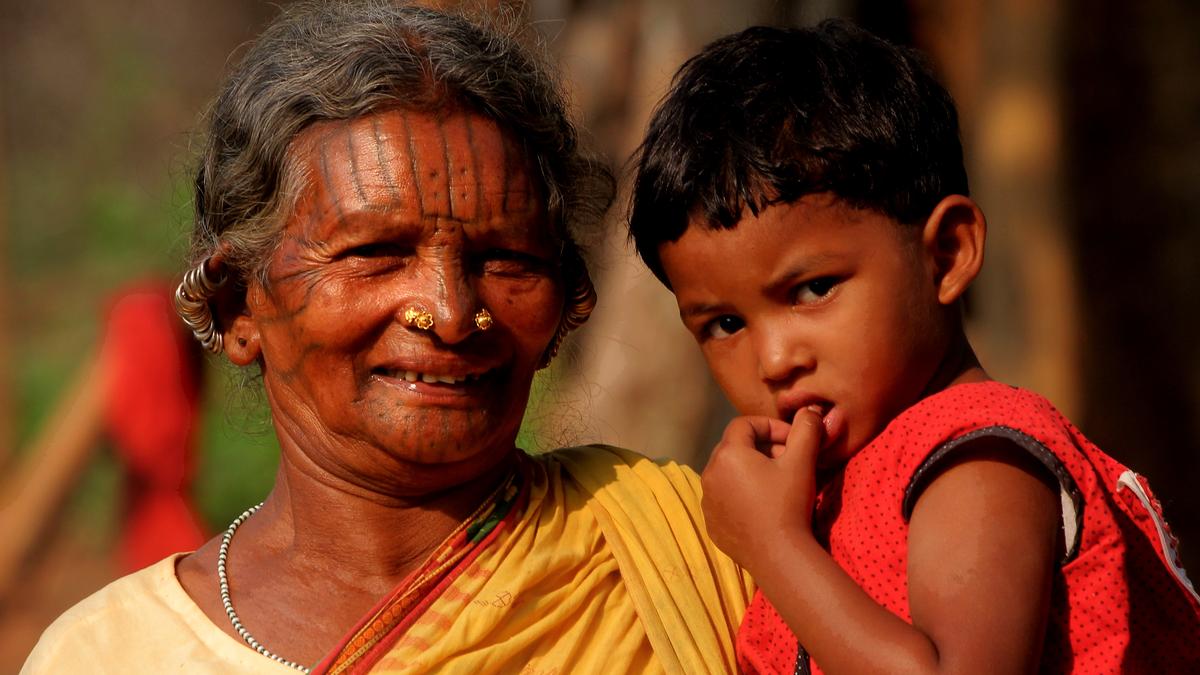
Once a painful form of self-protection, tattooed faces are now rare among women in Kandhamal
The Hindu
Vanishing tradition of facial tattoos among Kandha tribal women in Odisha rooted in protection from exploitation.
Subojini Pradhan, in her seventies, walks by the dusty lanes of Kutabadi village in Odisha’s remote Kandhamal district, the fair complexion of her face barely visible beneath an intricate pattern of deep black tattoos. Ms. Subojini Pradhan is among the last Kandha tribal women to bear these striking facial markings, a vanishing tradition rooted in a dark past. For generations, Kandha women tattooed their faces with stark, geometric designs — not as adornment, but as a form of protection. Their intent was to appear less attractive so that they could escape sexual exploitation by landlords, local royals, and British colonisers.
Now, as modernity seeps into the hills of Kandhamal, young girls have put an end to the practice, and Ms. Subojini Pradhan is happy that the painful tradition is not being passed on to the next generation.
Also read: Justice continues to elude Kandhamal
“God has given each of us a beautiful face. We have no right to disfigure it. But tradition was imposed on us, and we had little choice but to obey our elders. Perhaps I could have erased all my tattoos and seen my face in its natural, untouched form. Still, I am glad that my granddaughters are free from this strange, old practice — they don’t have to follow it anymore,” she said.
In earlier times, Kandha girls were subjected to facial tattooing as they approached the age of 10. The tattoos followed a uniform pattern, covering all parts of the face.
“I still tremble at the memory of that crude process,” Premanti Pradhan, a woman in her sixties from the same village, says. “Specially trained tattoo artists, usually elderly women, would pierce our skin with needles, showing no mercy. Blood would flow down our faces, and the resulting infections left us swollen and unrecognisable for days. For over a week, we could barely eat. It took nearly two months to recover completely. But this painful ordeal marked an important rite of passage in the life of every Kandha woman,” Ms. Premanti Pradhan recalled.
The tattoo tradition originated as a bizarre practice to escape sexual exploitation and gradually evolved into a defining marker of identity for the Kandha community.


Private organizations in Yadgir provide drinking water at temporary charitable houses to combat summer heat and dehydration.

BJP slams govt. approach to Musi rejuvenation project

Officials in Perambalur reach out to senior citizens and disabled voters to facilitate home voting for upcoming Assembly polls.

Three men were killed in a road mishap after their mini truck crashed into a stationary truck near Medahalli in east Bengaluru on Saturday night, police said.

Minister Satish Jarkiholi asserts confidence in retaining Davangere and Bagalkot seats in upcoming bypolls amid addressing internal discontent.

Southern Railways warns that stone pelting on trains is a serious crime, punishable with up to life imprisonment.

Women SHGs under the Indira Mahila Shakti initiative earned ₹3.09 crore profit by operating 565 income-generating units during the recent Medaram Sammakka-Saralamma Maha Jatara in Mulugu district.

Rotary Club of Mangalore Central and Rotract Club of Mangalore City presented Rotary’s 23rd Vandana Award to environment conservationist Radhakrishna Nair at a function in the city on Saturday.

Salem hotels face closure due to cylinder shortages; owners urge action against black market sales impacting operations.

B.PAC donates 20 electric autorickshaws to women and transgender drivers, promoting inclusive livelihoods in Bengaluru.

In an exclusive interview, DMK MLA Ezhilan discusses Tamil Nadu's 2026 elections, party structure, and local governance challenges.

Yakshagana Kalaranga of Udupi handed over its 91st house built in the series of its free houses, to a beneficiary student of its Vidyaposhak Scheme at Japti in Kundapur taluk of Udupi district on Saturday.

Sunil Ambekar of RSS emphasizes national unity, defending road prayer restrictions and promoting awareness of shared ancestry in India.