On gravity’s role in the earth’s journey through space Premium
The Hindu
Explore gravity's essential role in Earth's fast-paced journey through space and its impact on life and science.
A fresh year has just started, and we are already a month old. Year endings and startings are always occasions to ponder. Here in IIT Kanpur, where some of us teach, the first week of January is always hectic. A new semester just started, students are back after winter breaks, and people are rushing through foggy mornings towards their classes.
As people meet on the way, we invariably greet each other ‘Happy new year’. However, if you belong to that category of people, who have felt that last year wasn’t really that remarkable, let me try to convince you otherwise. The secret, as always, lies in the physics behind.
As the common folklore states, Issac Newton, about 400 years back, discovered gravity while sitting beneath an apple tree. That things attract each other just because they have some weight is quite extraordinary. And we see this everyday — when we fall, we fall towards the floor and not towards someone else (unless, of course you are falling in love). This is because, on earth, the heaviest thing around us is the earth itself.
In fact all of us, animals, humans, oceans and even our air is essentially stuck to this massive piece of toffee-like liquid filled rock which we call earth. All life, our leaders, their wars, are essentially the result of this cohabitation — the result of gravity.
But then, when two things attract because of gravity, it’s not necessary for them to get stuck to each other. A thing attracted to another may decide to just revolve around it. In the language of physics, we say this is when the gravitational pull acts as the centripetal force. Centripetal force is a force which acts towards a centre.
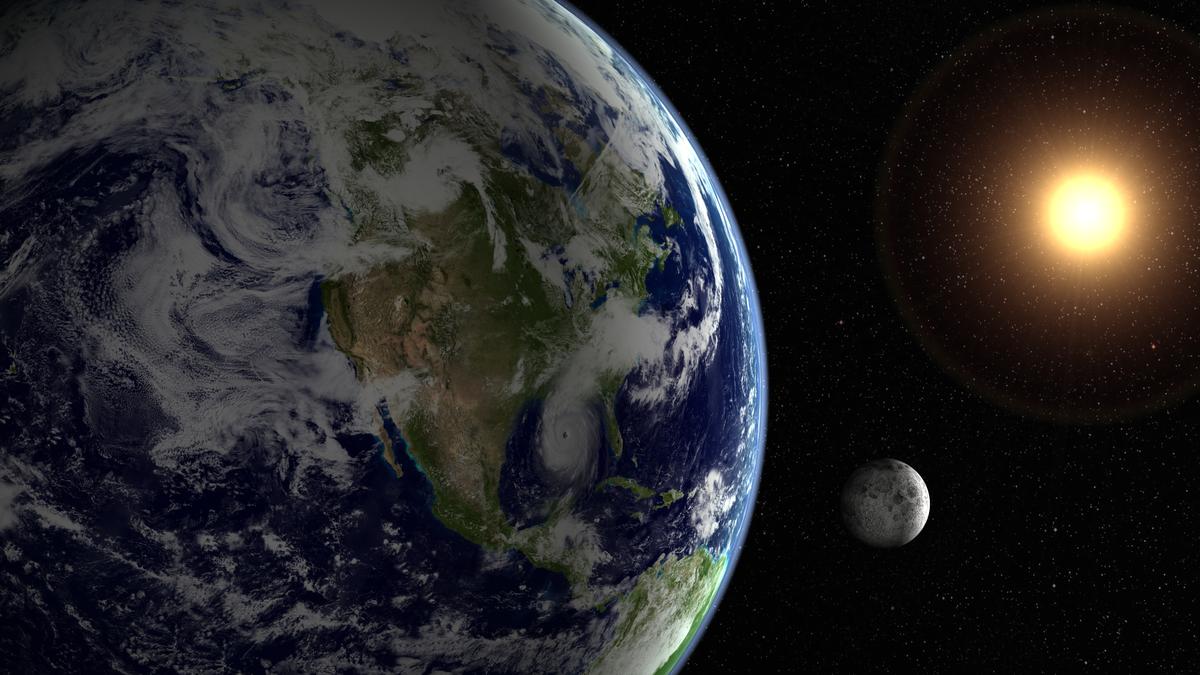
That pulling something towards you can rotate it is not something unusual. For instance, imagine you are tying a strong rope to the seat of a kid riding a bicycle and try to pull the cycle towards you. As you pull, instead of the cycle coming directly at you, it will make the cycle circle around you. If you continue to do so, the cycle may make a full turn. Here your pull acts like a centripetal force. And this is what the earth does to the moon through gravitational pull. The moon is attracted by the gravitational force of earth, but it makes the moon revolve around us. This very behaviour is repeated by the earth and the sun.


NASA revamps its Artemis lunar program to address delays and ensure a Moon landing by 2028.