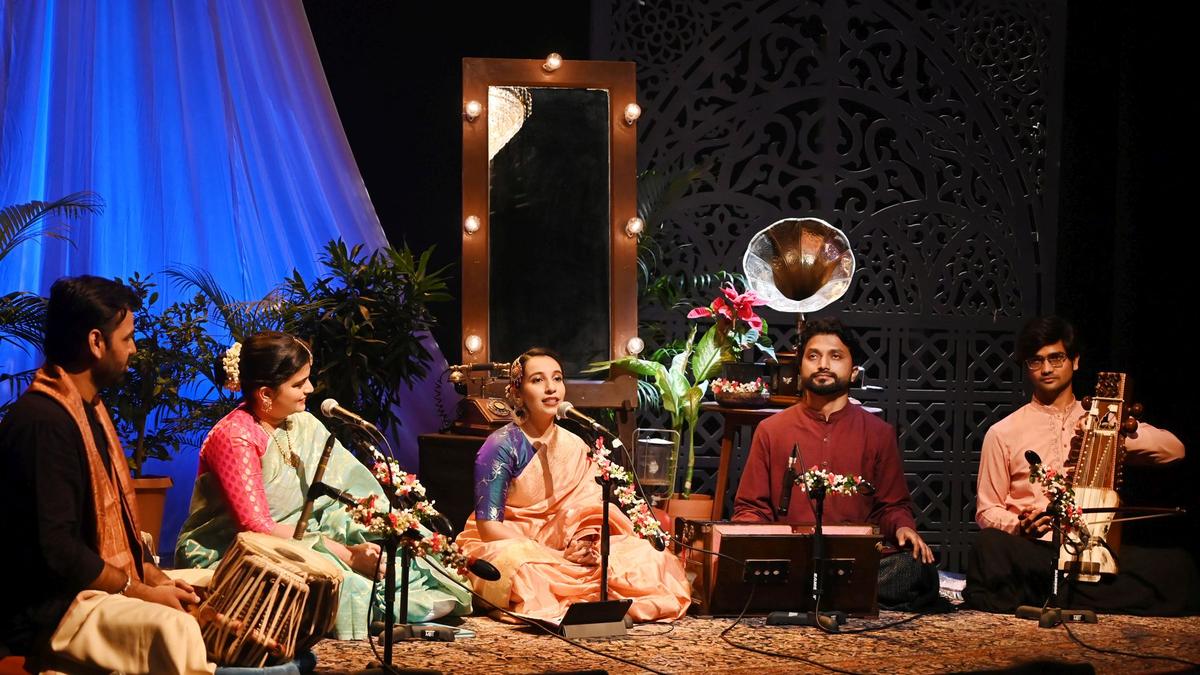
‘O Gaanewali’ is an ode to powerful female voices from the past
The Hindu
'O Gaanewali' celebrates legendary women singers through a series of thumri, dadra, and ghazal performances in Mumbai.
‘O Gaanewali’ is an ode to those legendary women singers who broke the glass ceiling and engaged with art beyond gender divide. Artistes such as Rasoolan Bai, Gauhar Jaan and Begum Akhtar showed the world how women can pursue their passion without being bogged down by societal norms.
‘O Gaanewali, a show that celebrates the beauty of thumri, dadra and ghazal, will launch its first EP — O Gaanewali Session 1. The EP will be released at a concert in Mumbai’s Royal Opera House on June 7. Having performed 55 shows across India over the past three years, the team behind O Gaanewali series felt it was time to put out a recording. The very first song will be Mirza Ghalib’s ghazal ‘Muddat hui hai yaar ko’ , which will be followed by a thumri later. ‘O Gaanewali’ plans to release songs every fortnight.
It is conceptualised and written by Avanti Patel, a Hindustani vocalist, who features along with singer Rutuja Lad in the series. The concert includes theatrical elements such as storytelling. Musical terms will be demonstrated and explained in a conversational mix of Hindi and English. The shows are directed by theatre personalities Mallika Singh and Meghana AT.
Avanti and Rutuja are trained under senior Hindustani vocalist Ashwini Bhide-Deshpande. They duo also carries the legacy of Ashwini’s aunt, Sarla Bhide, a senior disciple of Shobha Gurtu. Says Avanti: “It helps that Rutuja and I have the same guru in Ashwini tai, in that, our approach to music is similar.”
The idea for the EP, she reveals, originated during the lockdown as part of a series initiated by Harkat Studios. O Gaanewali was presented in March 2022 at the Experimental Theatre of the National Centre for the Performing Arts (NCPA). Soon, offers started coming in, but Avanti wanted the show to be interactive, and educate new listeners about the nuances of thumri. She says, “My knowledge of theatre was limited, but Mallika and Meghanahelped bring out that element and work withmusicians and the script.” The show was put together after researching the lives and music of legendary women artistes. “We wanted to talk about their hardships and challenges too,” adds Avanti.
Rutuja, who had earlier learnt from Jaipur-Atrauli gharana doyenne, Dhondutai Kulkarni, says she had her inhibitions, but quickly adapted to and began enjoying the new format. She explains, “As a classical singer, I was accustomed to the traditional style, where weannounce a piece and sing the composition. The directors helped me overcome that.”
The theme of the shows keeps changing to add some excitement to the presentation. O Gaanewali has had specials for Holi, monsoons and songs of Shobha Gurtu to mark her centenary year, along with love songs and ghazals among others. Avanti says this helps audience come back, as they know they will get something different each time. She adds, “By changing the basic theme, one will look for songs that have not been performed before. At times, we have to learn and practise something totally new, because it goes with the flow. But that is where the joy lies .”


CPI-M accepts DMK's five-seat offer for Tamil Nadu Assembly elections, prioritizing INDIA bloc unity over seat demands.

Ricky Rai, son of former underworld operative Muthappa Rai, on Monday appeared before the Bengaluru Traffic Police for questioning in connection with a case involving a Lamborghini performing dangerous stunts at Anil Kumble Circle on March 21.

The Dispur election heats up as 'CongBJP' defections shape a high-stakes contest between veteran candidates from BJP and Congress.

Bengaluru's M. Chinnaswamy Stadium conducts readiness drill ahead of IPL 2026, ensuring upgrades and technical preparations are complete.

First-level randomisation of EVMs completed in Nagapattinam for upcoming elections, ensuring transparency and security.

A district-level committee in Krishnagiri has been formed to assess and verify seizure claims of goods and cash.

Minister Anam Ramanarayana Reddy pledges government support for local fishermen and farmers facing challenges in Andhra Pradesh.

MP M. Sribharat urges collective efforts to revive Visakhapatnam Steel Plant, highlighting key reforms for crucial recovery and growth.

141 candidates have filed nominations for Kozhikode's Assembly elections, with scrutiny on March 24 and campaigning intensifying.

BJP's Vijayendra accuses Congress of using money to influence Bagalkot bypolls, urging voters to reject their tactics.

First randomization of electronic voting machines completed in Tirunelveli and Tenkasi districts for upcoming Assembly elections.

RPF seizes 10.12 kg of unclaimed cannabis worth ₹5.06 lakh from a train in Mangaluru.

Kolar's groundwater levels rise to 50-100 ft due to the K.C. Valley project, ensuring clean water and improved health outcomes.