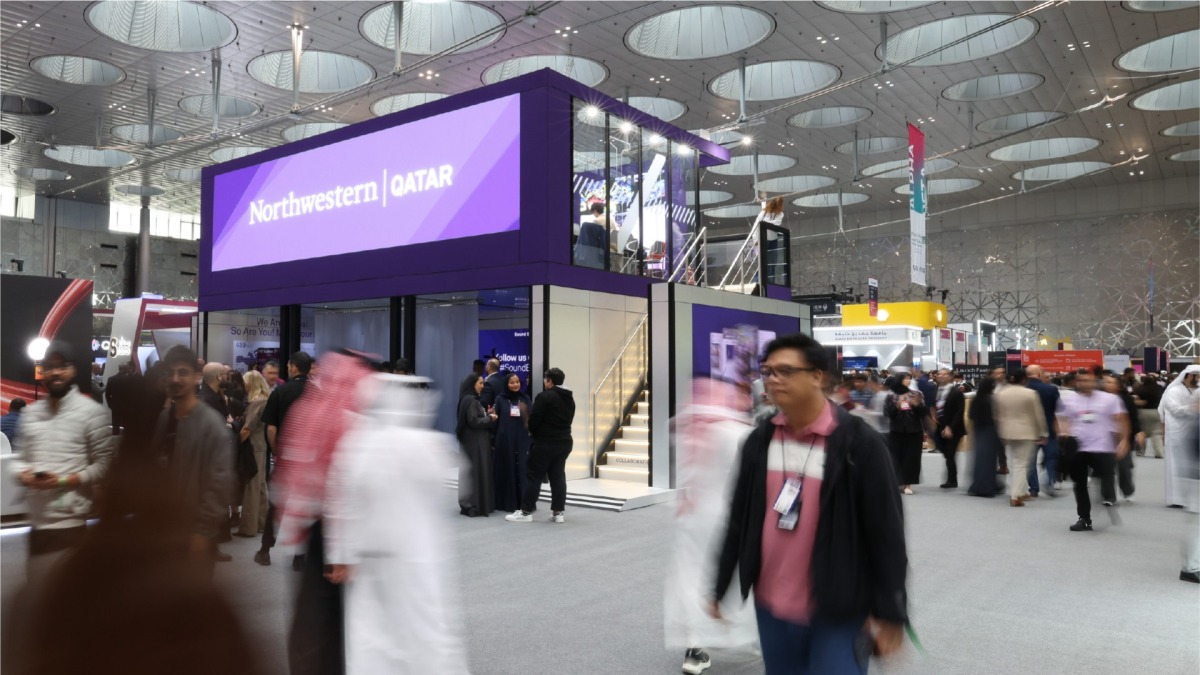
NUQ brings research, creativity and real-world insight to Web Summit Qatar
The Peninsula
Doha, Qatar: For the third consecutive year, Northwestern University in Qatar (NUQ) will be present at the Web Summit Qatar with an expanded presence,...
Doha, Qatar: For the third consecutive year, Northwestern University in Qatar (NUQ) will be present at the Web Summit Qatar with an expanded presence, underscoring its growing role in global conversations on technology, media, and communication.
Building on its participation over the past two years, the University will deliver an enhanced programme featuring research-driven discussions, creative showcases, and applied insights from its academic community.
“Our return to Web Summit heralds NU-Q’s broader engagement at the cutting edge of digital transformation. It reflects our commitment to deepen the impact of our expertise globally,” said dean and CEO of NUQ Marwan M. Kraidy in a statement. “It’s exciting to see research, teaching, and creative practice come together in ways that actually connect with real-world challenges. I’m proud of the talent and ideas our community is bringing to the table.”
NUQ at Web Summit Qatar 2026 will focus on key themes including technology, artificial intelligence, digital culture, and media, with contributions from the Institute for Advanced Study in the Global South, Artificial Intelligence and Media (AIM) Lab, the Media Majlis Museum, Executive Education, and faculty, students, and researchers from Northwestern’s Qatar and Evanston campuses. While Web Summit Qatar is best known as a gathering for start-ups, investors and industry leaders, the Media Majlis Museum sees its participation as essential to broadening the conversation. Speaking to The Peninsula, Director of the Media Majlis Museum Alfredo Cramerotti said the institution’s role is to translate industry-led discussions into meaningful public engagement.
“While Web Summit Qatar is primarily an industry-driven gathering focused on start-ups and business, it is important for us to be part of this conversation,” Cramerotti said. “As both a journalism and communication school and a museum, our role is to unpack industry discourse and make it accessible to a wider public without diluting its complexity.”


Doha: Qatar s Ministry of Interior (MoI) said bank branches located within shopping malls will continue operating according to their normal working ho...

Baghdad: A drone attempting to target a logistics center near Baghdad Airport was shot down, an Iraqi security source said Monday. Meanwhile, the M...

Doha: The State of Qatar has said that Iran must take a clear decision to stop attacks on the countries of the region, rejecting suggestions that in...

Doha: The State of Qatar has said that Iran must take a clear decision to stop attacks on the countries of the region, rejecting suggestions that in...

Doha, Qatar: The Ministry of Defense (MoD) of the State of Qatar announcedthat Qatar was subjected to an attack involving 14ballistic missiles and a n...

Doha, Qatar: The Ministry of Defense (MoD) of the State of Qatar announcedthat Qatar was subjected to an attack involving 14ballistic missiles and a n...

Abu Dhabi authorities are responding to a fire at the Shah oil field, caused by a drone strike, according to Abu Dhabi Media Office No injuries ha...

Doha, Qatar: The Primary Healthcare Corporation (PHCC) has announced the operating schedule for its health centers during the Eid Al Fitr holiday, run...

Doha, Qatar: The Primary Healthcare Corporation (PHCC) has announced the operating schedule for its health centers during the Eid Al Fitr holiday, run...

London: Chelsea were fined 10.75 million ($14.27 million) and received a suspended one year transfer ban on Monday in relation to historical breaches...

Riyadh: The main Saudi stock index closed higher Monday, gaining 59.63 points to close at 10,946.26 points, with trading valued at SAR 6.2 billion....

Doha, Qatar: The State of Qatar expressed its strong condemnation of the Iranian targeting that led to a missile striking a civilian vehicle in the Al...

Doha, Qatar: The State of Qatar expressed its strong condemnation of the Iranian targeting that led to a missile striking a civilian vehicle in the Al...