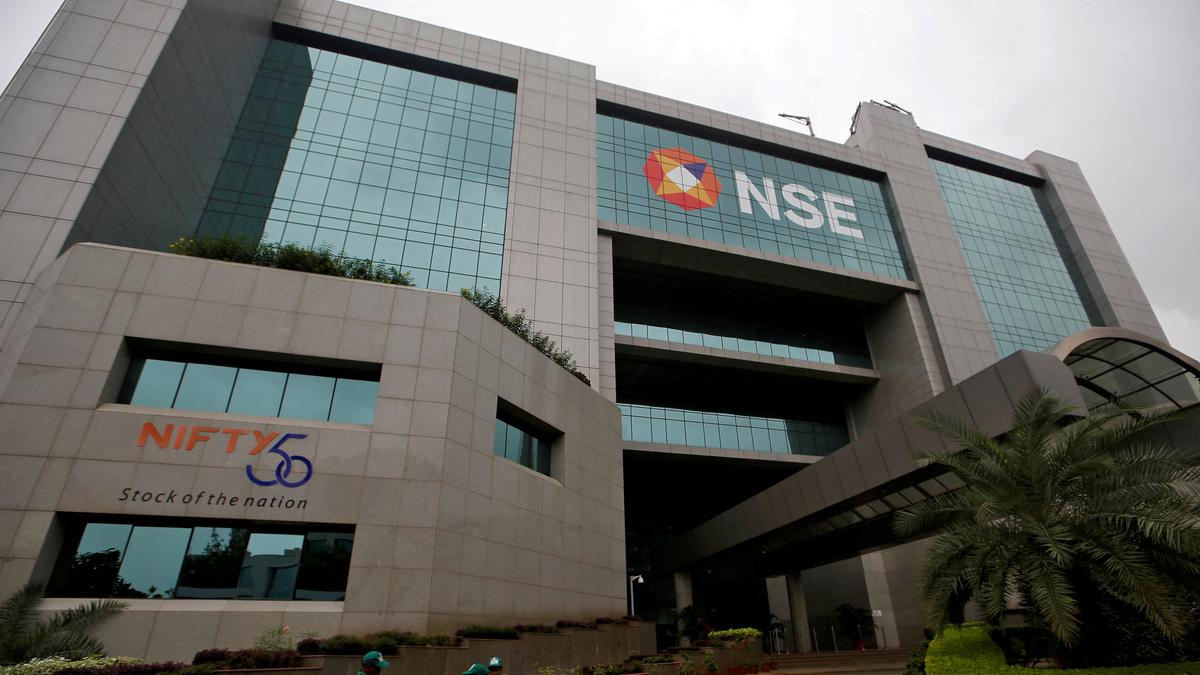
NSE asserts all decisions are ‘transparent’ amid heat over Adani Group stocks
The Hindu
The National Stock Exchange, in a statement, defends its indexing and surveillance moves, says there is ‘no human discretion in deciding on inclusion or exclusion of stocks in any of its indices’
The National Stock Exchange (NSE) late on Sunday issued a three-page statement to assert that its surveillance actions on individual stocks and decisions to include or exclude stocks in various Nifty indices are driven by “transparent” policies and rules without “human discretion”.
The statement comes two days after the exchange removed three Adani Group stocks, including its flagship Adani Enterprises, from its short-term additional surveillance framework. Stocks are put under the additional surveillance framework by exchanges to safeguard investors amid high volatility.
Also read: Congress flags SEBI’s silence over NSE stance on Adani Group stocks
The NSE statement also sought to defend its subsidiary NSE Indices’ decisions and said there was “no human discretion in deciding on inclusion or exclusion of stocks in any of if [sic] its indices”. Last month, the subsidiary had announced the addition of five Adani Group firms into 14 of its indices, effective March 30, while retaining Adani Enterprises and Adani Ports and SEZ in its flagship Nifty 50 index.
While the reconstitution of the indices was based on trading data for the six-month period ending January 31, financial experts had sought a review of the move to protect investor interest in the midst of the meltdown in the Group’s stocks since January 24, when U.S.-based Hindenburg Research released a report alleging several misdemeanours by the Group.
“NSE surveillance actions on eligible stocks are applicable as per transparent rules. These rules are non-discretionary, pre-announced and automatically applicable,” the exchange said, adding the norms are in the public domain, “common across exchanges” and are “implemented automatically and no human discretion is allowed”.
The exchange also underlined that “the overall Risk Management Framework put in place for trading in secondary market has been designed to provide robustness to capital market ecosystem, especially in volatile times”.


Iran continues to export millions of barrels of oil amid war, with 90 ships crossing the Strait of Hormuz despite sanctions.

Amazon CEO Andy Jassy said during an internal all-hands meeting he expects artificial intelligence could help cloud computing unit Amazon Web Services achieve $600 billion in annual sales, double his own prior estimate.

Government mandates airlines to allocate 60% of seats free, enhancing passenger rights and convenience across Indian aviation.

Microsoft is weighing legal action against Amazon and OpenAI over a $50 billion deal, the Financial Times reported

Stock markets rally with Sensex and Nifty gaining, despite HDFC Bank and others lagging behind amid falling crude prices.

OpenAI has signed a new deal to sell access to its AI models to U.S. defence and government agencies through Amazon’s cloud unit for classified and unclassified work, the ChatGPT maker said

Samsung Electronics said on Wednesday that it expects to start volume production of Tesla’s chips

The Trump administration said in a Tuesday court filing that the Pentagon’s blacklisting of Anthropic was justified and lawful

Mastercard Move aims to simplify cross-border payments for SMEs and students in India, enhancing efficiency and reducing costs.

SBI raises ₹6,051 crore through 10-year bonds, attracting strong investor demand with a 7.05% coupon rate.

In February, as per government data, domestic LPG production was slightly more than 1 million tonne.

Union Government urges States and UTs to expedite approval of gas pipeline projects to promote piped natural gas usage.

Parliamentary panel criticizes Ministry of Planning and Niti Aayog for persistent underutilization and poor financial management practices.