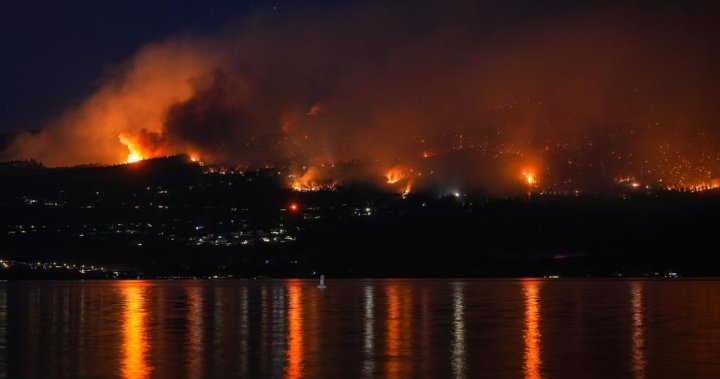
Night no longer offering firefighting reprieve, Canadian study shows
Global News
The availability of bone-dry fuels is the key mechanism promoting extreme fire behaviour and growth at night, a new Canadian study found.
The darkness of night has traditionally signalled reprieve for wildland firefighters, but a new Canadian study shows that’s changing, and drought is the driving force.
The availability of bone-dry fuels is the key mechanism promoting extreme fire behaviour and growth at night, the study says, though warming temperatures are also eroding the “climatological barrier” that has typically limited overnight burning.
Uncovering the role of drought led the researchers to further show that daytime conditions can be used to predict whether a fire will continue to burn and possibly spread through the night — information that could be crucial for firefighting efforts.
“We have fire growth models, and they handle the day really well most of the time, and that’s usually the most important part. But they don’t really do well at night,” says Mike Flannigan, one of the study’s co-authors in British Columbia.
“Any kind of information of how active a fire will be at night is really critical … especially if a fire is approaching a town, like West Kelowna last year,” he says, recalling a fast-moving blaze that began tearing through part of the Okanagan community one evening last August, ultimately destroying nearly 200 homes.
Wildland firefighters work overnight in such situations, when flames are threatening people and infrastructure, Flannigan says. It’s not standard policy for most blazes, and traditionally, nighttime reprieve is “almost relied upon as a given,” he says.
The study, published Wednesday in the peer-reviewed journal Nature, suggests that is an increasingly risky bet as climate models predict summers will get hotter and drier, conditions that Flannigan describes as a “powder keg” for wildfire.
Canada’s drought bulletin shows pockets of “exceptional” and “extreme” drought in central B.C. and southern Alberta, while drought conditions in swaths of both provinces were classified as moderate to severe at the time of the Feb. 29 update.


It may be the first day of spring, but Ontario’s long winter isn’t over, with more snow and icy conditions expected before a full warm-up arrives

The policy is something of a reversal from a government that killed a similar idea shortly after taking power. Back in 2019, the province said the policy would be unenforceable.

The recall states that 'the ovens in the ranges can experience a delayed ignition of the oven's bake burner, which can create a potential risk of burns.'

U.S. President Donald Trump is widening the cracks between the United States and European NATO members with his calls for allies to help him finish the war he started with Iran.

The legislation from U.S. Rep. Lloyd Smucker would launch a U.S. Trade Representative investigation into whether the Canadian law unfairly burdens American commerce.

The New York Islanders plan on moving their American Hockey League affiliate from Bridgeport, Connecticut, to Hamilton, Ont., for next season.

Mayor Michael Prue said Diageo appeared to lose steam in its attempts to quickly sell a facility in his town as soon as Doug Ford stood down his threat to ban Crown Royal.

Dillon Whitehawk has been found guilty of first degree murder in killing of Keenan Toto, but not guilty in killing of Jordan Denton.

Waterloo’s police chief says snipers may continue to be used at large events as needed, following their deployment during a St. Patrick’s Day street party.

Parents and students in Nova Scotia and Manitoba are dealing with the aftermath of what could have been two deadly school attacks, after FBI intel leads to arrests.

The Toronto Police Association and Ontario Premier Doug Ford both called on the judge who suggested police witnesses may have colluded to apologize.

Most Canadians want the government to ban or regulate the use of algorithms to set prices, a new poll suggests — with half of respondents saying the practice is unfair.

Two Quebec men accused of fathering hundreds of kids have been banned from donating sperm in the province while a court case against them unfolds.