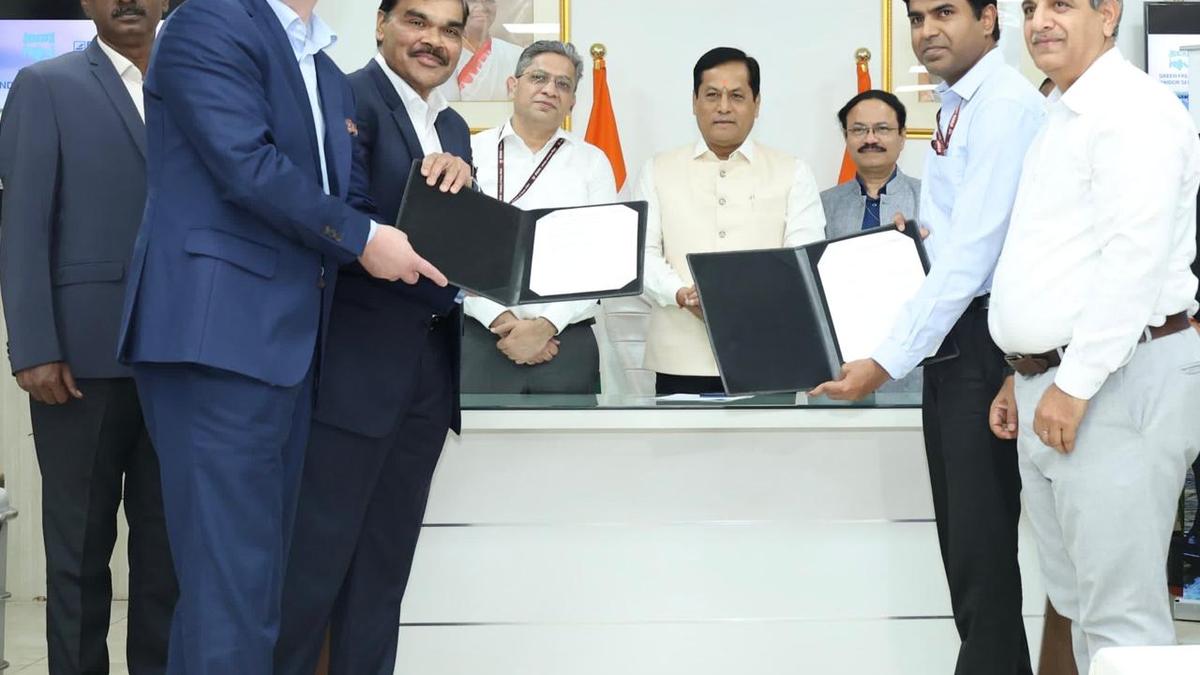
MoU signed for cargo movement by barges over inland waterways
The Hindu
IWAI partners with Rhenus Logistics to introduce barge services on national waterways, aiming for efficient cargo transportation.
:
In a bid to start barge services for transporting cargo across key national waterways, the Inland Waterways Authority of India (IWAI) on Tuesday (May 6, 2025) signed a Memorandum of Understanding (MoU) with global logistics major Rhenus Logistics India Private Limited.
“As part of the MoU, Rhenus will introduce 100 barges in a phased manner in the national waterways while 20 barges and 6 pushers [are] to be deployed in the first phase, targeting the movement of more than one million tonnes of cargo annually by the end of 2025,” the Ministry of Ports, Shipping and Waterways said in a statement.
“Inland waterways offer a remarkable opportunity to create a greener, cost-effective, and efficient logistics network,” Union Minister of Ports, Shipping and Waterways Sarbnanda Sonowal said, speaking at the event.
To begin with, Rhenus will operate on the Ganga, Brahmaputra, and Barak rivers, as well as the Indo-Bangladesh Protocol route, moving bulk and break bulk (non-standardised, individual units of) cargo across the north, east, and northeast India, with gradual expansion to other national waterways.
By leveraging Rhenus’s expertise in European inland navigation, and its global fleet of over 1,100 barges, the partnership aims to bring global best practices to India. “A combination of pushers and barges to suit the low draft navigation will be used to transport both bulk and break bulk cargo,” the Ministry said.
The number of operational national waterways in India grew from three in 2014-15 to 24 by 2023-24, with a target of 29 by 2024-25. Cargo movement has surged from 30 million metric tonnes per annum (MMTPA) in 2014-15 to 133 MMTPA in 2023-24, adding up to the cumulative movement of over 779 MMT in the past decade, according to the Ministry.


The Thane police have arrested two co-founders of cryptocurrency exchange platform CoinDCX in connection with an alleged fraud of Rs 71.6 lakh, officials said

Meta Chief Executive Mark Zuckerberg is building a CEO agent to help him do his job, the Wall Street Journal reported

Insurance penetration and density are often misunderstood and do not reveal how many families are insured or whether they would be financially secure if the main earning member were to die. The real issue is not reach but adequacy, as households may have life insurance but not enough cover to replace lost income, leaving them financially vulnerable.

Five top firms lose ₹1 lakh crore in market value, with HDFC Bank experiencing the largest decline of ₹56,124.48 crore.

L&T confirms 95% of its West Asia project sites are safe, while addressing logistics challenges amid ongoing regional conflicts.

Mines Ministry to auction 19 critical mineral blocks on March 23, expanding strategic resources for clean energy and technology sectors.

Mines Ministry to auction 19 critical mineral blocks on March 23, expanding strategic resources for clean energy and technology sectors.

Five top firms lose ₹1 lakh crore in market value, with HDFC Bank experiencing the largest decline of ₹56,124.48 crore.

HDFC Bank terminates three senior officials over client onboarding issues at its DIFC branch amid ethical concerns following chairman's resignation.

Air India CEO warns of potential flight cuts and reduced travel demand due to rising fuel costs amid ongoing Gulf conflict.

Options are widely used by retail traders to speculate on the value of the stock for immediate gains and such behaviour in large scale can distort the market

India achieves 1 billion tonne coal production for the second consecutive year, ensuring stable energy supply and economic growth.

Generic drugmakers in India launch affordable Semaglutide versions, targeting a $1 billion diabetes and weight loss market.