McMaster research targets menstrual cup ‘mess’ with absorbent tablets to tackle period stigma
CBC
Close to a quarter of the world’s population menstruates, but innovation in menstrual products has been sparse, says a McMaster researcher.
“This is a field ripe for innovation. There is so much that can be done. And then there are very, very simple needs that are not met,” said McMaster University professor Zeinab Hosseinidoust.
Hosseinidoust works out of the department of chemical engineering at the Hamilton university.
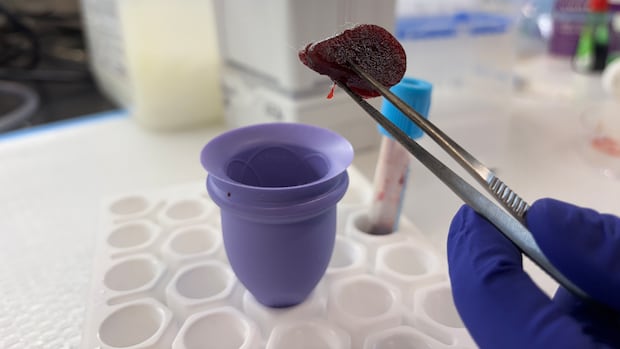
She worked alongside associate professor Tohid Didar to create smart tablets that work with menstrual cups to make them more accessible and reduce the “mess” that can come along with them.
According to UN Women, the United Nations agency charged with working for gender equality and empowering women, over two billion people in the world menstruate. In Canada, one in six people who menstruate have experienced period poverty, with the average person spending around $6,000 in period products over their lifetime, and one in four Canadians “agree periods are dirty and unclean,” according to federal government research.
Menstrual cups have become increasingly popular in recent years for being eco-friendly and cost-effective because they can be reused for years.
Hosseinidoust said she wondered why people weren't using menstrual cups, and decided to look at comments under social media posts.
“A lot of them ask, ‘what about the mess?’ So there is that concern, whether it's real or not,” she said.
It was a simple solution to a simple problem, said Hosseinidoust.
“It was just a matter of opening the doors and looking at the problem, rather than ignoring it, which one can argue that when it comes to menstrual health and women's health, that has been the attitude,” she said.
Dior David, a McMaster university student, told CBC Hamilton while the process is not messy for her, the tablets are a “great idea.”
David said using a tablet like that would allow her to change out a cup or disc in a public bathroom without having to walk out to a sink to rinse and said if available, she’d use it.
“It would honestly just make everything more convenient. I think that one of the reasons why I decided to empty my cup in the showers is because I want to avoid the mess, and [a tablet] would just be very easy to deal with,” said David.
Jennifer Abraham, who also goes to McMaster university, told CBC Hamilton it’s “cool to hear about innovations in the menstrual industry.”


Winter can be tough to bear. Even more so if you’re homeless.

Two future national First Nations leaders, a deputy premier and a city councillor are among the prominent Manitobans who appear in declassified intelligence files from years of RCMP spying on the Indigenous rights movement in the Cold War era.

Saskatoon city hall administration is planning to "refresh" the funding strategy for the proposed $1.2-billion downtown arena district amid a lack of commitments from higher levels of government.

A report of fraud tied to a walleye derby is under investigation after Montreal Lake Cree Nation said a participant allegedly violated derby rules and was asked to leave the fishing area.

An Edmonton architectural firm says it is in talks with the provincial government to potentially redevelop the former Royal Alberta Museum.

Does junior football have a future in Prince George?

People are descending upon the city for the dozens of events and live music performances this week as the Juno Awards are set to take place Sunday at Hamilton's TD Coliseum.

For nearly two decades, Amanda Loewen's world ended where the pavement did.

The notion that home ownership guarantees financial security in old age is being challenged by a recent survey.

The family of Nash Prystie has identified him as the man who died in an Ontario Provincial Police (OPP) shooting earlier this month north of Kenora, and is calling for more and quicker help for people with mental health challenges.

Playoff action in the Ontario Hockey League gets underway Thursday night for Guelph and Friday in Kitchener.

UPEI wants its faculty to sign on to an updated version of its sexual assault and discrimination policy, but the union that represents the school's academic staff says it wants the policies to be part of its collective agreement.

In Texas this week for a global energy conference, the federal natural resources minister is proclaiming "Canada is back" and ready to bolster its energy sector and grow exports.