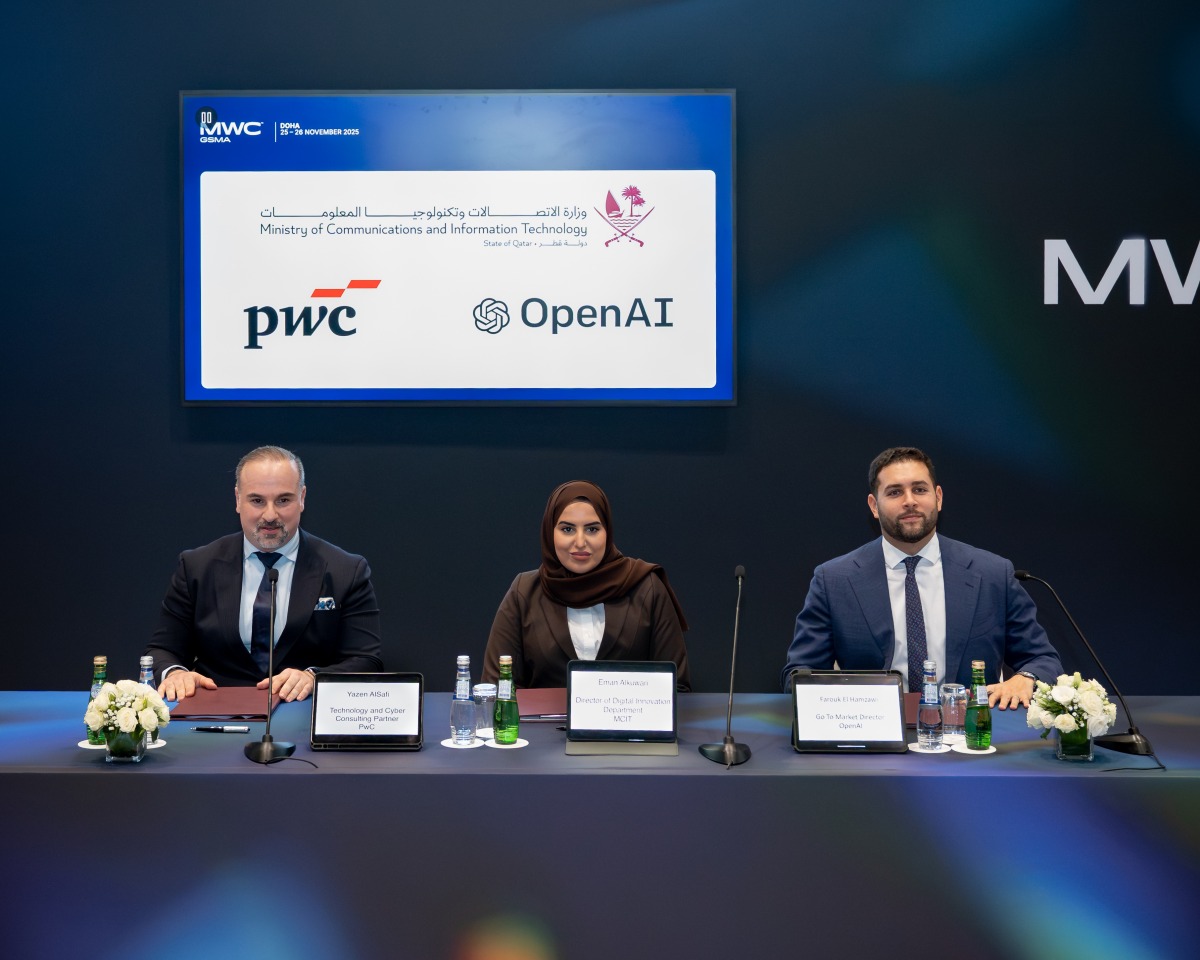
MCIT signs agreement with PwC Middle East and OpenAI
The Peninsula
Doha, Qatar: The Ministry of Communications and Information Technology (MCIT) has announced the signing of a collaboration agreement with PwC Middle E...
Doha, Qatar: The Ministry of Communications and Information Technology (MCIT) has announced the signing of a collaboration agreement with PwC Middle East and OpenAI, marking a significant milestone in Qatar’s efforts to build an integrated national artificial intelligence ecosystem.
The collaboration aims to advance Qatar’s AI infrastructure, expand the practical adoption of AI across public and private sectors, and promote secure, reliable, and innovative AI solutions that enhance operational efficiency and improve service quality.
The collaboration focuses on three main pillars. These include launching a new AI Sandbox for government entities and startups, accelerating productivity across government entities through the use of ChatGPT, and developing innovative AI-powered projects in priority sectors. Together, these efforts support Qatar’s broader digital transformation by combining global advisory expertise with advanced AI capabilities.
The agreement was signed by Iman Al-Kuwari, Director of the Digital Innovation Department at MCIT, Yazan Al-Safi, Consulting Partner at PwC Middle East, and Farouk Hamzaoui, Head of Enterprise for the Middle East and North Africa at OpenAI, on the sidelines of MWC25 Doha.
Commenting on the collaboration, Iman Ahmed Al-Kuwari, Director of the Digital Innovation Department at MCIT, said: “This collaboration represents a practical step toward strengthening the national AI ecosystem through clear governance frameworks and the adoption of secure, high-quality, and innovative solutions. Our goal is to empower government entities and startups to develop AI-driven projects that enhance public service quality, improve operational efficiency, and support the country’s transition toward a sustainable, knowledge-based economy. This partnership accelerates our initiatives related to government productivity, the design of sector-focused digital projects, and the development of national talent capable of leading AI technologies responsibly and at scale.”


Doha, Qatar: The Minister of State for Energy Affairs HE Eng. Saad bin Sherida Al Kaabi, met today with the Director General for Energy at the Europea...

Doha, Qatar: Following the completion of the legally required quorum, representing (76.81%), Barwa Real Estate Group held the meeting of the Company s...

Doha, Qatar: Active trading and strong investor participation marked the last week at the Qatar Stock Exchange (QSE) as the market remained open and o...

Doha, Qatar: Oil prices spiked to nearly $120 per barrel before falling back slightly on Monday as Iran continued its attacks on several Arab countrie...

Doha, Qatar: Shares in Qatar stock market ended the week on a positive note as shares registered strong gains. The Qatar Stock Exchange (QSE) Index ha...

Dooha, Qatar: Vodafone Qatar held its Ordinary General Assembly Meeting virtually on Sunday, March 1, 2026 chaired by Vodafone Qatar Chief Executive O...

Doha, Qatar: Mwani Qatar recorded significant growth in its operational performance during February on a year on year basis, driven by an increase in...

Doha, Qatar: The year 2025 delivered an apparent contradiction at the heart of the global economy. On the one hand, global trade volumes surprised to...