Mapping places where women hung out in Bengaluru’s Cantonment area Premium
The Hindu
But the Bengaluru-based writer and teacher, an assistant professor at St. Joseph’s University, did not just stumble upon Nair’s term serendipitously. “I was initially reading Mobile Girls Koottam: Working Women Speak by Madhumita Dutta, and was talking to my dean, Dr. Arul Mani, about the book,” she says. “It was he who suggested I read Janaki Nair.”
It was while reading historian and writer Janaki Nair’s book, The Promise of the Metropolis: Bangalore’s Twentieth Century, that Nikhita Thomas first encountered an interesting expression: kineticization, “a phenomenon in the 80s and early 90s where there was an increased presence of women in the public sphere due to the popularity of the Kinetic Honda.”
But the Bengaluru-based writer and teacher, an assistant professor at St. Joseph’s University, did not just stumble upon Nair’s term serendipitously. “I was initially reading Mobile Girls Koottam: Working Women Speak by Madhumita Dutta, and was talking to my dean, Dr. Arul Mani, about the book,” she says. “It was he who suggested I read Janaki Nair.”
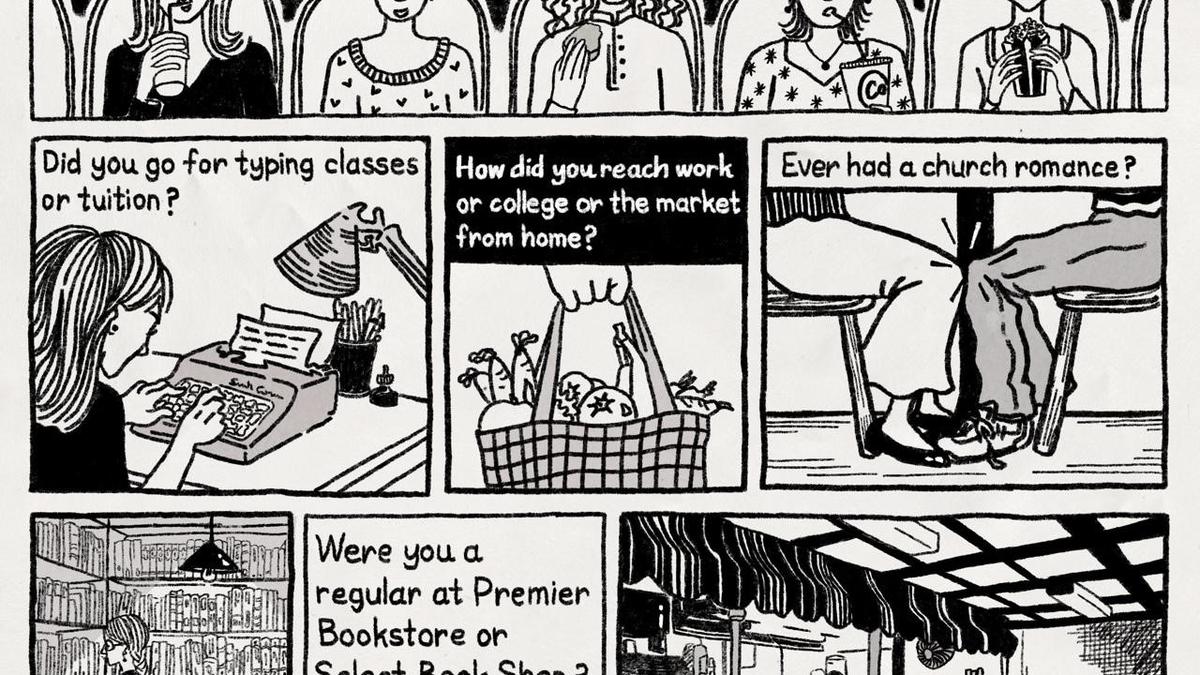
The growing participation of women in public life got her thinking about how the phenomenon of just hanging out transpires for women, says Nikhita, who, along with Pranav V.S., has embarked on a project to map places where women hung out in the city’s Cantonment area between 1984 and 1994. “The idea was to talk to women who lived, studied and worked in Bengaluru Cantonment during the 80s and the 90s,” she says. “We picked this specific period because of the “kineticization” that Janaki Nair talks about and because this was a period of rapid change in the country, including two waves of liberalisation.”
This project, supported by the India Foundation for the Arts (IFA) under its Neighbourhood Engagements of Project 560, “seeks to explore the spatial relationships women have with the cities and neighbourhoods they call home,” states the IFA website, adding that Nikhita’s and Pranav’s research engages with the following questions: When are women rendered invisible, and when are they on display in the city? How does the purpose of their movement through the city get women tossed between obscurity/safety, and visibility/danger? And how can spaces designated for one kind of interaction be persuaded to house other exchanges, given the spatial practices of women?
Nikhita first applied for an IFA grant in 2023, wanting to look at student migrants in the city and the spaces they occupied, “specifically to go into their hostel or PG rooms and draw from that,” she says. While she cleared the first round of the grant, she didn’t make it to the final round, “but they encouraged me to apply again.”
In July 2024, Pranav, too, joined the English Department at St. Joseph’s University. They were in conversation with Dr. Mani, she says, who encouraged them to apply for the grant together this time. “We were bouncing ideas off each other, with Pranav initially suggesting we do something about the lakes that used to exist in Bengaluru,” she says.
Dr. Mani, however, was not enthusiastic about this idea, recalls Nikhita, who, around the same time, was also reading the Janaki Nair book. There was also a movie that both of them liked, Brahman Naman, “a movie about the quizzing culture in Bangalore with mostly boys who loiter about the city,” she says. “It is a super movie, but it left us wondering: Where are all the women?”


Learn how elderly and disabled voters can easily cast their ballots from home in the 2026 Assembly Elections.

Parliament Budget Session LIVE: Track updates on the Parliament Budget Session as the Transgender Bill moves to the Rajya Sabha. Follow The Hindu for the latest updates on the Budget Session on March 25, 2026.

Congress leaders in Kerala accuse LDF and NDA of a secret deal to undermine their influence in the upcoming Assembly elections.

Agnikul Cosmos successfully test-fires a revolutionary 3D printed booster engine, enhancing launch efficiency and scalability in space transportation.

Katha Dhara Hyderabad event by Katha&Krafts brings theatre to government school students. The initiative introduces government school students to theatre, puppetry and creative expression.

Gaurav Gogoi dismisses Himanta Sarma's Pakistan allegations as a "wild theory," asserting focus on corruption and government accountability.

T.N. CM Stalin urges the Centre to build consensus with transgender persons before imposing changes to the Trans Amendment Bill 2026.

Trump's engagement with Pakistan as a mediator for Iran echoes Nixon's historical diplomacy with China amid shifting geopolitical dynamics.

Telangana's Petroleum Dealers Association assures no fuel shortage, attributing temporary stock issues to panic buying fueled by rumors.

The Ottiyambakkam panchayat had an harrowingly difficult time keeping people from swimming in the deadly quarry with its protruding rocks under the water. There had been many deaths. And then nature intervened, and the fatal accidents stopped. An invasive, floating weed that is a bane of water sources everywhere, the water hyacinth is not just tolerated in the quarry but welcomed

Fuel supply panic causes severe traffic congestion in Hyderabad on March 25, 2026, prompting police intervention to manage long queues and road chaos.

Mohamed Salah will leave Liverpool at season's end, concluding a remarkable nine-year tenure at Anfield.

Telangana CM to hold urgent meeting on March 25 to address petrol, LPG, and urea stock concerns amid rising demand.