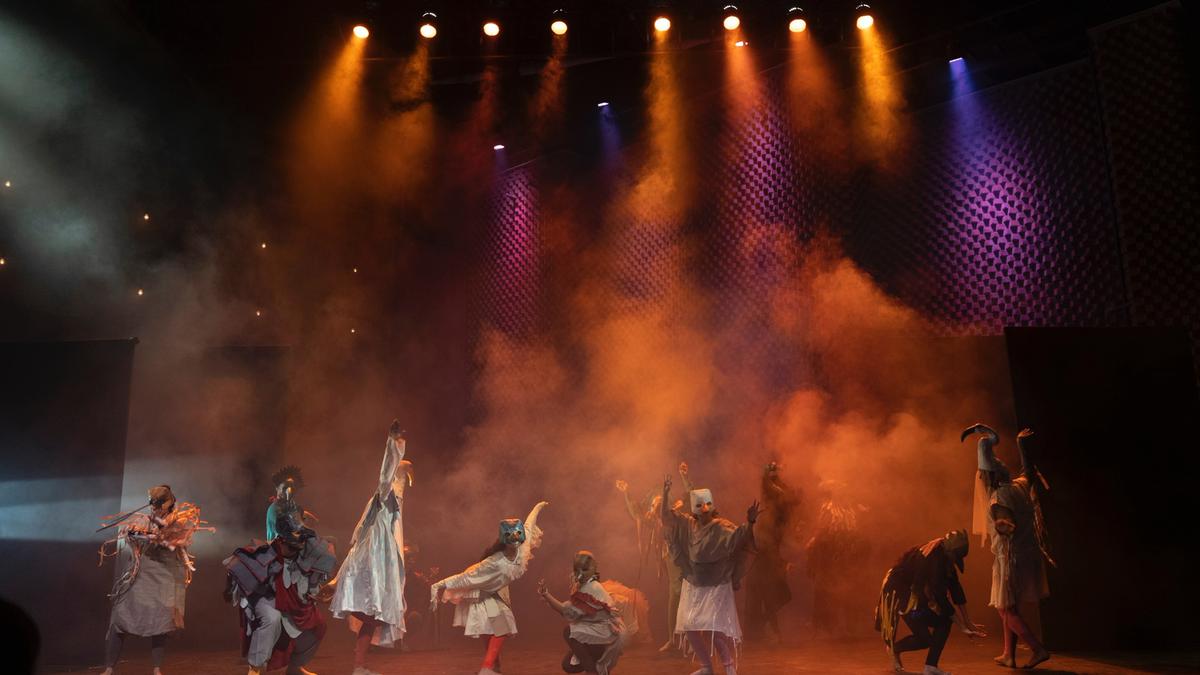
Mallika Sarabhai’s new work, The Conference of the Birds, gives wings to human emotions
The Hindu
An adaptation of the sufi saint Fariddudin Attari’s poem, the production traces the highs and lows of human existence through the flight of birds
As the sun went down on the Sabarmati river in Ahmedabad, the way to the Natarani amphitheatre on one side of the river bank transformed into a mysterious pathway where a group of children and adults moved amidst the sounds of birds in bushes sparkling with fairy lights. They entered the world of a theatrical production, an adaptation of the 12th century Persian parable, The Conference of the Birds, by Sufi saint Fariddudin Attari. It was going to be a metaphorical psychological journey produced by the iconic Mallika Sarabhai.
Director Yadavan Chandran of the Darpana Academy of Performing Arts, in this latest multiple-level and multi-art production, reflected the true spirit of the performance aesthetics of the Natyashastra, the seminal text of Indian performing arts. He explored the journeys of the human psyche playing with the metaphors of the mirror, shadow, mask, and reflection. His approach intertwined realism and symbolism, technology and performance arts of theatre, dance and music with his statement, ‘My aim was to make everything fly, the space, the characters, and most of all — the audiences’ minds!’
The twilight existence of reality and mental consciousness opened with a one-by-one introduction of the different birds and other characters. On one screen was the actor and the other screen depicted the person’s masked/ costume character. The masks designed by Margaret Matteson and executed by Pandarinathan brought out diverse human qualities reflected in birds, creating a magical reality of performed identities. For instance, Hoopoe stood for wisdom, the falcon for power, the parrot for freedom, the sprightly sparrow for energy, the peacock for pride, the nightingale for love, and the heron for self-centred existence. The birds’ conference worked under the leadership of the Hoopoe to seek their sovereign, a mythological bird ‘Simurgh,’ who lived beyond the existential seven valleys on Mount Qaf.
The story where the birds’ journey evolved in which characters, props, music, dialogue, and lighting generated tension flowing into suspense, unfolding the odyssey of the spectacle. The use of Hindi and English languages created inclusive participation among the audiences. The range of emotions through stories that touched on repulsion, astonishment, and humour captured the young audiences’ imagination, who alternated between clapping, laughing and rapt silence.
In the first part of the production, for instance, the Hoopoe (performed by Mallika) urged reluctant birds to journey with her. Although individually, the stories convey the trappings of emotions and ego that prevent birds from agreeing to the venture, the Hoopoe counters each argument and releases the tension for the story to proceed. For instance, the falcon sitting on the hand of the king is filled with power and does not feel the need to journey to find Simurgh. The Hoopoe counters by explaining the illusion of control that the king focused on his survival will not protect the falcon if the king feels challenged or threatened. Alongside, the interaction of the dainty sparrow braving the journey in contrast to the mighty yet reluctant falcon brought out existing social challenges, such as the issue of the reality of a committed minority of weaker sections in society. Preeti Das, who played the sparrow, expressed, “on each level, it was a journey of personal growth. Although small, the sheer grit and enthusiasm communicated an iron strength.”
Another example is the heron hypnotised in self-centred territorial existence, begins from the point of a full stop to transforming into the shape of its own body, a question mark, and seeks to find himself on a magical journey. “We get so used to our everyday routines and situations that we resist change and limit our growth. The role of the heron has indeed contributed to my personal growth,” said Harsh Dharaiya, who played the role of the heron.
The third part of the production is the voyage across valleys of different existential worlds. However, the intermedial second part of the production connected the first and the third part by unravelling worldly truths surrounding each one and preparing for the valleys beyond. In this second phase of the production, for instance, the blind bat seeks light, only to be told, “how can you see Sun when you live in a well!”. In another story, on one side of the high wall in the amphitheatre sat the nightingale singing her love for the ephemeral rose soulfully, juxtaposed on the other wall where sat a princess wooed by a forlorn sufi. The costumes by Anshul Juneja complimented the perfect singing of the nightingale (played by Hiral Brahmbhatt), and the theme of love portraying two love situations drew the audiences to comprehend human foibles.


Kanye West (Ye) announces his debut India show on March 29

Iranian director in exile, Mohammad Rasoulof, has already started working from his adopted country exploring themes around the autonomy of an artist

Anirudh Ravichander launches Albuquerque Records and announces a nationwide concert tour celebrating 15 years of his musical career.

Veteran screenwriter Salim Khan hospitalized in Mumbai; family and Salman Khan visit amid updates on his condition awaited.

Actors Rahul Bhatt and Sunny Leone open up on essaying complex characters in Anurag Kashyap’s ‘Kennedy’, all set to stream on Zee5

Acclaimed Tamil filmmaker Thiagarajan Kumararaja has reunited with his Super Deluxe star Vijay Sethupathi for his upcoming film, Pocket Novel

Legendary actor Robert Duvall, known for iconic roles in "The Godfather" and "Apocalypse Now," dies at 95.

The film is set to release in 2027 and is produced under Bhansali Productions and Maya Movies, with Mehta also serving as a writer on it

The concert is part of Kanye West's global run of headline performances and will take place in New Delhi’s Jawaharlal Nehru Stadium

Sinclair Daniel and Mark O'Brien speak of their experiences of working on 'The Copenhagen Test', balancing the action with emotion, and the challenges of filming in extreme weather

Tamil film producer V. Tamil Azhagan, known for iconic films, passes away at 70; Rajinikanth expresses deep condolences.

Arundhati Roy withdraws from Berlin Film Festival, criticizing Wim Wenders' stance on Gaza and the role of politics in art.

‘My Lord’ movie review: Except for a contrived pre-climax sequence, Raju Murugan’s film intersperses social satire and political commentary with wit, heart, and conviction