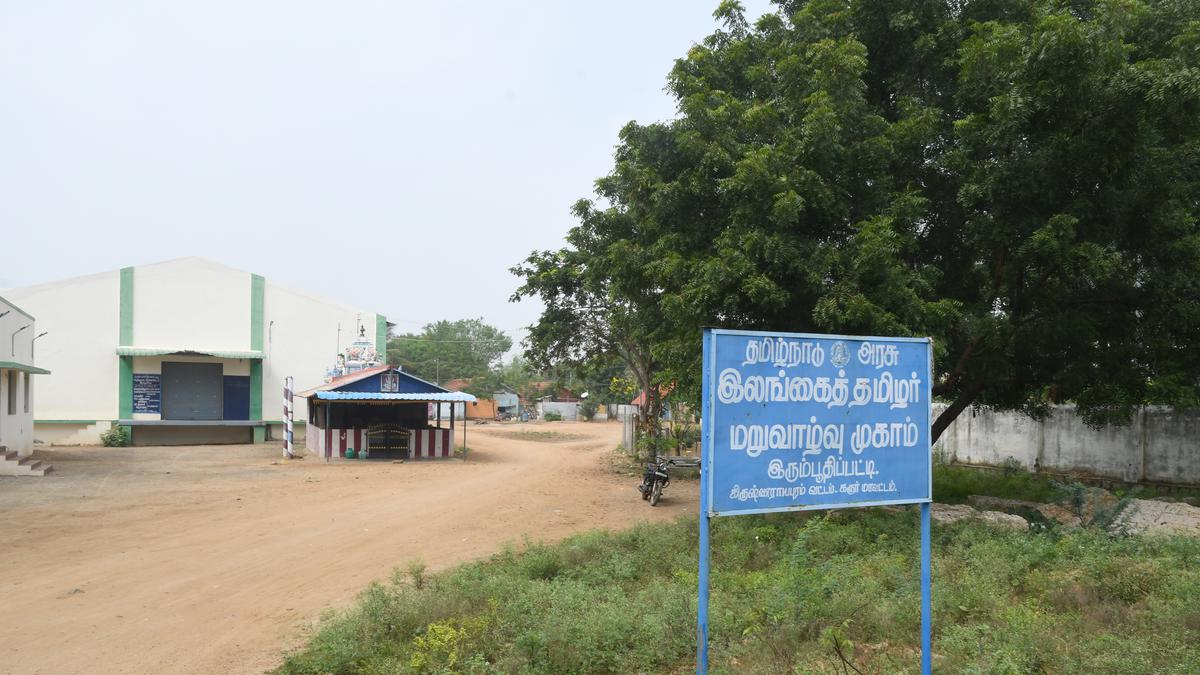
Madras High Court rejects plea to grant Indian citizenship to children born at Sri Lankan Tamil refugee camps
The Hindu
Madras High Court refuses to grant Indian citizenship to children born in Sri Lankan refugee camps in Tamil Nadu.
The Madras High Court on Thursday, March 14, 2024 refused to issue a general direction to the Centre to grant Indian citizenship to all children born at the special camps for Sri Lankan refugees in Tamil Nadu. The court disposed of a public interest litigation (PIL) petition which sought such a direction.
Chief Justice Sanjay V. Gangapurwala and Justice D. Bharatha Chakravarthy said, the PIL petition was bereft of details and that the authorities concerned would be able to consider the plea only when basic details such as the date and place of birth, parents’ citizenship and so on could be submitted.
V. Ravikumar, an advocate based in Chennai, had filed the PIL petition. He claimed to have made a representation to the National Human Rights Commission (NHRC) on September 17, 2022, for considering the issue of granting Indian citizenship to every baby born in the camps for Sri Lankan Tamil refugees.
After the NHRC took cognizance of the issue, the Union Home Ministry (citizenship wing) sent a detailed communication to the petitioner on December 14, 2022 explaining why citizenship by birth could not be claimed now, as a matter of right, by all those who were born at the refugee camps.
The Ministry stated that Indian citizenship was granted to Indian origin Tamils as per the terms of Sirimavo - Shastri Agreement of the year 1964 and the Sirimavo - Gandhi Agreement of the year 1974. Then, the issue was dealt with under Section 5(1)(b) of the Citizenship Act applicable to people of Indian origin.
However, the statutory time limit for making an application under the Sirima - Shastri pact of 1964 was fixed to be October 31, 1981 and the Indian Origin Tamils who had failed to apply before the cut-off date were not entitled to get Indian citizenship even under Section 5(1)(b).


Maharashtra's Ladki Bahin Yojana promises ₹1,500 monthly for women, but many face hurdles in accessing benefits.

CM Rekha Gupta highlights her government's achievements in one year, surpassing AAP's decade of work on legacy issues.

The Indian hockey team aims for redemption in Hobart against Spain and Australia in the FIH Pro League.

About 60,000 students from 350 colleges celebrate creativity at SRMIST's Milan cultural fest in Chennai.

Southern Railway submits draft MoU for MRTS takeover to Tamil Nadu government, awaiting Railway Board's approval for project advancement.

Delhi High Court grants bail to SUV driver accused of killing two, pending trial and conditions set by the magistrate.

Telangana govt prepared to meet challenges posed by rapid rise of AI: IT Minister

Allahabad High Court criticizes U.P. police's FIRs as exaggerated and script-like, granting interim protection to the accused.

HRD Minister Nara Lokesh envisions Amaravati's Central Library as a symbol of Andhra Pradesh's history and modern educational innovation.

PM Modi discusses bilateral cooperation in trade, technology, and AI with leaders from Mauritius, Sri Lanka, and Slovakia.

Congress plans Kisan Sammelans to address the negative impact of the India-U.S. trade deal on farmers' livelihoods.

Mysuru-based anti-corruption activist Snehamayi Krishna, the complainant in the MUDA case against Chief Minister Siddaramaiah and his family members, was questioned for almost all day by the Bengaluru City Police on Friday for allegedly using forged documents and audio to make false allegations.

Alexandra Kosteniuk discusses her chess journey, the game's evolution, and her motivations as a top player in her 40s.