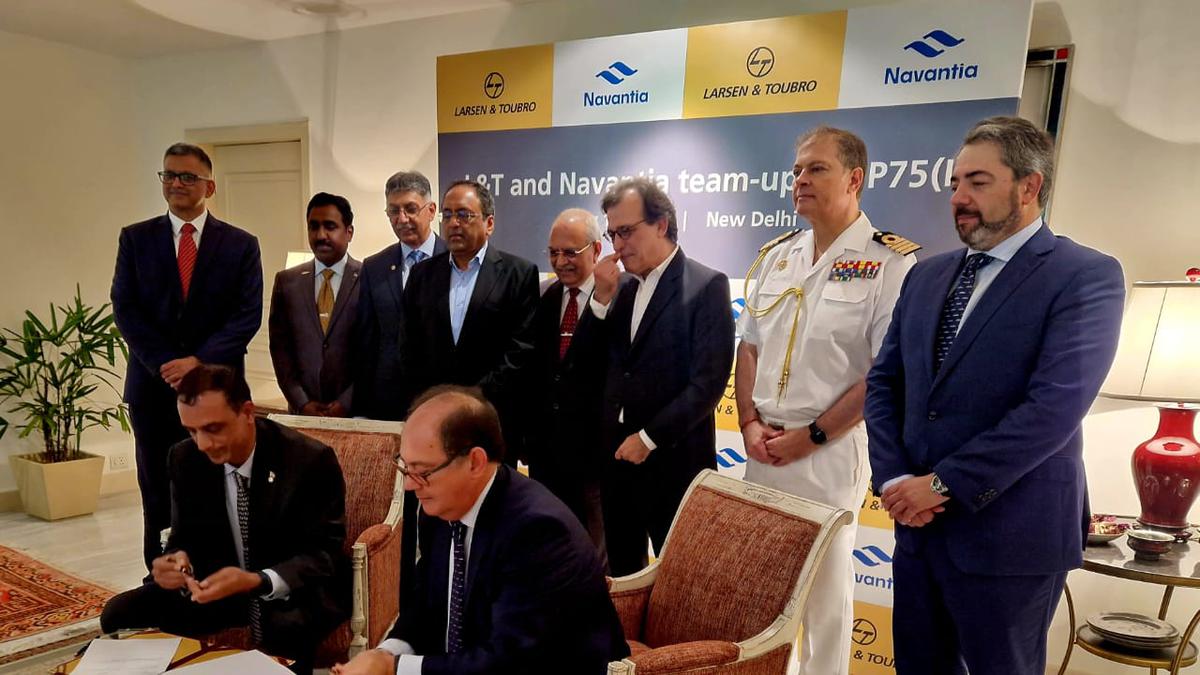
L&T, Nevantia join hands to bide for Indian Navy’s mega submarine acquisition programme
The Hindu
Larsen & Toubro and Spanish defence major Navantia on July 10 inked a ‘teaming agreement’ to jointly bid for the Indian Navy’s ₹43,000-crore contract for the procurement of six stealth submarines.
Larsen & Toubro and Spanish defence major Navantia on July 10 inked a 'teaming agreement' to jointly bid for the Indian Navy's ₹43,000-crore contract for the procurement of six stealth submarines.
The firming up of the pact came over a month after German defence major Thyssenkrupp Marine Systems (TKMS) and state-run Mazagon Dock Shipbuilders Ltd (MDL) signed a framework agreement to bid for one of the biggest defence acquisition projects under the 'Make in India' initiative.
"Larsen & Toubro and Navantia, Spain signed a Teaming Agreement (TA) today for the purpose of submission of a techno-commercial bid for the Indian Navy's prestigious P75 (India) submarine programme," the L&T said in a statement.
The pact was signed at a ceremony in Delhi in the presence of, L&T CEO and Managing Director S. N. Subrahmanyan, Naval Construction Vice President and Member of the Board of Navantia Augustin Alvarez Blanco and Spanish envoy Jose Maria Ridao Dominquez.
The Defence Ministry is in the process of procuring the six domestically built conventional submarines for the Indian Navy under the Project-75 (India) programme.
The construction of the submarines would take place in India and is expected to have significant local content.
The submarines will be built under the much-talked-about strategic partnership (SP) model that allows domestic defence manufacturers to join hands with leading foreign defence majors to produce high-end military platforms to reduce import dependence.


Erran Berger, the Vice President of Product Engineering at LinkedIn, thinks the former type of division of labour is rapidly disappearing

India mandates oil and gas firms to share import and export data to mitigate consumer shortages amid rising global prices.

HDFC Bank's chairman Atanu Chakraborty resigns over ethical concerns; Keki Mistry appointed interim chairman for three months.

Stock markets continue to rise for the third day as Sensex and Nifty gain nearly 1%, fueled by IT stocks.

Indian-flagged vessels in the Strait of Hormuz carry 2 lakh MT LNG and 16.7 lakh MT crude, amidst geopolitical tensions.

Equity analysts downgrade earnings forecasts for oil marketing companies, citing rising costs and market pressures for fiscal 2027.

Plastic product prices may surge by 50-60% in April due to rising polymer costs amid ongoing geopolitical tensions.

Centre offers 10% more LPG to States that accelerate piped gas rollout amid ongoing supply challenges and increased consumer demand.

Indian-flagged vessels in the Strait of Hormuz carry 2 lakh MT LNG and 16.7 lakh MT crude, amidst geopolitical tensions.

Stock markets continue to rise for the third day as Sensex and Nifty gain nearly 1%, fueled by IT stocks.

Rising oil prices and LPG shortages are driving India's shift to electric cooking, offering cost-effective and energy-efficient alternatives.

The rupee fell to a record low of 92.63 against the dollar, while equities surged with Sensex up 633.29 points.

Alibaba is sharpening its artificial intelligence strategy by focusing on agents that connect the many businesses under its sprawling corporate umbrella.