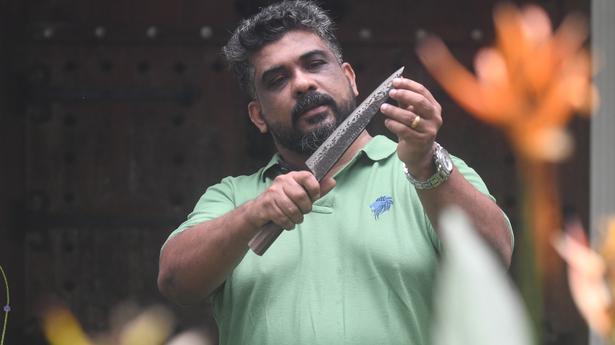
Kerala-based Jesudas Puthamana makes 13 kinds of personalised Japanese kitchen knives
The Hindu
Hankotsu, usuba, nakiri... Jesudas Puthumana of Chendamangalam, Kerala, makes 13 kinds of personalised Japanese kitchen knives
Nirvana 2019, the house Jesudas Puthmana built on Valiya Pazhampilly Thuruth — one of the tiny islands that dot the Periyar and make up Chendamangalam, Kochi — looks especially Marquezian on a rain-drenched day.
Fashioned in such a way that it seems like an extension of the scenery, it is a labour of love, and a passion project, for which he drew the plan, sourced the material, designed the floor tiles and even calculated the angle of the sun’s shade on the roof. He built a wood-fired masonry oven for its kitchen, where he bakes pizza, bread, cake and naan. Jesudas also makes artisanal Japanese kitchen knives under Urukk Blades.
He brings out five handmade knives, in different stages of completion, and lovingly explains each. For use in the kitchen and by chefs, the knives are personalised with the name stamped on one side of the blade and a unique serial number on the other. Japanese kitchen knives are varied, each with a different purpose, for example, usuba, a traditional knife used for vegetables and intricate cutting, hankotsu, a boning knife, nakiri, a vegetable cleaver for up and down chopping. Jesudas makes 13 types of knives, with a choice of four finishes and three types of wood handles.
Since March 2022, when he started, he has delivered 45 knives, to a clientele that includes chefs Thomas Zachariah of The Locavore, Hussain Shahzad of The Bombay Canteen, and Avin Thaliath, co-founder and director, Lavonne Academy of Baking Science and Pastry Arts.
“I want my knives to be used, and chefs who understand a good knife because it is their primary tool,” says the 44-year-old mechanical engineer. The Serbian meat cleaver among the Japanese kitchen knives proves he is up for a challenge. Next, he plans to make a bread knife for a Mumbai-based baker by adapting a serrated type of Japanese kitchen knife.
He forges, sharpens and polishes knives out of Ultra High Carbon (UHC) steel also known as tool steel for the same reason as he built his house and its wood-fired oven — “the feeling of making something from zero, to build something out of scratch.” Or, if he were to be ‘arrogant’, he jokes, “because I can!”
If he were to pinpoint what piqued his interest in swords/knives, he pegs it on a documentary on Japanese Katana swords. While working for a construction company in Dubai, with access to a workshop, he made a couple of knives on a whim.


76-year-old Kurian Jacob from Kerala triumphs with seven medals, including five golds, at the Open Masters Games in Abu Dhabi.

Can nations unite to protect the endangered Hudsonian godwit and address the challenges of climate change and habitat loss?

Discover the Minor Planet Centre, the key hub for tracking and verifying observations of small solar system bodies.

Discover the Minor Planet Centre, the key hub for tracking and verifying observations of small solar system bodies.

In this week's Science for All newsletter, XX explains

Test your knowledge with the quiz on Science films at the Oscars through history

Set between the Siwalik hills and the plains, Butwal offers travellers a mix of regional cuisine, pilgrimage trails to Lumbini and the comfort of Hyatt’s new hospitality landmark

Explore 2026's wallpaper trends in India, highlighting botanicals and handmade designs that enhance modern homes with nature-inspired aesthetics.

Mercedes-Benz CLA 250+ with EQ Technology review: design, performance, range and features explained. Discover how the new electric CLA combines advanced AI, long range, fast charging and futuristic styling for the next generation of luxury EVs.

AI tool for sparrow conservation

BTS’s comeback with ‘Arirang’ marks a major global music event. When does the album release, and where can you watch their concert live stream? We have all the details

The 2026 U.S. cholesterol guidelines urge starting screening and treatment at 30 to prevent cardiovascular disease effectively.

Olam Festival 2026 in Thiruvananthapuram returns March 27-29 with 120+ vendors, music, art, and cultural zones.