Is Russia winning the Ukraine war? | Explained
The Hindu
Ukraine scrambles for military aid as Russia maintains defensive lines in Eastern Ukraine.
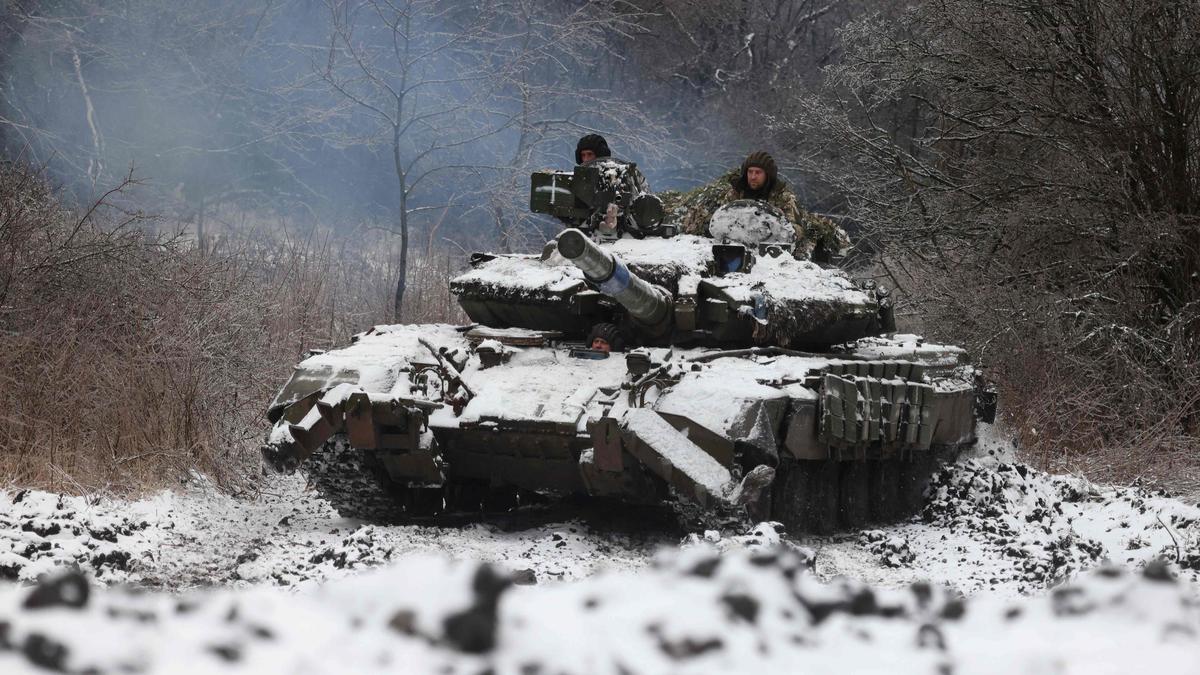
The story so far: It has been six months since Ukraine launched its much-anticipated counteroffensive with advanced weapons and training provided by the West. The Eastern European country, having failed to make any major breakthrough in the battlefield, is now scrambling for more military assistance. President Volodymyr Zelensky was in Washington earlier this week and is now touring European capitals to ensure that the aid keeps flowing in. Russia, on the other side, is keeping its defensive lines that cut across southern and eastern Ukraine more or less intact, and is on the offensive in parts, especially in Avdiivka in Donetsk. With hard winter approaching, Kyiv is looking for a new strategy to alter what Ukrainian Generals call a “stalemate” and recapture the territories lost to Russia (roughly 20% of Ukraine).
In June, Ukraine launched its counteroffensive at three points on the about 1,000-km long frontline — two axes in the south towards Melitopol and Berdyansk and the third in the east towards Bakhmut in Donetsk, which Ukrainian troops had lost in May. The main focus, however, was on the southern front where Ukrainian soldiers wanted to quickly cut through Russia’s formidable defence lines and link up with the Sea of Azov coast. This would have allowed Ukraine to cut off Russia’s land bridge between the mainland and the Crimean Peninsula, which Russia annexed in 2014. If the land bridge is gone, the only link between Crimea and the Russian mainland would be the Kerch Bridge across the Strait of Kerch, which was attacked twice by Ukrainians since the Russian invasion began in February 2022. In the east, the calculation was that Russia’s defence positions would be weak in Bakhmut where both sides suffered huge losses in the months-long battle.
Prior to the counteroffensive, Ukraine’s western allies had supplied them with advanced weaponry, including missile defence systems, armoured vehicles, medium and long range rockets, and main battle tanks, besides artillery shells and ammunition. The U.S. and other NATO members also trained nine Ukrainian brigades, roughly 36,000 soldiers, in the basics of manoeuvre warfare. In August, Ukrainian troops made small advances in the south. When they captured Robotyne in Zaporizhzhia, it was hailed as a breach of Russian defences. But Robotyne turned out to be a killing hamlet for Ukrainians. Some of the elite Ukrainian troops suffered heavy losses in Robotyne, while the West-supplied weapons, including Stryker armoured vehicles and German Leopard tanks, were burned by Russian fire. In the following weeks, Ukraine found it extremely difficult to break through Russia’s multi-layered defences, forget reaching the Sea of Azov. Ukrainian troops’ attempts to advance were stopped in the huge minefields, and even minesweepers came under fire from Russia’s attack helicopters. Russia’s electronic warfare capabilities blunted Ukrainian response, while lack of sufficient air power exposed Kyiv’s blitzkrieg strategy to counter attacks. Even after six months since the offensive’s launch, the frontline has hardly changed.
Russia, which was forced to retreat from Kharkiv and Kherson last year, seems to have taken an upper hand in the war ever since. After the initial Russian thrust into Ukraine met with strong resistance and the West swung back to help Ukrainian troops, President Vladimir Putin of Russia announced a partial mobilisation to draft and train some 3,00,000 troops. As the battle of Bakhmut, led by Wagner, lasted for months with tens of thousands of Ukrainian troops tied to the hopeless defence of the eastern city, Russia’s regular soldiers were busy building strong defence lines along the frontline. Ukraine was supposed to start the counteroffensive earlier (it was called the ‘spring offensive’), but Ukrainian Generals reportedly resisted the U.S. push to launch the attack, saying they weren’t ready yet. By the time the attack started, the Russians were in a strong defensive position, their traditional forte. Compared to Ukraine, whose economy and military have been reliant on supplies and aid from the West, Russia has reinvigorated its military industrial base, ramping up defence production. (If Russia manufactured 100 tanks a year before the war, now it is making 200 tanks, according to American officials).
Russia has also amassed drones (from Iran) and shells and ammunition (from North Korea) so that it can continue the war of attrition without any supply glitches. Western sanctions aimed at weakening Russia’s economy and thereby its war machine have produced mixed results. The sanctions have clearly hit the Russian economy and damaged Russia’s energy ties with Europe with long-term consequences. However, the West’s move to put a price cap on Russian crude to limit Moscow’s oil revenues has failed as Russia continues to find big markets. Russia has also seized the crisis to diversify its energy trade with China and India, two huge markets that are dependent on energy imports, emerging as the top buyers of Russian crude. Turkey, a NATO member, and Central Asian republics emerged as conduits for Russia’s sanctions-proof trade with Asian markets. Therefore, Russia appears to be stable as of now, both in the battlefield and in the sphere of economy.
As Ukraine’s counteroffensive faltered, the support it enjoyed in the West, especially in the U.S. came under growing pressure. Last month there were reports in the American media that the U.S. and the EU are now encouraging Kyiv to start talks with the Russians. Last week, Republicans blocked an emergency spending Bill in the U.S. Congress that would provide $50 billion in security assistance to Ukraine, which was an indication that the pro-Ukraine alliance at Capitol is fraying. The White House has said in unmistakable terms that Ukraine could lose the war if U.S. aid dries up. Opinion polls in recent months have repeatedly shown that U.S. public support for Ukraine is declining. Half of Republican voters now believe that the U.S. is providing “too much aid” to Ukraine.
While Zelensky was visiting Washington, President Joe Biden said the U.S. would support Ukraine “as long as it can”, markedly different from his earlier rhetoric that the U.S. would support Ukraine “as long as it takes”. This puts Kyiv in a spot. The White House has signalled that it would make compromises with the Republicans on border policy (to crack down on immigrants) to pass the spending Bill. But even if this Bill passes, how long can Kyiv stay fully reliant on Western aid if it doesn’t make any major battlefield breakthrough? There is also a growing uncertainty in the U.S. as the country goes to presidential elections next year. Donald Trump, Mr. Biden’s main rival, has vowed to bring the Ukraine war to an end within days of assuming power. This should set alarm bells ringing in Kyiv if they have a long plan in their conflict with Russia.


Shorts News:Watch: Cuba right now in ‘very bad shape’: Trump

As political loyalties shift, Vice President Vance navigates the turbulent MAGA landscape amidst Trump's new war strategy.

Oil prices drop over $2 as Iraq and Kurdish authorities finalize an export deal, easing supply concerns amid ongoing conflict.

Marco Rubio denies U.S. efforts to oust Cuba's President, calling a New York Times article "fake" and misleading.

Shooting at Holloman Air Force Base in New Mexico leaves one dead and another wounded; lockdown lifted, base declared safe.

The U.S. offers undocumented migrants $2,600 and free flights to voluntarily self-deport through a new DHS program.

Israeli strikes in central Beirut reportedly kill six, escalating tensions amid ongoing conflict with Hezbollah and regional instability.

Few people realise that the ocean floor beneath the Persian Gulf and Red Sea is crisscrossed with thousands of kilometres of fibre-optic cable.

Ali Larijani, Iran's influential politician, played a key role in both security policy and the violent suppression of protests.

Shooting at a Georgia VA clinic leaves one employee hospitalized and the gunman dead, prompting investigations by authorities.

UNICEF reports 100,000 flee South Sudan's Akobo due to escalating conflict, worsening conditions for displaced populations in Ethiopia.

Cuba restores electricity to two-thirds of the country after a nationwide blackout amid ongoing economic challenges and U.S. sanctions.

U.S. President Donald Trump declares the U.S. no longer needs ally support in Iran conflict amid rising tensions and global energy concerns.