Is academic freedom a made-up concept?
The Hindu
Academic freedom's complexities and importance in shaping society are explored through history, politics, and education in various contexts.
In Satyajit Ray’s 1980 satirical fantasy film Hirak Rajar Deshe, literally “in the kingdom of the Diamond King”, the education minister of the king dictates what should be taught in school. Finally, the minister closes the school. Is the story a true reflection of the contemporary world, to some extent?
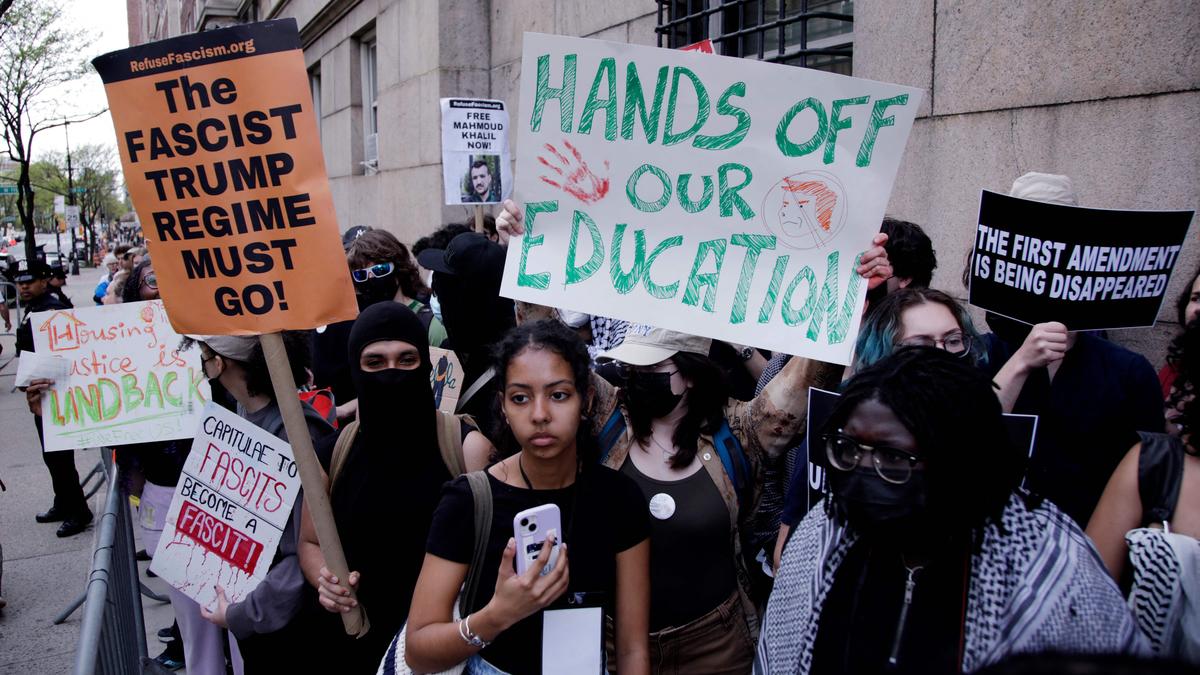
The nature of education and how it shapes society can be examined in a variety of contexts, from the fictional kingdom of the Diamond King to real-life Donald Trump’s America. Given that Columbia, an Ivy League university, surrendered its academic freedom, and Harvard, the oldest and richest American university, has chosen to legally defend it, one would wonder what academic freedom is and what its scopes and limitations are.
When then President Pranab Mukherjee spoke at the “International Buddhist Conference” in Nalanda in 2017, he invoked Nalanda and Taxila, the ancient universities, to pitch for an atmosphere free from prejudice, anger, violence, and doctrines. “It must be conducive to free flow intellectual persuasions,” he stated.
However, it’s not so easy, always. Scholars who disagreed with church theology or behaved in ways the church deemed unacceptable risked persecution in medieval Europe. Then, philosopher Wilhelm von Humboldt created a new university in Berlin in the early 19th century. The fundamental principles of academic freedom – freedom of scientific inquiry and the unification of research and teaching – were institutionalised in and diffused to other countries by the Humboldtian model of higher education. Today’s seemingly made-up concept of academic freedom can be summed up as follows: students have the right to learn in an academic environment free from outside interference, and teachers have the right to instruct. The right of teachers to engage in social and political critique is another definition, though. In a 2022 paper published in the Houston Law Review, Yale Law School professor Keith E. Whittington stated that universities committed to truth-seeking and the advancement and dissemination of human knowledge essentially require “robust protections for academic freedom for scholars and instructors.”
At the UNESCO-organised International Conference in Nice in 1950, the Universities of the World pledged for “the right to pursue knowledge for its own sake and to follow wherever the search for truth may lead.” Academic freedom was then defined as “the freedom to conduct research, teach, speak, and publish, subject to the norms and standards of scholarly inquiry, without interference or penalty, wherever the search for truth and understanding may lead” at the first annual Global Colloquium of University Presidents held at Columbia University in 2005. But is defining and accomplishing academic freedom really that straightforward?
Tenure, promotions, pay hikes, research funding, and academic honours are all intimately correlated with research publications in the current academic environment. Thus, today’s scholars are driven by the peer pressure of publishing. And the interest of funding agencies has a significant impact on academicians’ research. Nowadays, universities are also concerned with their international rankings, which are largely based on research papers.
How serious is today’s “publish or perish” culture? Quite a bit, indeed. One significant exception was 2013 Nobel laureate British physicist Peter Higgs, well known for the Higgs Boson. Higgs never published aggressively. He stated that he became “an embarrassment to the department when they did research assessment exercises” and that he would have most likely been fired from his job at the University of Edinburgh if he had not been nominated for the Nobel Prize in 1980. However, he thought that because he would not be deemed “productive” enough in today’s academic system, no university would hire him. Thus, today’s academic system doesn’t even permit a future Nobel winner to peacefully conduct his own research without regularly generating research papers.


Russia claims control of Potapivka village in Ukraine's Sumy region amid ongoing military efforts to establish a buffer zone.

Iranian missile strikes on Israeli towns cause widespread damage and injuries, marking a significant escalation in the ongoing conflict.

As Gor makes first trip as U.S. Special envoy to South Asia, Delhi watches strategic signals closely
Sergio Gor's inaugural trip as U.S. Special Envoy to South Asia signals strategic U.S. engagement amid regional tensions.

Slovenians vote in a tight election between liberal and populist candidates, impacting the country's future domestic and foreign policies.

Netanyahu asserts U.S.-Israel alliance fights Iranian threats, emphasizing global security after missile strikes on Israeli and European targets.

Israeli settlers attack Palestinian villages in the West Bank, causing injuries and destruction amid ongoing settlement expansion.

Britain asserts no evidence of Iran planning missile strikes on Europe, despite Israeli claims of missile capabilities.

UNESCO reports over half of countries have banned phones in schools due to concerns about attention, cyberbullying, and social media impact.

Analysis reveals a U.S.-operated Patriot missile likely caused a pre-dawn explosion in Bahrain, injuring numerous civilians.

Sri Lanka raises fuel prices by 25% amid ongoing West Asia conflict, impacting petrol and diesel costs significantly.

Iran strikes near Israeli nuclear research center as Trump threatens attacks on Iranian power plants
Iran's missile strikes near Israel's nuclear site escalate tensions as Trump threatens retaliation against Iranian power plants.

Saudi Arabia intercepts one of three ballistic missiles targeting Riyadh amid ongoing regional tensions and threats from Iran.

Iran's death toll exceeds 1,500 amid escalating war, with heavy airstrikes and shifting U.S. and Israel strategies reported.