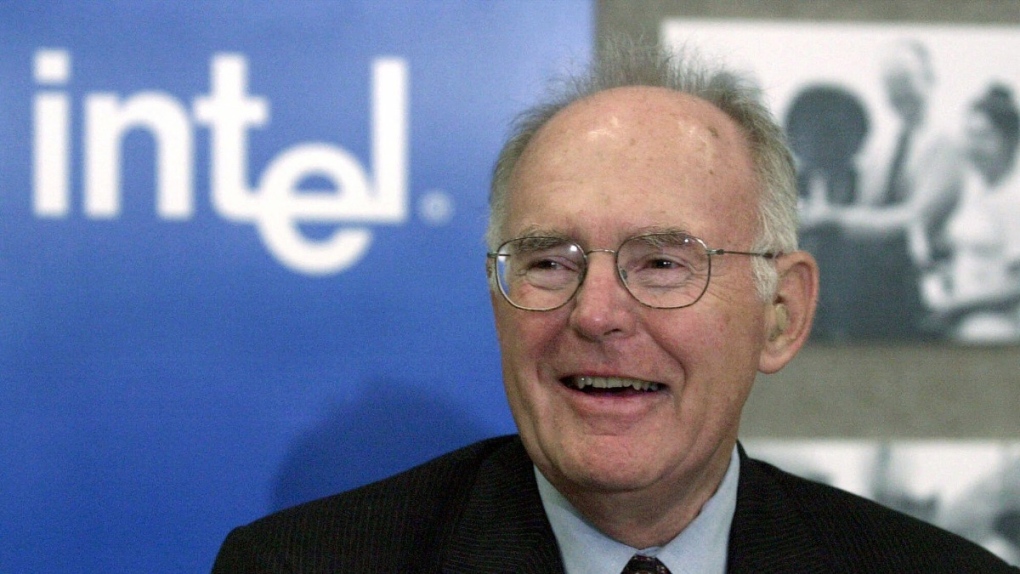
Intel co-founder, philanthropist Gordon Moore dies at 94
CTV
Gordon Moore, the Intel Corp. co-founder who set the breakneck pace of progress in the digital age with a simple 1965 prediction of how quickly engineers would boost the capacity of computer chips, has died. He was 94.
Gordon Moore, the Intel Corp. co-founder who set the breakneck pace of progress in the digital age with a simple 1965 prediction of how quickly engineers would boost the capacity of computer chips, has died. He was 94.
Moore died Friday at his home in Hawaii, according to Intel and the Gordon and Betty Moore Foundation.
Moore, who held a Ph.D. in chemistry and physics, made his famous observation -- now known as "Moore's Law" -- three years before he helped start Intel in 1968. It appeared among a number of articles about the future written for the now-defunct Electronics magazine by experts in various fields.
The prediction, which Moore said he plotted out on graph paper based on what had been happening with chips at the time, said the capacity and complexity of integrated circuits would double every year.
Strictly speaking, Moore's observation referred to the doubling of transistors on a semiconductor. But over the years, it has been applied to hard drives, computer monitors and other electronic devices, holding that roughly every 18 months a new generation of products makes their predecessors obsolete.
It became a standard for the tech industry's progress and innovation.
"It's the human spirit. It's what made Silicon Valley," Carver Mead, a retired California Institute of Technology computer scientist who coined the term "Moore's Law" in the early 1970s, said in 2005. "It's the real thing."


This year’s hard winter weather likely left significant damage for many homeowners coming into spring. Building and renovation expert Ryan Thompson spoke to CTV’s Your Morning about some of the biggest areas to focus on around the exterior of your home, to help prevent serious damage after the cold, hard winter.

Iranians are managing to get online during the current war with the U.S. and Israel despite drastic censorship and frequent blackouts, throwing the spotlight on to providers of tools such as VPNs (virtual private networks).

March is Nutrition Month, and two Ottawa dietitians joined "CTV Your Morning Ottawa" to mark the occasion and share three sample performance plates for three different levels of activity.

Dozens of models with Down syndrome strutted down a catwalk at a fashion show in Romania’s capital for an evening celebrating style, “atypical beauty” and courage to mark World Down Syndrome Day.

Hawaii suffered its worst flooding in more than 20 years as heavy rains fell on soil already saturated by downpours from a winter storm a week ago, officials said Friday while warning that still more rain was expected during the weekend.

While Canada is well known for its accomplishments in space — including building the robotic arms used on the Space Shuttle and the International Space Station — the country still has no ability to launch its own satellites. This week, Ottawa committed nearly a quarter‑billion dollars towards changing that.

March is Liver Health Month, and while many people think about alcohol and diet when it comes to liver health, a growing risk factor is chronic hepatitis B.

It’s an enduring stereotype that Canadians are unfailingly nice, quick to apologize even when they have done nothing wrong. But an online urban legend claims the opposite of Canada’s soldiers, painting a picture of troops so brazen in their brutality that international laws were rewritten to rein them in.

Friday marks the first official day of spring in the northern hemisphere, but it will still feel like winter this weekend for many Canadians, as snow, sleet, rain and sub-zero temperatures are forecast across the country.

A social media post from the U.S. Food and Drug Administration this week shows a big-eyed macaque staring out from behind bars.

Young people in southeast England and beyond are lining up for the meningitis B vaccine after an outbreak killed two people, sparking supply warnings from pharmacies and raising broader questions about the best public health response to the disease.

Many wage earners are engaging in “microshifting,” a flexible scheduling approach that involves tackling job duties in short, productive bursts instead of a single nine-to-five stretch.

Tyson Atleo, a hereditary leader of the Ahousaht First Nation, says the creation of three new forestry areas to be managed by his community and two others on the west coast of Vancouver Island marks the realization of a long-standing promise.