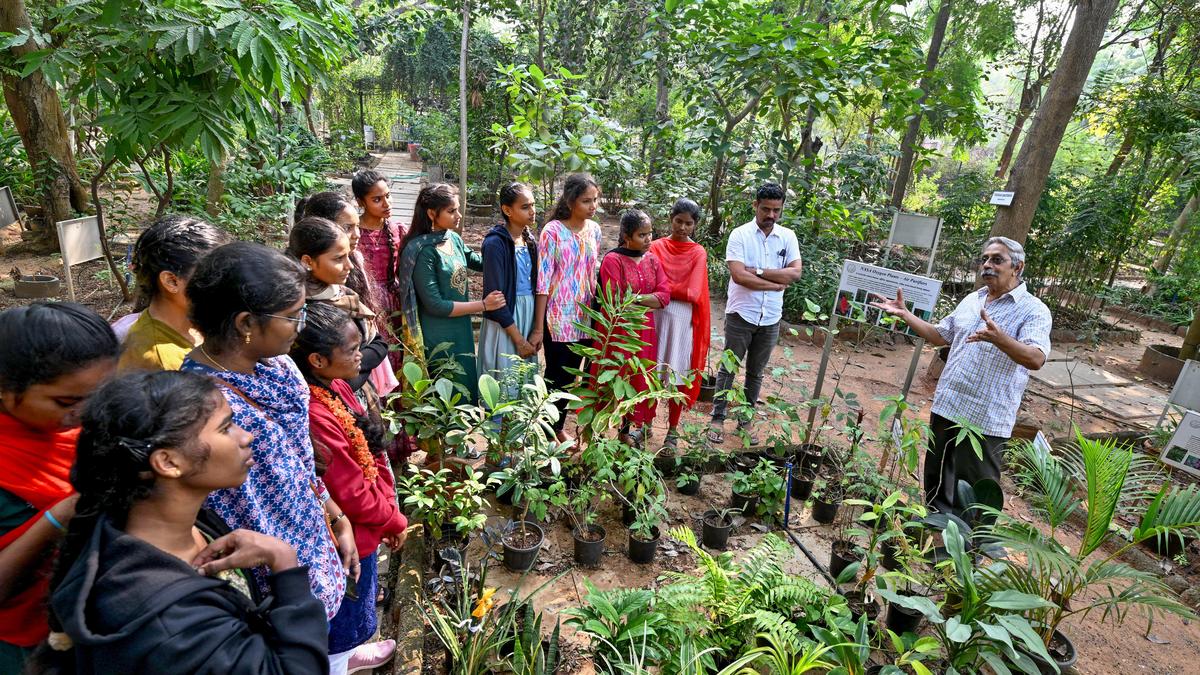
Inside Visakhapatnam’s 25-year-old Biodiversity Park
The Hindu
Visakhapatnam Biodiversity Park marks 25 years of conservation
The first time I saw a small spider brush against a leaf and disappear into the toothed rim of a pitcher plant, it felt as though an unfamiliar chapter of Nature had quietly opened. Earlier, another plant had drawn my attention for an equally gentle response. A leaf folded inward the moment it was touched. Nearby, a lantern-red flower swayed and rotated in the breeze, almost as though guided by an unseen rhythm.
These moments did not unfold in a distant wilderness. They occurred on a regular morning within the Biodiversity Park located inside the campus of Rani Chandramani Devi Government Hospital at Peda Waltair in Visakhapatnam.
A bee feeds on a passion flower (Passiflora vitifolia) in full bloom at the Biodiversity Park, located on the premises of RCD Hospital, in Visakhapatnam. | Photo Credit: KR Deepak
The park, maintained by the Dolphin Nature Conservation Society (DNCS) with support from the Visakhapatnam Metropolitan Region Development Authority (VMRDA), shelters nearly 2,500 plant species. As the green space marked its silver jubilee this week, the milestone reflected the quiet persistence of a botanical refuge that has taken root in the city’s collective memory.
Spread across several thematic sections, the garden brings together desert and cactus collections, orchids, rare and endemic medicinal plants, succulents and a greenhouse with delicate specimens. Among its most striking residents is Ginkgo biloba, a relic from the Mesozoic era that has survived millennia of environmental shifts. Each pathway reveals an assortment of forms and textures that introduce visitors to the varied strategies through which plant life adapts and survives.
Mantha Rama Murty and his wife Mangathayi Mantha, founders of the Biodiversity Park in Visakhapatnam. | Photo Credit: K R Deepak


Hyderabad's Children's Parliament demands zero-eviction policy, cleaner air, and safer spaces for children's welfare and community integration.

Kerala CM urges PM Modi to intervene in addressing travel issues and high ticket prices for stranded Keralite expatriates amid the Iran conflict.

Justice S.A. Dharmadhikari sworn in as the 55th Chief Justice of Madras High Court in a formal ceremony.

TMC criticizes the Modi government for reshuffling governors, alleging Raj Bhavans have turned into BJP war rooms undermining federalism.

Tragic IAF jet crash claims Flight Lieutenant Purvesh Duragkar, remembered fondly by his father and family just days later.

President Murmu will visit Darjeeling on March 7 to attend the 9th International Santal Conference, following a rescheduled itinerary.

Karnataka's 2026 Budget mentions the Navali Balancing Reservoir proposal, but tangible progress remains elusive.

Water supply disruption in parts of Hyderabad for 36 hours due to essential repair works

Minister V. Sivankutty requests an RDO report on Thiruvananthapuram Corporation's post-Pongala clean-up delays amid public concerns.

A short story on women's empowerment and sports by Rachna Chhabria

Tamil Nadu government doctors end their fast after Rajiv Gandhi Government General Hospital dean denies protest permission, sparking strong condemnation from their federation.

Visakhapatnam Biodiversity Park marks 25 years of conservation

First rock blast for Kerala's Anakkampoyil-Kalladi-Meppadi tunnel road project successfully completed under safety measures, inaugurated by Chief Minister Vijayan.