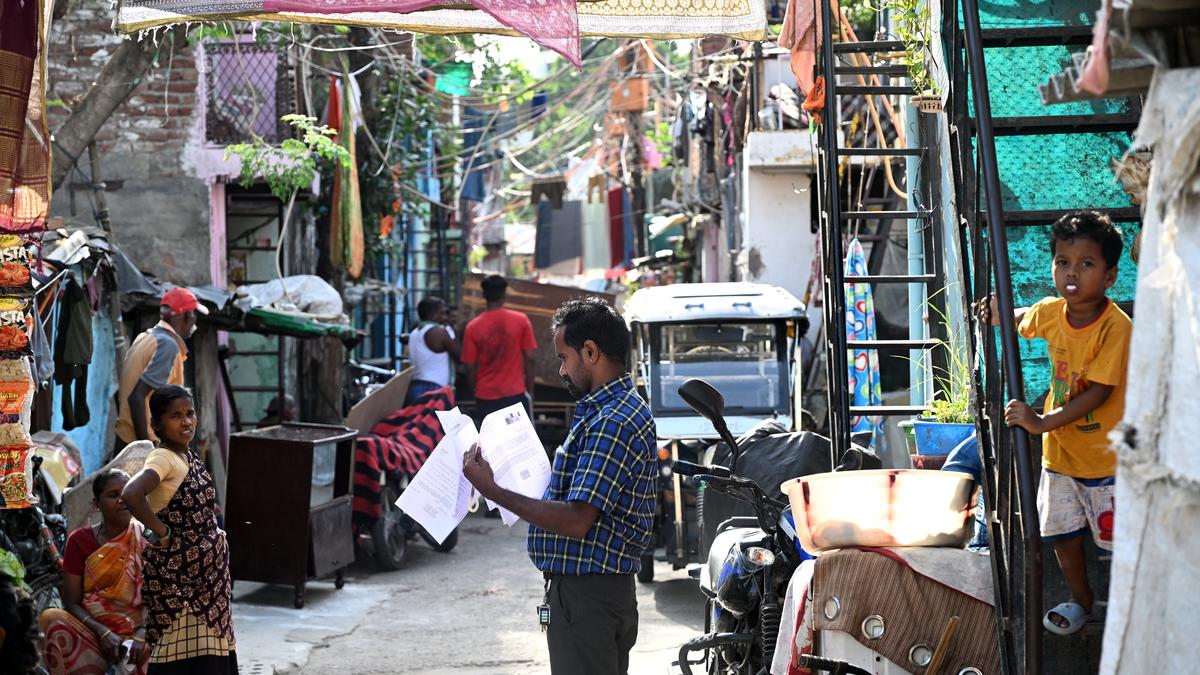
Inside Delhi’s Madrasi Camp, the fear of a community disintegration
The Hindu
Madrasi Camp residents face eviction for Barapullah drain restoration, sparking political drama and community upheaval in Delhi.
Each home in Delhi’s Madrasi Camp sports a drishti bommai (a black mask with exaggerated features such as bulging eyes and red lips). Invariably, at the entryway to each single-room home are two lemons covered in red powder to keep the ‘evil eye’ away.
But Yennu Malai, a 50-year-old resident of the camp, laments that ‘bad luck’ has fallen upon everyone over the past year. The camp, which was established between 1968 and 1970 in the shadow of the Barapullah drain, will be demolished for the upcoming restoration and cleaning project of the 16-kilometre nallah, a Mughal structure dating back about 400 years.
Sitting cross-legged on a cement slab in front of his home, Malai, a vegetable seller, looks over his shoulder at the soon-to-be demolished Madrasi Camp in south Delhi’s Jangpura-B, near the Hazrat Nizamuddin railway station. He has called the locality home his entire life.
Malai, talking to his brother-in-law and sister, questions the government’s logic, angry, but also chuckling at the irony: “My ration, voter, and Aadhaar cards say Madrasi Camp, and suddenly, they want us to pick up everything and leave. How is this justice?” Malai is referring to the May 9 Delhi High Court order to demolish Madrasi Camp starting June 1. The HC has also directed government departments to ensure proper rehabilitation of the eligible residents of the unauthorised colony.
Madrasi Camp has 370 shanties, and families living in 189 of them have been found eligible for rehabilitation under the Delhi Slum and Jhuggi Jhopri Rehabilitation and Relocation Policy, 2015. They will be given housing in Narela, about 40 km from their current location.
The public toilet in Madrasi Camp is barely functional, and residents relieve themselves on the train tracks, a minute’s walk away. The odour of the sewage from the drain on one side and garbage-collection facility on the other, is overpowering, but residents say that over the decades they have built a community here, based on a common culture.
During the rainy season in 2024, a public interest litigation was filed in the HC on the flooding in parts of Nizamuddin East and Jangpura. The court had ordered agencies such as Delhi Development Authority (DDA), Archaeological Survey of India (ASI, which maintains the Barapullah), Municipal Corporation of Delhi (MCD), and Public Works Department (PWD) to clean up the oversaturated drain.


Four Assam police commandos injured in an extremist attack during a gunfight in Tinsukia district, officials report.

Campaigning intensifies in Ernakulam district as candidates engage voters ahead of the crucial Assembly polls.

Lord Rama rides Hanumantha Vahanam on sixth day of Brahmotsavams in Tirupati

Nagapattinam faces underdevelopment and resource challenges, impacting its rich heritage and the livelihoods of its fishing community.

Governor Arlekar emphasizes that justice must embody human values, fairness, and accessibility for all citizens at VIT conference.

Motorists on Valparai Road are warned of increased wild animal activity this summer, particularly elephants seeking water.

In a surprising turn of events, Urvashi theatre, one of Bengaluru’s iconic single screens, has re-opened, with the much-talked-about Dhurandhar: The Revenge running to a full house in the theatre. After the expiry of the 45-year lease, it seemed like curtains would come down on the king-size theatre but for now, it’s good news for fans.

First tranche of Rythu Bharosa released by CM Revanth

Collectors in Kanniyakumari and Thoothukudi inspect polling stations to ensure election preparedness ahead of Tamil Nadu's assembly elections.

The Vice-Chancellor of Rajiv Gandhi University of Health Sciences (RGUHS) B. C. Bhagavan said on Sunday that the university will soon open a research centre on Yoga and Naturopathy on 60-acre land in Bengaluru.

Parliamentary committee urges swift action to fully operationalise Lokpal's inquiry and prosecution wings amid rising corruption complaints.

Hyderabad paediatrician Dr. Sivaranjani Santosh faces legal action from pharma firms over her remarks on ORS labelling reforms.

Palla urges NDA leaders to unite for grassroots outreach, enhancing public trust through balanced welfare and development initiatives.