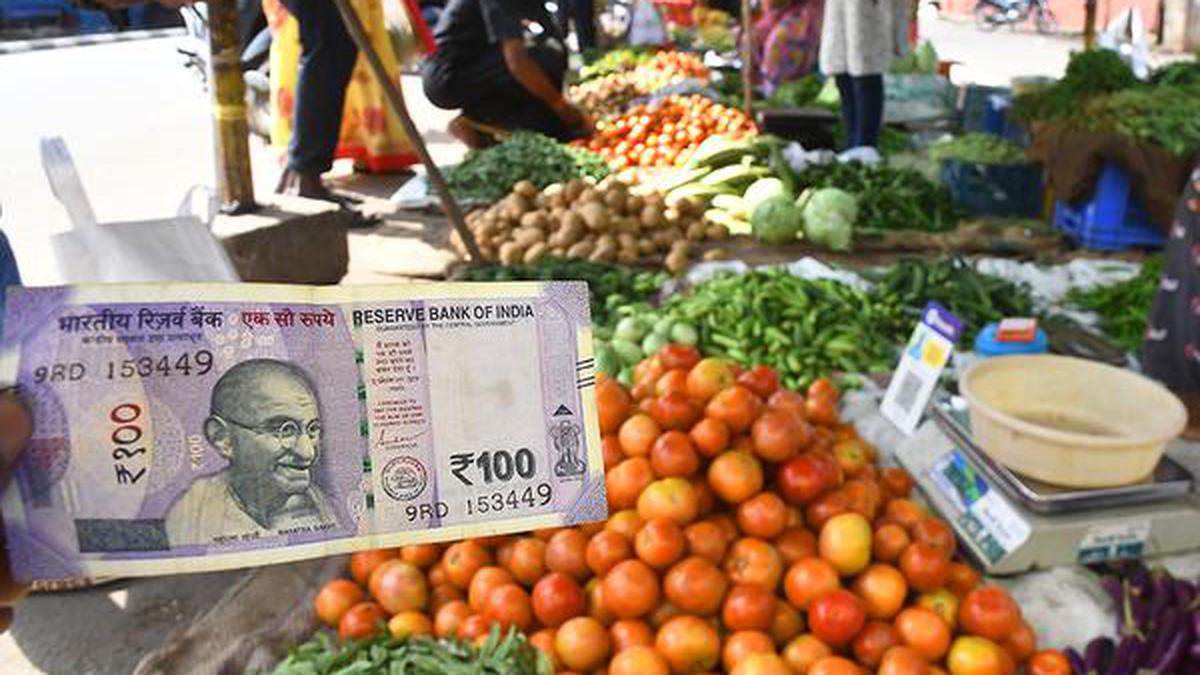
India’s retail inflation drops to 5.66% in March
The Hindu
For the first time in three months, India’s retail inflation slid below the 6% mark to 5.66% in March 2023.
For the first time in three months, India’s retail inflation slid below the 6% mark to 5.66% in March 2023, aided by base effects as the same month had recorded almost 7% price rise last year.
The inflation figure in March is within the RBI’s comfort zone as it is below 6%.
Food price inflation, which was 7.7% in March 2022 and 6% in February this year, eased to 4.8% last month, as per data from the National Statistical Office. On a month-on-month basis, however, inflation measured by the Consumer Price Index (CPI) inched up by 0.23% while the Consumer Food Price Index was up 0.3%.
India’s industrial output grew 5.6% this February, marginally higher than the 5.45% in January, with manufacturing output picking up pace to rise 5.3% even as electricity generation grew less than 10% for the first time in four months at 8.7%.
Consumer durables production contracted for the third month in a row, to drop 4% in February. The favourable base from February 2022 when durables’ output fell 10%, didn’t help much, and their production levels were also 0.4% below this January’s output.
On the other hand, consumer non-durables saw a 12.1% surge in output this February compared to a nearly 7% decline in the same month of 2022. However, February marked the second month of a sequential decline in output with production 6% below January levels.
Reserve Bank of India has projected the CPI inflation at 5.2% for FY2023-24, with 5.1% in Q1, 5.4% in Q2, 5.4% in Q3, and 5.2% in Q4, and risks evenly balanced.


OpenAI has signed a new deal to sell access to its AI models to U.S. defence and government agencies through Amazon’s cloud unit for classified and unclassified work, the ChatGPT maker said

Samsung Electronics said on Wednesday that it expects to start volume production of Tesla’s chips

The Trump administration said in a Tuesday court filing that the Pentagon’s blacklisting of Anthropic was justified and lawful

Mastercard Move aims to simplify cross-border payments for SMEs and students in India, enhancing efficiency and reducing costs.

SBI raises ₹6,051 crore through 10-year bonds, attracting strong investor demand with a 7.05% coupon rate.

In February, as per government data, domestic LPG production was slightly more than 1 million tonne.

Union Government urges States and UTs to expedite approval of gas pipeline projects to promote piped natural gas usage.

Parliamentary panel criticizes Ministry of Planning and Niti Aayog for persistent underutilization and poor financial management practices.

LPG consumption in India dropped 17.7% in March due to war-related supply disruptions, impacting household cooking gas availability.

LPG eKYC is required only for unauthenticated customers, clarifies the Ministry of Petroleum and Natural Gas.

India's second LPG carrier, 'Nanda Devi', arrives at Gujarat's Vadinar port, carrying 46,500 metric tonnes of gas.

European publishers, tech firms and startups have urged EU antitrust regulators to wrap up a near two-year probe into Alphabet unit Google’s alleged favouring of its own services in online searches and impose a fine on the tech giant.

OpenAI is in advanced talks with private equity firms including TPG, Advent International, Bain Capital and Brookfield Asset Management to form a joint venture