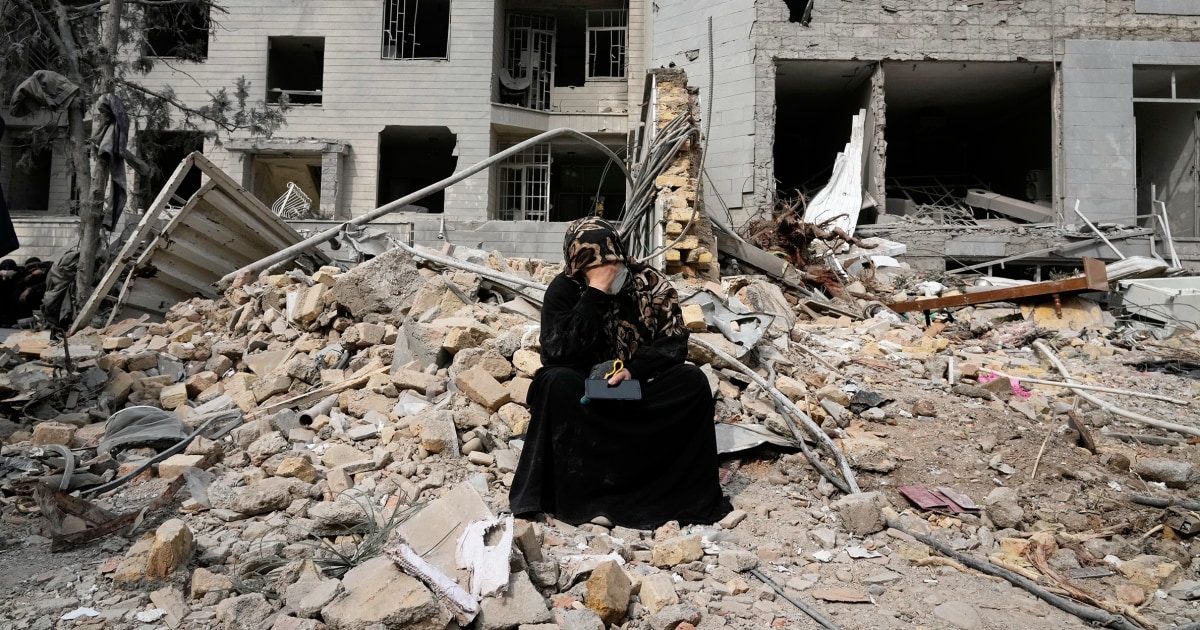
In Tehran, hope for change turns to panic: 'They are turning the country into ruins'
NBC News
Hoda was so furious over Iran’s violent crackdown on protesters in January that she wanted the country’s security forces to be attacked as payback.
Hoda was so furious over Iran’s violent crackdown on protesters in January that she wanted the country’s security forces to be attacked as payback. Then the bombs began to batter areas near her Tehran home.
“I was always against these people and thought it would be limited and finished fast,” she said of the U.S. and Israeli attacks. “I regret that and take it back. They are turning the country into ruins.”
Hoda, 40, like others interviewed for this article, asked that only her first name be used out of fear of arrest or harassment from security forces.
Since the war started, the U.S. and Israeli military have targeted multiple locations across the country, but it is in Tehran, a bustling, densely packed metropolis of 10 million people, where the strikes have been felt the most. As of Thursday, more than 1,200 people had been killed by Israeli and American strikes, according to the Iranian Red Crescent Society.
In addition to substantial damage to historical cultural sites in Tehran, like the ornate Golestan Palace, the targeting of oil facilities has added a surreal element to life in the capital, residents say, with thick smoke in the air and black rain coming down that has left a slimy residue on cars. Many people stay off the streets, where being stuck in two to three-hour traffic jams to cross the city was the norm before the war started.


The International Energy Agency siad member countries had unanimously agreed to release 400 million barrels of oil from their reserves

Follow live NBC News coverage and latest updates on the Iran war, as the U.S. and Israel launch strikes and Tehran aunches its 'most intense strikes' to date.

Follow live NBC News coverage and latest updates as the Iran war hits oil prices, Iran vows to block the Strait of Hormuz and Israel strikes Tehran and Lebanon.

Thick black smoke billowed into the sky, making day seem more like night.

Mojtaba Khamenei has been named as Iran’s new supreme leader just over a week after his father, Supreme Leader Ayatollah Ali Khamenei, was killed in U.S.-Israeli strikes

A statue of the Nubian god Apademak stands alone in the courtyard of Sudan’s National Museum, one of the few survivors of systematic looting amid a conflict that has developed into one of the world’s worst humanitarian crises

For President Donald Trump, global power may boil down to the United States and China — what he calls the “G2,” or Group of Two.

The mix of joy and anxiety among the Iranian diaspora in recent days reflects the complicated emotions many feel as violence escalates in the Middle East.

Russia launched a barrage of drones and missiles at Ukraine overnight on Saturday, damaging infrastructure and killing at least seven people, including two children, in the northeast city of Kharkiv, Ukrainian officials said

Russia is providing intelligence to Iran on the location of U.S. forces in the Middle East, a boost for the Tehran regime as it launches missile and drone attacks on American bases and other targets in the region, according to four sources with knowledge of the matter.

Follow live updates and the latest news coverage as the U.S. and Israel strike Iran, Tehran hits back across the Gulf and Americans are stranded in the Middle East.

Since the U.S. and Israel launched attacks across Iran last weekend, the Islamic Republic has retaliated by firing missiles and drones across the region, striking Bahrain, Qatar, the United Arab Emirates and other countries.

Iranian Foreign Minister Abbas Araghchi said Thursday that his country is ready for a ground invasion by American troops as the war launched by the United States and Israel has quickly spread across the region.