In Russia, a 'sham tribunal' investigates what it says are Ukraine's war crimes
CBC
Standing in a war-ravaged suburb outside Kyiv last April, a prosecutor for the International Criminal Court proclaimed: "Ukraine is a crime scene."
In the months since, more than three dozen investigators on the ground and a team of lawyers in The Hague have been working to uncover evidence of possible war crimes committed as part of Russia's brutal invasion of its neighbour.
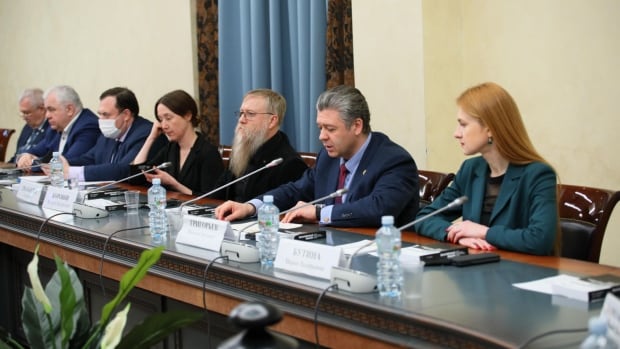
Meanwhile, in a pale yellow conference room in central Moscow around that same time, a very different inquiry was beginning: the International Public Tribunal on Ukraine.
It is the project of Maxim Grigoriev, a member of the quasi-governmental Civic Chamber of the Russian Federation. Its stated goal is to "collect data and prove the commission of war crimes by the Kyiv regime, discrimination against its own citizens, and persecution on linguistic, national and ideological grounds."
The tribunal has held a series of hearings and news conferences since April, with Grigoriev producing and releasing videos of his tours throughout occupied Ukraine.
Opening the tribunal, Grigoriev blasted the Ukrainian government as responsible for "murders and repression," a "huge wave of neo-Nazism," and the "persecution of the Orthodox Church." But, he said, the ICC "simply refuse[d] to accept" all this supposed evidence — which propelled him to hold his own hearings.
Seated alongside Grigoriev at the chamber's horseshoe-shaped conference table was Russia's secret weapon in their effort to bill themselves as the victim: Westerners.
Grigoriev had invited Americans, Canadians and Europeans living in Russia to present their own evidence of Ukraine's alleged crimes, boasting that more than 20 countries were represented at the tribunal.
Since April, the tribunal has pumped out video in English and Russian to domestic social media sites, like VK and Rutube, and to YouTube — collectively racking up millions of views.
But experts say the tribunal is Moscow's way of combating and discrediting legitimate efforts to hold soldiers, generals and politicians to account for very real atrocities taking place in Ukraine.
And given that many of Grigoriev's so-called star witnesses have a history of spreading disinformation, there is concern that, as the war drags on, the tribunal could be a powerful propaganda tool for Russia.
"It is pretty crucial to understand that the Russian domestic audience does really matter here," said Tim Squirrell, head of editorial and communications at the Institute for Strategic Dialogue, a think-tank that studies Russian disinformation.
"One of the reasons that you'll bring in foreign influencers to testify — in front of what is, effectively, a sham tribunal — is to try to show the Russian people, the domestic audience, that other people are also on their side."
Since the start of Russia's invasion, investigators — both professional and amateur — have documented evidence of war crimes in Ukraine.


U.S. President Donald Trump is urging other countries to help secure the Strait of Hormuz as Iran targets ships in the vital oil route, but so far there are few firm commitments.

Arab Gulf states reported new missile and drone attacks on Sunday after Iran threatened to widen its campaign as the war in the Middle East entered its third week.


The former secretary general of NATO says he doesn't think allies will be pulled further into the conflict in the Middle East, but he's concerned the ongoing war with Iran will benefit Russia's economy and take the world's attention away from the invasion of Ukraine.

As American and Israeli strikes pound Iran — while it attacks shipping and energy infrastructure across the Persian Gulf — U.S. President Donald Trump made a new threat to Tehran's leaders.

The armed man who rammed his vehicle into one of the largest Reform synagogues in the U.S. Thursday has been identified as a 41-year-old naturalized citizen born in Lebanon, according to federal officials.

With jagged cliffs rising from the Arabian Sea, the Strait of Hormuz is striking in its scenery — and these days, its emptiness. This resource superhighway, which normally hosts more than a hundred of the world’s largest oil and liquid natural gas (LNG) tankers every day, has seen no more than a handful all week.

The Canadian government said Tuesday it is alarmed by the escalation of violence and attacks in Lebanon, as the war in the Middle East expands.

In a resounding victory that is guaranteed to reshape Nepal's politics, rapper-turned-politician Balendra Shah appeared headed for a landslide win in the South Asian country's first polls since youth-led protests toppled the previous government last fall.

China’s latest blueprint for driving growth in its economy was largely written before the U.S. and Israel instigated the most far-reaching war in the Middle East in decades.

U.S. President Donald Trump's firing of Homeland Security Secretary Kristi Noem on Thursday overshadowed the announcement of his plans to nominate Republican Sen. Markwayne Mullin as her successor.

The truck carrying Nepali prime ministerial candidate Balendra Shah was swarmed by cheering supporters in the capital, Kathmandu, on Saturday, unable to inch forward as the former rapper, wearing sunglasses and a sleek black suit, danced on top of the roof.

Israel sent troops into southern Lebanon on Tuesday and warned residents of more than 80 villages to evacuate as the Iran-backed militant Hezbollah group said it was ready for an "open war" with Israel in the wake of the U.S.-Israeli war with Iran.