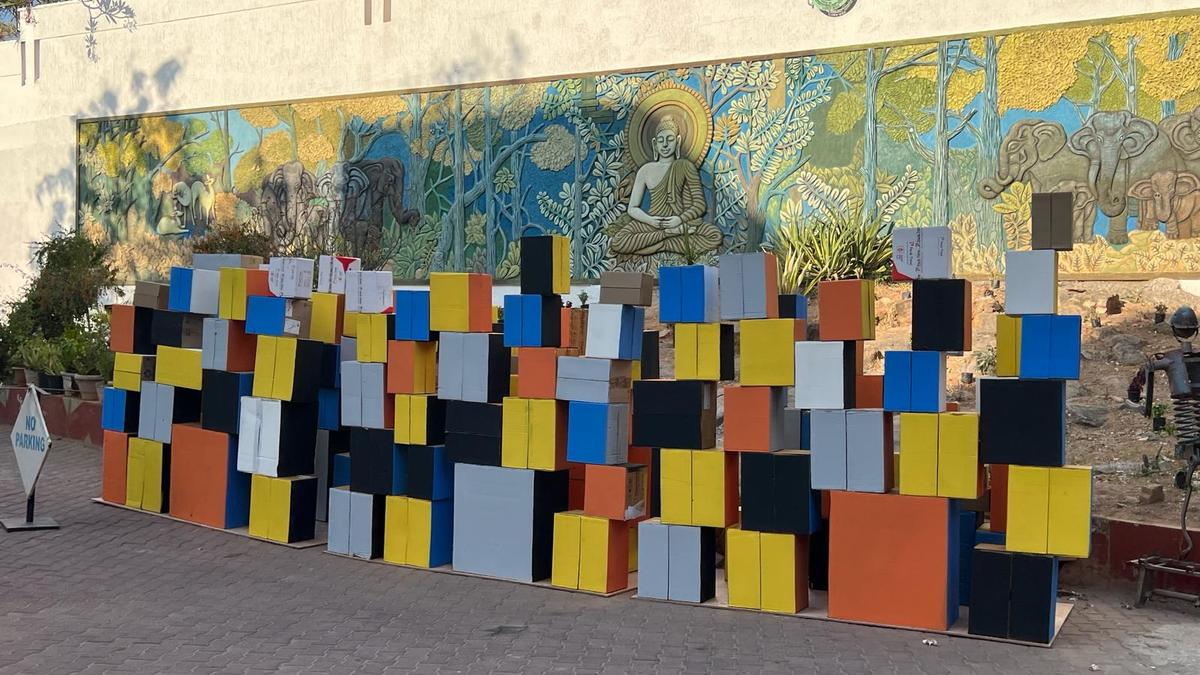
In Hyderabad, artist Rahul Mitra’s Box City installation draws attention to urban living
The Hindu
In Hyderabad, artist Rahul Mitra’s Box City installation draws attention to urban living. His work is on view at State Gallery of Art as part of The NEWS Art Fest 2024; his solo exhibition of paintings titled Elephant in the Room is on view at Gallery 78.
At the State Gallery of Art, Hyderabad, artist Rahul Mitra takes a look at the 300 cardboard boxes he bought from the Esamia Bazar in Koti. Once he paints them, these boxes will go into designing an installation titled ‘Box City’, alluding to box-like homes in urban spaces. He has showcased Box City installations internationally for over a decade. This time, the installation will be a part of The NEWS Art Fest 2024, on view at the State Gallery till March 7. Meanwhile, Rahul’s solo exhibition of artworks titled Elephant in the Room will be on view at Gallery 78, Madhapur, from February 18 to 22.
The Hyderabad-born and Houston-based Rahul Mitra is also a writer and a scientist. He was the Director of the non-coding RNA Cancer Center at MD Anderson Cancer Center, USA, and helped develop therapeutics for ovarian cancer, which are now in clinical trials. In some of his paintings displayed as part of Elephant in the Room at Gallery 78, elements of science make their presence, for instance, through a DNA helix.
Box City is a collaborative art project he has showcased at the Lawndale Art Center in Houston, Paris, Turin, New Delhi and Berlin among several other cities. People from different social backgrounds are invited to paint on cardboard, wood or metal boxes. “People are at first curious about me and what I intend to do with the boxes. Once the concept is explained, they come forward to paint,” he says. The boxes used are often the ones discarded and serve to highlight the socio-economic conditions of the marginalised in society.
In Delhi’s Khirki village, children living in the locality painted the boxes. “An older person told me the boxes won’t last long; I was game even if the installation stayed for a day. Four months later, a graffiti artist from Italy who spotted these boxes shared a photograph on Facebook. Since the children had painted these boxes, they had a sense of ownership and did not dismantle them,” Rahul recalls.
In Turin, street artists painted the boxes. In Berlin, the installation was done with the participation of refugees. “The collaborative process opens a dialogue,” says Rahul and explains how urban dwellings have all broadly become boxes, large or small. When he worked on the installation at the Portland Museum of Art for the 2013 Biennial, 150 others collaborated, and he made it a point to credit all of them. “The project gave me 150 new friends.”
Social consciousness pervades Rahul Mitra’s art. One of his paintings titled ‘Elephant in the room is not the elephant’ makes the viewer pause and look at the people in the room that also has an elephant. Gazing at the painting, one can wonder how the elephant got there in the first place. Or you can think of the conversation between the people that might reveal hidden secrets. The ‘elephant in the room’ is a metaphor for such possibilities.
In another painting featuring a man wearing a spotless white shirt, Rahul explains how the idea of wearing “the whitest of the white” shirt is of aspirational value. Snakes and ladders are also recurring motifs. He explains how the snake is worshipped as well as feared; it signifies a passage of time in its ability to shed its skin and denotes a trap, akin to the game of snakes and ladders.


Kanye West (Ye) announces his debut India show on March 29

Iranian director in exile, Mohammad Rasoulof, has already started working from his adopted country exploring themes around the autonomy of an artist

Anirudh Ravichander launches Albuquerque Records and announces a nationwide concert tour celebrating 15 years of his musical career.

Veteran screenwriter Salim Khan hospitalized in Mumbai; family and Salman Khan visit amid updates on his condition awaited.

Actors Rahul Bhatt and Sunny Leone open up on essaying complex characters in Anurag Kashyap’s ‘Kennedy’, all set to stream on Zee5

Acclaimed Tamil filmmaker Thiagarajan Kumararaja has reunited with his Super Deluxe star Vijay Sethupathi for his upcoming film, Pocket Novel

Legendary actor Robert Duvall, known for iconic roles in "The Godfather" and "Apocalypse Now," dies at 95.

The film is set to release in 2027 and is produced under Bhansali Productions and Maya Movies, with Mehta also serving as a writer on it

The concert is part of Kanye West's global run of headline performances and will take place in New Delhi’s Jawaharlal Nehru Stadium

Sinclair Daniel and Mark O'Brien speak of their experiences of working on 'The Copenhagen Test', balancing the action with emotion, and the challenges of filming in extreme weather

Tamil film producer V. Tamil Azhagan, known for iconic films, passes away at 70; Rajinikanth expresses deep condolences.

Arundhati Roy withdraws from Berlin Film Festival, criticizing Wim Wenders' stance on Gaza and the role of politics in art.

‘My Lord’ movie review: Except for a contrived pre-climax sequence, Raju Murugan’s film intersperses social satire and political commentary with wit, heart, and conviction