If China invades Taiwan, these islands would be on the front line. But there's little panic here
CBC
For a place squeezed up against a hostile adversary and that’s often referred to as the “front line of democracy,” the mood in Kinmen is notably chill.
Tourists from mainland China are the top visitors to this outpost of Taiwan, usually arriving by ferry from the Fujian city of Xiamen, just a few kilometres across the bay.
The top attractions here are former war sites and relics that collectively tell the history of these islands — located more than 300 kilometres west of the Taiwanese capital Taipei — which have been the site of conflict several times since the 1949 Chinese civil war between nationalist and communist forces.
“What you see from those military attractions are meant to let people remember the cruelty of war,” said Jerry Wu, a taxi driver and tour guide, who said the conditions on Kinmen's beaches during the battles of 1949 were similar to those of the Normandy landings five years earlier.
To this day Beijing claims Kinmen, and the rest of democratically governed Taiwan, as its own territory, and the communist leadership has not renounced using force in its quest to bring them under its control.
With U.S. President Donald Trump expected to meet Chinese leader Xi Jinping on the sidelines of the Asia-Pacific Economic Cooperation (APEC) Summit in Gyeongju, South Korea on Thursday, the future of Taiwan is certain to figure prominently.
U.S. intelligence has suggested that Xi has told his military to be ready for an invasion of Taiwan by 2027.
While for decades the United States has been Taiwan’s unshakable military backer, Trump has added a sense of unpredictability to the relationship. He has already reportedly paused a $400 million arms transfer to Taiwan.
The U.S. president’s at times haphazard approach to China — slapping on tariffs one moment, only to reverse them later — has left many Taiwanese nervous that their islands' status could be a bargaining chip for Trump to secure a favourable trade deal with Xi, although U.S. Secretary of State Marco Rubio recently denied that’s the case.
China's leader is reportedly pushing Trump to disavow Taiwan's independence. That would represent a significant break from previous administrations, which have simply advocated for maintaining the status quo.
For decades, Kinmen has been viewed by many within Taiwan as a patriotic symbol of resilience and defiance against mainland China. For others, the islands represent the potential for a more peaceful and integrated relationship with their neighbours.
In 1949, during the Chinese civil war, retreating forces of the Republic of China piled into Kinmen and used its two principal islands as a buffer against the advancing Communist army that eventually controlled the mainland.
As many as 100,000 troops were once based here. At one point during the 1958 Taiwan Strait Crisis, mainland forces shelled the islands for 44 continuous days.
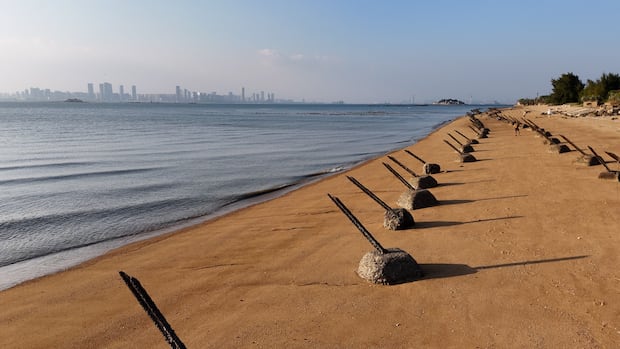
On Kinmen’s sandy beaches, decades-old anti-tank stakes stick out of the sand at low tide; concrete bunkers with artillery mounts point toward the mainland and pockmarked buildings bear the scars of two ill-fated attempts by communist forces to take the islands.


China’s latest blueprint for driving growth in its economy was largely written before the U.S. and Israel instigated the most far-reaching war in the Middle East in decades.

U.S. President Donald Trump's firing of Homeland Security Secretary Kristi Noem on Thursday overshadowed the announcement of his plans to nominate Republican Sen. Markwayne Mullin as her successor.

The truck carrying Nepali prime ministerial candidate Balendra Shah was swarmed by cheering supporters in the capital, Kathmandu, on Saturday, unable to inch forward as the former rapper, wearing sunglasses and a sleek black suit, danced on top of the roof.

Israel sent troops into southern Lebanon on Tuesday and warned residents of more than 80 villages to evacuate as the Iran-backed militant Hezbollah group said it was ready for an "open war" with Israel in the wake of the U.S.-Israeli war with Iran.

U.S. President Donald Trump has given Americans a short list of his objectives in attacking Iran, but when it comes to the justification for launching the war and how the conflict is expected to play out, he and his team are sending mixed messages.

Omid Golabkesh dragged his suitcase down a long hallway marking the exit of the Kapikoy border crossing in eastern Turkey. He had nearly reached the end of an exhausting journey that included a 12-hour drive to the checkpoint from his home in Tehran.