Human Rights Tribunal dismisses complaint over public washroom access in Sudbury, Ont.
CBC
A Sudbury, Ont., man says he's disappointed that the Human Rights Tribunal of Ontario won't hold a hearing on his complaint regarding the need for 24-hour public access to washrooms for people living on the street.
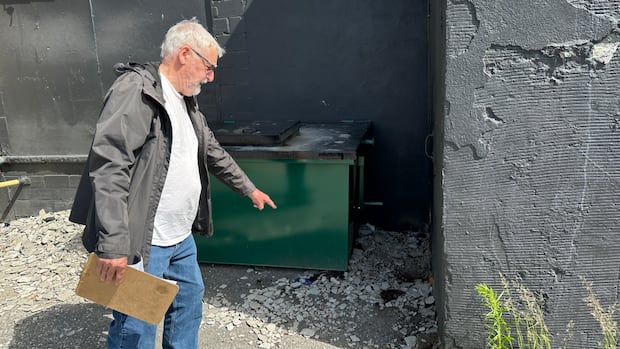
Holland Marshall points out the signs and smells of human excrement as he walks downtown to a local café.
Marshall says there are few options during the day for people with substance use disorders and mental health issues to use a toilet and wash their hands, and close to none at night.
The onus, he argues, lies with the city to provide access at all times to everyone.
"Proper toilet facilities and potable drinking water is a human right recognized by the United Nations," he said.
"We may not be able to afford to put everybody into a proper apartment. We may not even be able to put them into transitional housing and all the rest of it; but we can at least give 24-hour washrooms and drinking water supplies. If we can't do that, we're not doing the basics."
Many buildings and churches, most recently the historic downtown Ukrainian church, have erected fences to prevent people from urinating and defecating in alcoves, or even setting fires to keep warm.
Downtown business owners have complained about having to clean their doorsteps of human waste every morning.
According to the last count, the city says there are about 500 homeless people in Sudbury.
About a year-and-a-half ago, Marshall met 21 people on the street and filed a human rights complaint on their behalf, claiming it's the city's obligation to provide them around the clock facilities and potable water.
In a decision released June 27, the Human Rights Tribunal of Ontario ruled Marshall's application doesn't fall under its jurisdiction, and has dismissed it.
It says it can only enforce the legal code which prohibits discrimination on 17 grounds including disability, gender, race, age and others.
"While there may be a correlation or connection between homelessness and disability, these concepts cannot be substituted for each other, " wrote Human Rights Tribunal of Ontario member Stephen Eaton in the decision. "In this case, not all of the 21 purported applicants have an identified disability."
Marshall says he's disappointed although not terribly surprised.


The Swale Watchers plan to keep watching.

In a smaller city like Prince Albert, Ramadan can feel different.

About 125 people came out for a town hall meeting on health care in Charlottetown Monday night.

This is the second of two-part CBC News report on Taser use by Edmonton police. To read the previous story, click here.

A Merritt, B.C., father is urging parents to be on the lookout for ticks while the weather warms up, after his six-year-old son was partially paralyzed by a tick bite last week.

About that heartbreaking loss to the U.S. at the 2026 Olympic women's hockey final last month, Sarah Nurse says, “that was the most fun I’ve had in a hockey game in a very long time.”

The U.S. government on Monday said electric vehicle (EV) maker Tesla and South Korea's LG Energy Solution had signed a supply agreement to build a $4.3 billion lithium iron phosphate (LFP) prismatic battery cell manufacturing facility in Lansing, Mich., with an expected production launch in 2027.

In one small town in Alberta, the assistant principal says teachers almost never meet alone with parents anymore.

Tens of thousands of customers are without power and four parts of Highway 401 are closed Tuesday morning as blasts of blowing snow hit the Ottawa-Gatineau area.

Melody Macsemchuk says volunteers at Grace Place in Thunder Bay, Ont., serve between 300 and 350 meals a day.

Groups of volunteers continue to search alongside police for a man who went missing in late January near Owen Sound, Ont., covering land on foot, and using drones for a view of the conservation area where his car was found.

Jessica Hay says her daughter Charlie loves to be included in everything — and a new accessible shopping cart at her local grocery store in Cornwall makes it possible for Charlie to come along for the ride.

The N.W.T. cabinet says it will review whether or not the territory needs an independent child and youth advocate after a motion by Range Lake MLA Kieron Testart calling on it to establish such a position was carried in the legislative assembly.