How Ulloor Krishi Bhavan in Thiruvananthapuram is handholding small scale farmers
The Hindu
Discover how Ulloor Krishi Bhavan supports small farmers in Thiruvananthapuram
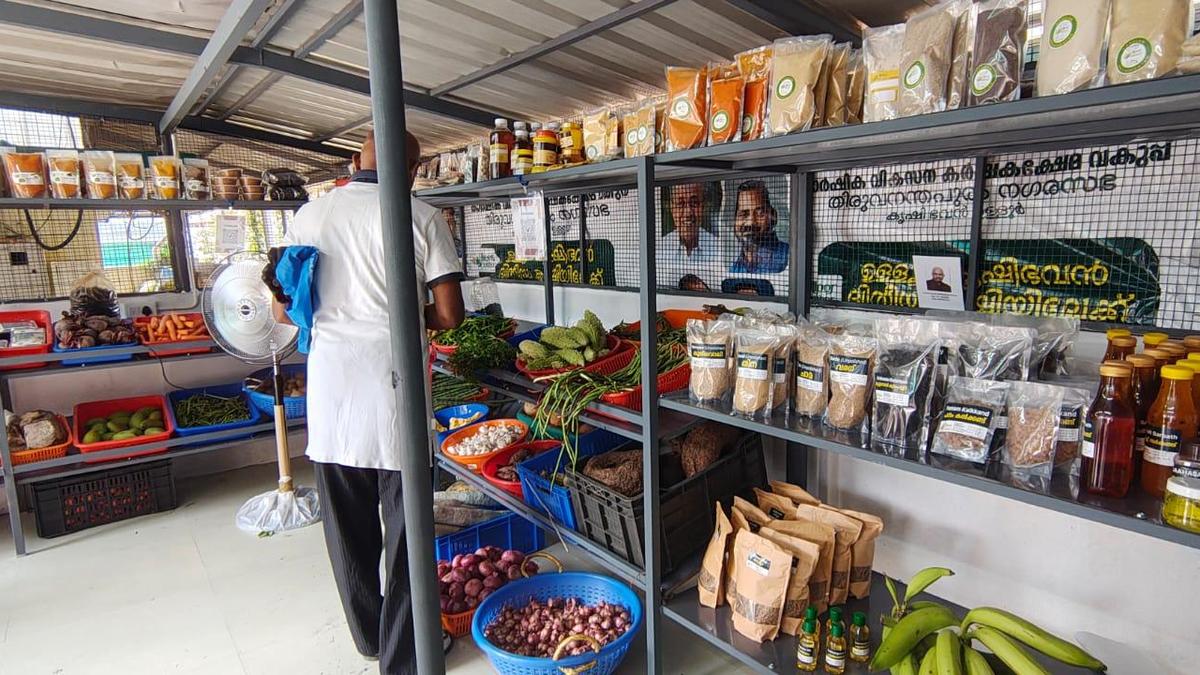
Lissy Radhakrishnan is all smiles when she takes us through her journey as an agripreneur. We meet her at the recently-opened Krishi Samridhi retail outlet, a space attached to Ulloor Krishi Bhavan at Parottukonam, in Thiruvananthapuram, where you get over 100 products of the Krishikkottams or farming collectives under the Krishi Bhavan.
Rainbow, which is Lissy’s Krishikkoottam, sells spice powders, cut vegetables, pickles, and coconut oil among other products. Nearly 50 such collectives spread across 11 wards have been registered under the Krishi Bhavan. Krishikkoottam is an initiative of the Kerala Government’s Department of Agriculture and Farmer’s Welfare and is an extension of the campaign to promote farming in households.
A view of Krishi Samridhi retail outlet | Photo Credit: SPECIAL ARRANGEMENT
The Krishi Bhavan, led by Sopna S, the agricultural officer, has set forth a small agri revolution through multiple initiatives over the last one year. The Krishi Samridhi outlet is the recent addition to it. A highlight is the traceability QR codes of each Krishikkoottam displayed at the outlet, which helps customers to browse the produce’s journey through photographs and videos.
Besides fresh vegetables and fruits, the outlet sells honey, millets and millet-based products, milk and dairy products, rice, pickle, fruit-based drinks, spices, medicinal herbs etc. The products are sold under the brand Ulloor Greens, on the lines of Kalliyoor Greens, which Sopna had taken the initiative to launch while working as the agricultural officer at Kalliyoor, the vegetable hub of the district.
“We have taken a multi-pronged approach to support farmers. A major initiative is the launch of secondary agriculture, wherein the farmers are encouraged to take up value-addition and processing,” explains Sopna. She adds, “Production alone has been the focus of most of the farmers for long. Take the case of banana. When they sell the fruit as it is they seldom get any profit. That is why they are trained to come up with value-added products,” she adds.


Discover options to dine in Hyderabad this weekend

Malayalam filmmaker Ranjith arrested by police in sexual abuse case following a complaint from a female actor.

Commercial LPG cylinder prices rise with effective from April 1, 2026

Iran's Revolutionary Guards threaten retaliation against U.S. tech firms like Apple and Google for targeted assassinations of Iranian leaders.

Modi criticizes Congress for exploiting the West Asia conflict for political gain, urging national unity amidst global crises.

Ashwini Bhide is appointed as Mumbai's first female Municipal Commissioner, marking a historic milestone for the city's governance.

Netanyahu claims Israel is systematically weakening Iran while forging new regional alliances, emphasizing significant achievements against Tehran's regime.

Chengalpattu residents voice frustrations over unmet infrastructure demands, including water management and road improvements, amid political neglect.

Kerala Assembly polls heat up as CPI(M)-led LDF and Congress-led UDF intensify campaigns amid rising identity politics.

Techie couple in Bengaluru ends their lives amid marital issues and mental stress, police investigate the incident.

Myanmar junta chief Min Aung Hlaing elected Vice-President, advancing toward civilian leadership amid ongoing military influence in governance.

Chengalpattu residents voice frustrations over unmet infrastructure demands, including water management and road improvements, amid political neglect.