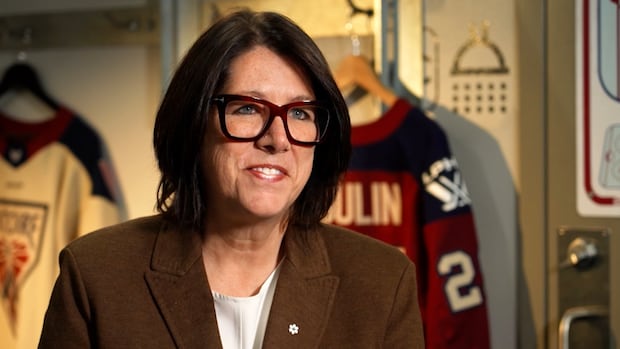
How the woman who wasn't allowed to play built a future for Canadian hockey
CBC
Few people in this country have had the kind of profound impact on how Canadians live and breathe sport like Danièle Sauvageau.
Her name is synonymous, certainly in Quebec, with the game stitched across the nation’s heart.
“She's touched every level of female hockey and male hockey, to be honest,” said Marie-Philip Poulin, captain of the Montreal Victoire and the decorated women’s national team.
“She's always had a strong drive to make sure that we grew female hockey here in Quebec. And for many years, it was difficult. I feel like right now we have such incredible momentum, to see the crowd that comes to the Victoire games and to see young girls wear jerseys all over the place, it's pretty incredible.”
Sauvageau, the girl who grew up in Deux-Montanges, Que., and wasn’t allowed to play on an organized hockey team because she wasn’t a boy, is now inextricably linked to the growth and strength of the game. The general manager of the PWHL’s Montreal Victoire became a national hero when she led Team Canada to the country’s first hockey gold in 50 years at the Salt Lake City Olympics in 2002.
She’ll soon join an elite class of eternal hockey demigods when she’s inducted into the Hockey Hall of Fame as a Builder. The category, which honours non-players making significant contributions to the sport, already includes NHL commissioner Gary Bettman, former coaches Scotty Bowman and Pat Burns, and Lord Stanley (yes, that Lord Stanley).
There are 119 Builders in the Hall of Fame. Sauvageau is the first woman.
She’s a force in hockey. Respected, revered and, yes, maybe a bit feared. At least, until you encounter the passion that lies beneath her straightforward demeanor.
“I mean, she is intimidating,” Poulin said with a smile. “She still is to this day to me. But she has a soft inside. And that's something that's quite a privilege when you get to know her.”
Poulin’s respect for Sauvageau runs deep. She hung posters of the coach on her walls as a child, something her mother immediately told Sauvageau when they met in person at a hockey festival when Poulin was still young.
Their professional relationship spans nearly two decades, starting when Poulin moved to Montreal as a teenager to play in the new Canadian Women's Hockey League (CWHL). Sauvageau supported her through her first Olympics in Vancouver 2010, through World Championships and coached Poulin on the Professional Women's Hockey Players Association Montreal team, which sprang up after the CWHL folded.
"It's just a privilege to be able to represent Canada and obviously she's done that for many years. She's lived it,” said Poulin. “It’s such a privilege to play on her behalf.”
Though she wasn’t allowed to play in boys' hockey leagues, Savageau's childhood still revolved around recreational games at the outdoor rink down the street from her family home.
She says she never forgot how it felt to be told she couldn't play, but being told no as a child would eventually bring her to create opportunities for others.


The government of Saskatchewan has announced plans to reduce the length of non-resident game bird hunting licences to combat illegal guiding.

An 87-year-old Alberta man is fighting extradition to the United Kingdom to stand trial for historical allegations of physical and sexual assault involving minors.

Eight casinos across southwest B.C. have been sold to First Nations in the last two years, with the province's gambling scene set to be reshaped as a result.

Hamilton hosts the Junos Sunday, and the musical awards show is bringing tourists, musicians, concerts and a ton of themed events to the city this week.

The multi-million-dollar deal at the heart of a high-profile fight between the Canadian government and one of the world’s biggest carmakers contains multiple clauses about the company’s footprint in Ontario, according to a copy obtained by CBC Windsor.

In recent months, Calgary police have carried out three day-long safety blitzes, parading out dozens of officers to flood an area with their increased presence — at least, temporarily.

A national organization is seeking people with experience in Canada's forestry sector as they put together a working group that will examine ways to improve forest recovery following wildfires.

Ella Heyder is bracing for a breakup, even though she already moved out decades ago.

Shawne Hopkins never saw it coming.

Politicians return to Queen’s Park Monday for a shortened spring session, as Premier Doug Ford prepares to unveil his eight budget amid heightened global economic uncertainty.

Despite a recent announcement that a water supply pipeline will be build in Oneida Nation of the Thames, some members of the community say that's no excuse for taking water for granted.

As scandal has swirled around former prince Andrew Mountbatten-Windsor, questions and curiosity have also focused on his ex-wife, Sarah Ferguson, and their daughters, Princesses Beatrice and Eugenie.

Friday may have been the first day of spring, but winter storms are not over yet for Newfoundland.