How is President’s Rule imposed? | Explained
The Hindu
Delegation of Manipur MLAs press for viable government after President's rule; Article 356 misuse discussed, judicial watchdog role highlighted.
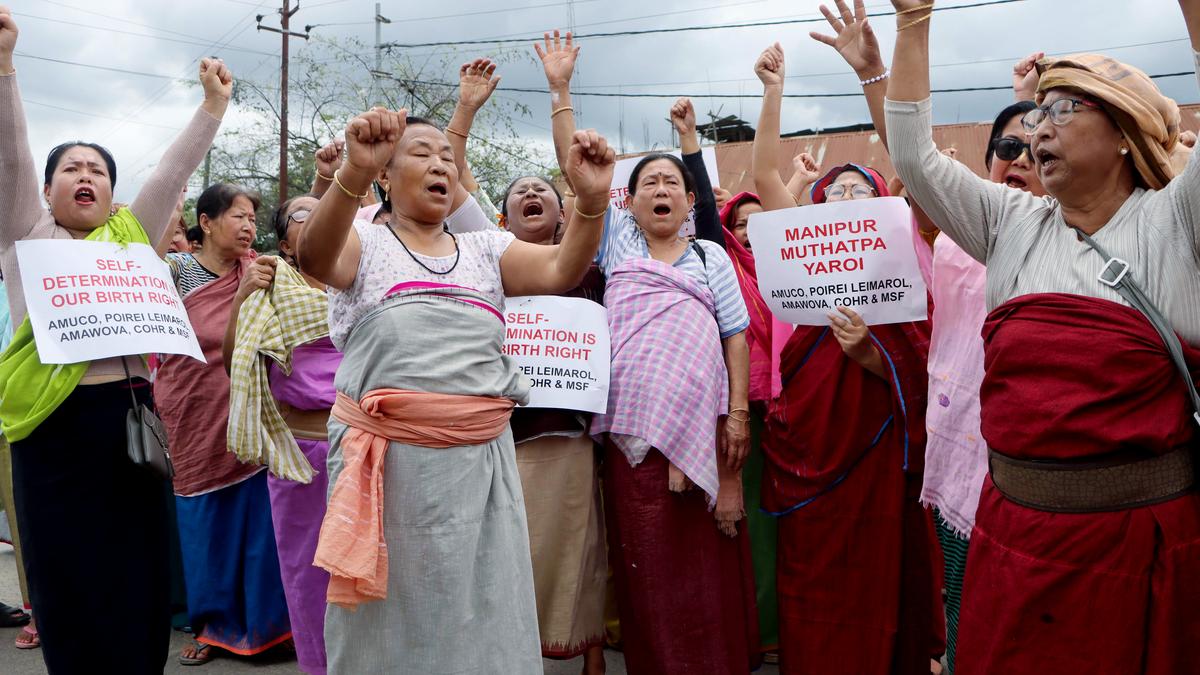
The story so far: A delegation of 10 MLAs from the Manipur Assembly met the Governor of the State and pressed for the formation of a viable government in Manipur that has been under President’s Rule since February 2025.
Article 356 is invoked to impose President’s Rule in a State after removing the State government. While there are duties cast on federal governments in the U.S. and Australia to protect the States, their constitutions do not have any provision for removing State governments. Under Article 356, the President (central government) may take over the governance of a State when it cannot be carried out in accordance with the provisions of the Constitution. The President can make such a proclamation based on a receipt of report from the Governor of a State or otherwise. The latter situation may arise under Article 365 due to failure of a State to comply with or give effect to any directions of the Union government.
The proclamation of President’s Rule must be approved by both Houses of Parliament within two months from the date of its issue by a simple majority. Once approved by Parliament, the President’s Rule continues for six months, from the date of proclamation, unless revoked earlier. It can be extended for a further period of six months at a time by an approval of both the Houses of Parliament by a simple majority. The President’s Rule cannot extend beyond a period of three years in total.
Dr. B.R. Ambedkar during the Constituent Assembly debates wished that Article 356 would never be called into operation and that it would remain a dead letter. However, it has been a travesty that Article 356 was misused on several occasions, removing elected governments that enjoyed majority in the States, violating constitutional principles and federalism. Reasons varied from loss in Lok Sabha elections to deterioration of law and order. When it comes to the dissolution of the Legislative Assembly after imposition of President’s Rule, there has been no uniformity in the approach. More than constitutional principles, it was political expediency that drove such decisions in the past.
Various Governors have adopted different approaches in similar situations in regard to the dissolution of the Legislative Assembly. The advice of a Chief Minister, enjoying majority support in the Assembly, is normally binding on the Governor. However, where the Chief Minister had lost such support, some Governors have refused to dissolve the Legislative Assembly on his/her advice, while others in similar situations, accepted the advice, and dissolved the Assembly. The Assembly was dissolved in Kerala (1970) and in Punjab (1971) on the advice of the Chief Minister whose claim to majority support was doubtful. However, in more or less similar circumstances in Punjab (1967), Uttar Pradesh (1968), Madhya Pradesh (1969), and Orissa (1971), the Legislative Assembly was not dissolved immediately based on the outgoing Ministry’s advice. Attempts were made to install alternative Ministries.
The Supreme Court and High Courts during the first four decades after Independence refrained from interfering in the decision of the Centre to impose President’s Rule in States. It was only after a categorical judgment of the Supreme Court in the S. R. Bommai case (1994), that misuse of Article 356 has been restricted. The court in this judgment held that Article 356 should be imposed only in the event of a breakdown of constitutional machinery as distinguished from an ordinary breakdown of law and order. It also held that imposition of President’s Rule is subject to judicial review and should not be misused for political reasons. It further ruled that till Parliament approves the imposition of President’s Rule, the Legislative Assembly should not be dissolved, and can be only kept under suspended animation.
The higher judiciary has been a watchdog, since the S. R. Bommai case, against the arbitrary use of Article 356. Notably in the case of Bihar (2005), Uttarakhand (2016) and Arunachal Pradesh (2016), the courts have struck down the wrongful imposition of President’s Rule.


Perundurai's industrial growth faces challenges of pollution, water scarcity, and healthcare, impacting residents ahead of the 2026 elections.

The Travancore Devaswom Board asserts that courts should respect community beliefs in its Supreme Court submission on Sabarimala's entry issue.

Karnataka cancels Deendayal Upadhyay event at KSOU due to protocol violations, citing inconsistency with university objectives.

Illegal pickle unit busted in Hyderabad, one arrested; unhygienic stock worth ₹3 lakh seized

Karnataka has entered a state of demographic transition where a large working-age population will no longer be enough to drive economic growth, and future gains will depend on how productively people are employed, the ‘State of Working India 2026’ report said.

Key demands in Sulur Assembly constituency include reviving the powerloom sector, addressing farmers' needs, and protecting River Noyyal.

Kodihalli urges Karnataka CM to allocate ₹10,000 crore revolving fund for seamless procurement of farm products under MSP scheme.

Kerala's political parties continue to marginalize women candidates, highlighting a troubling disconnect between gender demographics and representation.

The High Court of Karnataka on Tuesday ordered the issue of a notice to the State government on a PIL petition, which had complained about disturbances caused to people residing in the localities around the National Public School situated in Rajajinagar 5th block due to use of loudspeakers with high volume in the school and parking of school buses in residential areas.

China is extensively mapping ocean floors to enhance submarine warfare capabilities against the U.S. and allies across key oceans.

AIADMK's 2026 manifesto promises free rations, women's benefits, education reforms, and economic growth initiatives for Tamil Nadu.

The vehicle towing drive will soon resume in the city to ease traffic congestion. The Bengaluru Traffic Police (BTP), in coordination with the Greater Bengaluru Authority (GBA), is set to relaunch the vehicle towing drive across the city shortly to tackle traffic congestion and illegal parking.

Panic buying, not shortage, is leading to long queues at Hyderabad petrol pumps.