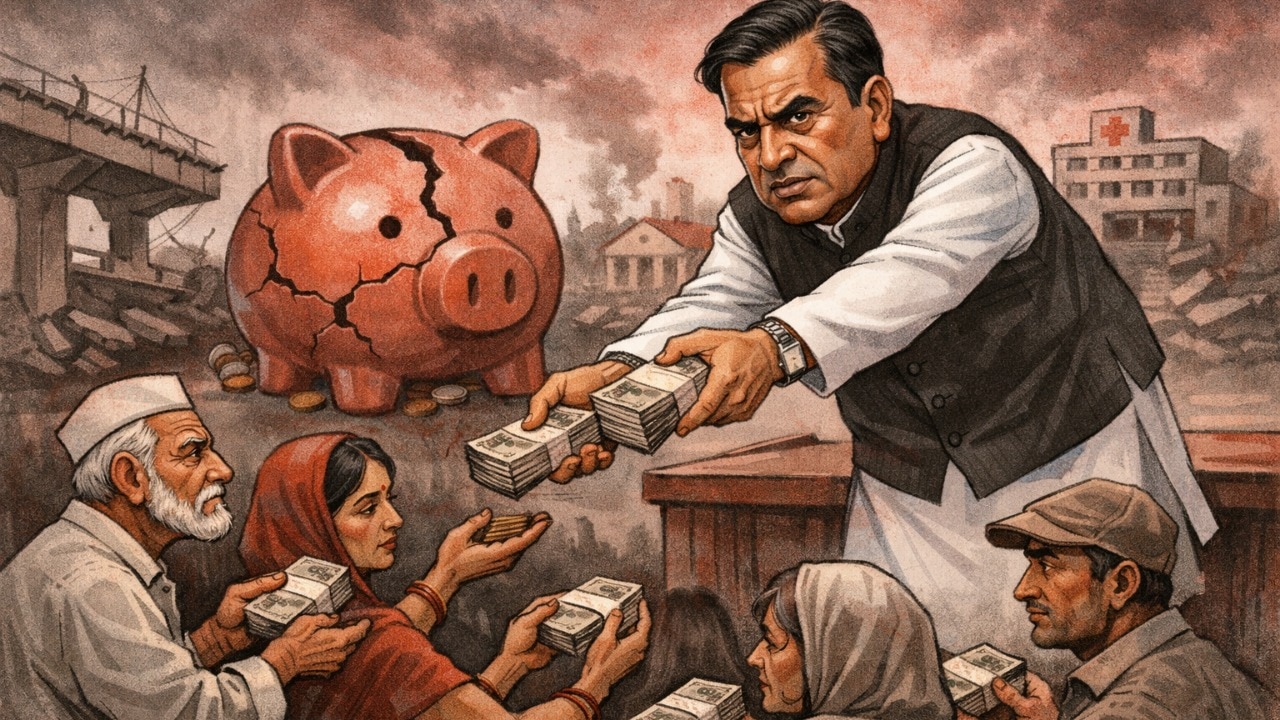
How freebies bled Indian economy. Economic Survey suggests a Brazilian model
India Today
The Economic Survey 2025-26 flags the unchecked rise of freebies provided by the state governments in India. It says they are draining public finances, widening deficits by leaving little money for investments in infrastructure and human capital. It argues that reforms are needed to the freebie culture, and urges policymakers to adopt outcome-linked, time-bound models like Brazil's Bolsa Familia.
The rising trend of freebies in Indian states has begun delivering an adverse visible economic cost, the Economic Survey 2025-26 has warned. The policy document presented by Finance Minister Nirmala Sitharaman on Thursday, noted that unconditional cash transfers (UCTs), rolled out aggressively by states, ballooned more than fivefold between FY23 and FY26, with spending touching an estimated Rs 1.7 lakh crore this year.
While these schemes, largely targeted at women, have provided immediate income relief and boosted consumption, the Survey argues they have failed to deliver durable gains in nutrition, education or poverty reduction.
Instead, they have deepened revenue deficits, crowded out capital expenditure and tightened states' fiscal flexibility. "The expansion of unconditional cash transfers across several states has contributed to rising revenue expenditure, with implications for fiscal space and public investment at the state level," noted the Economic Survey 2025-26. With committed expenditures now consuming nearly two-thirds of state revenues, infrastructure and human capital investments are increasingly being sacrificed at the expense of freebies or the UCTs.
The Survey cautions that without reform, these transfers risk becoming permanent fiscal liabilities rather than safety nets. It also flags that freebies have reduced female labour force participation.
To arrest the fiscal bleeding, the Survey proposes a shift towards conditional, time-bound welfare. It cites examples of such programmes from other countries, like Brazil's Bolsa Familia, and one each from Mexico and the Philippines. The message is that welfare without outcomes is not fiscally sustainable.
The Economic Survey is prepared by the Chief Economic Adviser (CEA) and the Department of Economic Affairs of the Ministry of Finance. It is tabled in Parliament ahead of the Union Budget. It presents an official assessment of the economy, explaining what is happening, why it is happening, and suggesting policy directions based on data and analysis.


Venkataraman joined Flipkart in 2015 and has been part of the company's leadership team through a period of growth and restructuring. During his tenure, he helped strengthen the company's financial operations.

The gold rate today is around Rs 1.5 lakh per 10 grams for 24-carat gold, while 22-carat gold is near Rs 1.4 lakh, with prices edging higher after recent losses. Silver is also seeing a slight uptick after a volatile phase.

Early indicators suggest a positive start. GIFT Nifty futures were trading at 23,250.5 at around 08:24 am, indicating that the Nifty 50 may open above Thursday's close of 23,002.15.

With multiple energy hubs under threat, the risk to global supply chains has increased sharply. For countries like India, which depend heavily on imports, this means higher costs and tighter supply in the near term.

In a statement, the central bank said it has taken note of the recent developments at HDFC Bank and has approved the transition arrangement proposed by the bank for the position of part-time chairman.

Global brokerage JPMorgan has maintained a "neutral" rating on the stock with a price target of Rs 1,090. HDFC Bank stock is already trading near its 52-week low, adding to weak sentiment around the counter.

The IPO is expected to be structured as an "offer for sale" (OFS). This means existing investors will sell a part of their stake to the public, rather than the company issuing new shares.

Sensex ends 633 points higher, Nifty above 23,700; Infosys up 3%

The Sensex was up 825.79 points, or 1.09%, at 76,896.63, while the Nifty 50 gained 239.10 points, or 1.01%, to trade at 23,820.25 as of 11:44 AM. It may be noted that the Sensex has gained over 2,000 points this week after a sharp losing spree.


The reconstituted panel includes several key institutional representatives. These include members from the Life Insurance Council and the General Insurance Council, along with heads of important professional bodies.