How firms like Samsung view labour | Explained Premium
The Hindu
Samsung strike in Tamil Nadu ends after negotiations, highlighting challenges of forming unions in foreign-owned enterprises in India.
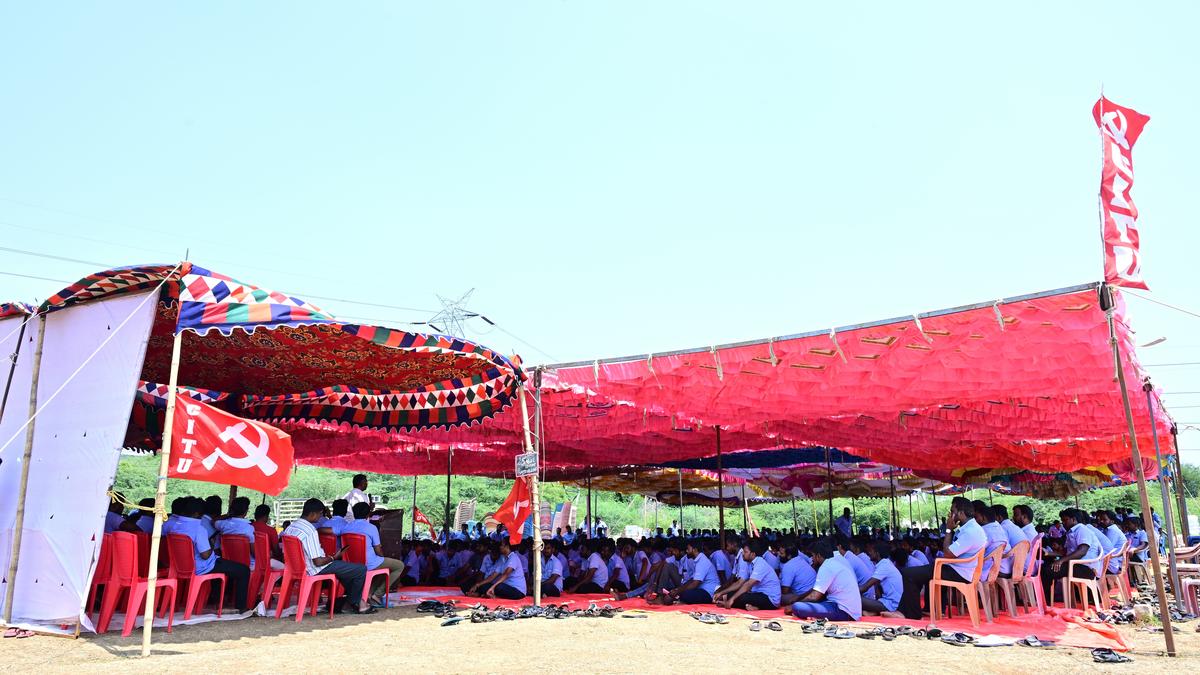
The story so far:On October 15, the Tamil Nadu labour department announced that the month-long strike at Samsung’s manufacturing facility in Sriperumbudur has ended after successful negotiations between the workers and company management. The Samsung India Workers’ Union (SIWU), affiliated to the Centre for Indian Trade Unions, announced the withdrawal of the strike and said they will return to work on October 17. While workers have raised various economic demands such as an incremental increase in their salaries over the next two years, at the heart of their protest is the demand for the recognition of SIWU. The management has continued to stonewall this particular demand, and the workers have resorted to the judicial route, with the matter now pending before the Madras High Court.
The South Korean company, Samsung commenced its operations in India in 1995. The biggest generator of revenue for the company in India are smartphone devices, with most of these manufactured at its second plant in Noida, Uttar Pradesh. Its facility in Sriperumbudur was established in 2007, and produces consumer durables such as televisions, refrigerators, washing machines and air conditioners. It employs close to 5,000 workers. In 2022, the company signed an MoU with Tamil Nadu government, through an investment of ₹1,588 crore, to set up a new plant to produce compressors for refrigerators.
Forming a workers’ union in a foreign-owned enterprise in India is a challenge in itself, with the need to pass through several political-bureaucratic loops to get it registered. However, getting it recognised by the management has often proved to be even more difficult. Labour subordination and disciplining has remained the default setting of most East Asian companies operating in India, especially in the past two decades. Some notable workers’ protests in different parts of India have been at manufacturing facilities with East Asian capital — Honda Scooters and Motorcycles in 2005, Maruti Suzuki in 2011-12, Wistron in 2020 and Foxconn in 2021. The stressful working conditions in these factories are shaped and determined by their management philosophy, which largely draws inspiration from the Japanese production method called Kaizen — that is, continuous improvement to increase work intensity and reduce idle time. Over the years, through offshore supply chains, global manufacturing in the electronics industry has been reordered into just-in-time production — a system in which products are created to meet demand rather than in surplus or in advance of need. As companies adopt this model to increase efficiency, the output is ramped up ahead of product launches and peak sales periods. It leads to punishing work ethic, regimented culture of rules and unyielding deadlines.
It is in this context that the demand for representative associations is pertinent from a labour-centric perspective. However, past experiences — the ready reference being Maruti Suzuki workers’ struggles to form a union — reflect the reluctance of managements. They remain extremely wary of unions, especially those with communist affiliations, and are apprehensive of their militant actions. As is visible in the present case, while there has been some conciliation towards other demands, Samsung has remained adamant on not recognising SIWU.
Also read | On Samsung workers’ right to unionise
Companies in South Korea such as Samsung are called Chaebols. These are large, diversified business conglomerates owned and controlled by families or their close kin for generations. Chaebols have dominated South Korean economy since the 1960s and have also had significant links to the country’s polity. Their origins can be traced to the encouragement and support provided by the authoritarian military dictatorship to rebuild the economy post the Korean war in 1953. The export-led growth strategy of Chaebols was dependent on their labour management strategies which was a combination of minimising labour costs, and intensification of work. Since then the work environment has moved from militaristic labour control and subordination in the 1970s to more paternalistic management practices such as welfare schemes and subsidies in later years. According to scholars Seung-Ho Kwon and Michael O’Donnell, as independent trade unions emerged in the country in the 1980s, the Chaebols brought in automated production systems, introduced external subcontractors and restructured as well as decentralised their operations to curb labour power (including transnational investments). Presently, Samsung, founded by Lee Byung-chul in 1938, is the country’s largest Chaebol.
The prolonging of the strike causes concerns for both central and State governments — for the former, regarding India’s manufacturing ambitions and becoming an alternative to China, and for the latter, who are forced to strike a balance between attracting foreign investments and signifying its political-governing philosophy of dignity and justice. The resolution of the issue is therefore a matter of prestige and urgency rather than any pro-labour development.


Five top firms lose ₹1 lakh crore in market value, with HDFC Bank experiencing the largest decline of ₹56,124.48 crore.

HDFC Bank terminates three senior officials over client onboarding issues at its DIFC branch amid ethical concerns following chairman's resignation.

Air India CEO warns of potential flight cuts and reduced travel demand due to rising fuel costs amid ongoing Gulf conflict.

Options are widely used by retail traders to speculate on the value of the stock for immediate gains and such behaviour in large scale can distort the market

India achieves 1 billion tonne coal production for the second consecutive year, ensuring stable energy supply and economic growth.

Generic drugmakers in India launch affordable Semaglutide versions, targeting a $1 billion diabetes and weight loss market.

Indian and Asian refiners eye Iranian oil purchases as U.S. waives sanctions amid energy crisis linked to the Iran-Israel war.

Iran war impacts pesticide prices, warning of a 20-25% rise and increased risk of counterfeit products during the kharif season.

India's forex reserves fell by $7 billion to $709.76 billion, according to RBI data for the week ending March 13.

Natco Pharma will launch its Semaglutide injection (multi dose vials) in the domestic market on Saturday.

Flipkart announces a 105% bonus payout for 2025, rewarding employees for strong growth and performance metrics.

Core sector growth in India plummeted to 2.3% in February, amid declining domestic production and impending West Asia crisis impacts.

Stock markets rebound with Sensex rising 325 points, driven by IT and PSU bank stocks amid fuel price concerns.