How fast should US Federal Reserve cut interest rates
The Peninsula
DOHA: Forecasting policy rates in the US has been a challenge in recent quarters, after the aggressive monetary policy tightening stabilised with rate...
DOHA: Forecasting policy rates in the US has been a challenge in recent quarters, after the aggressive monetary policy tightening stabilised with rates at 5.5%. This was due to significant volatility in both growth and inflation expectations.
In fact, from late 2023 to early 2024, after a sequence of lower-than-expected inflation prints and weaker GDP growth, markets started to weigh an aggressive schedule of rate cuts. At peak “dovish” expectations in January, markets were pricing close to 200 basis points (bps) in policy rate cuts for this year. But conditions changed markedly throughout the year as three consecutive months of high inflation prints fuelled concerns regarding the disinflation path. This, alongside higher growth expectations, led to a significant re-pricing of short-term interest rates, which were then expected to remain “higher for much longer.” Some analysts and investors even considered the possibility of further rate hikes to prevent a sustained re-acceleration of inflation.
After the latest round of “inflation scare,” softer data for growth and inflation in recent weeks are suggesting that the US Federal Reserve (Fed) should start cutting rates sooner rather than later, kick-starting the monetary policy easing cycle. In our view, the Fed will have room to cut rates at a faster pace than markets are currently expecting, particularly next year. Three main factors sustain our outlook.
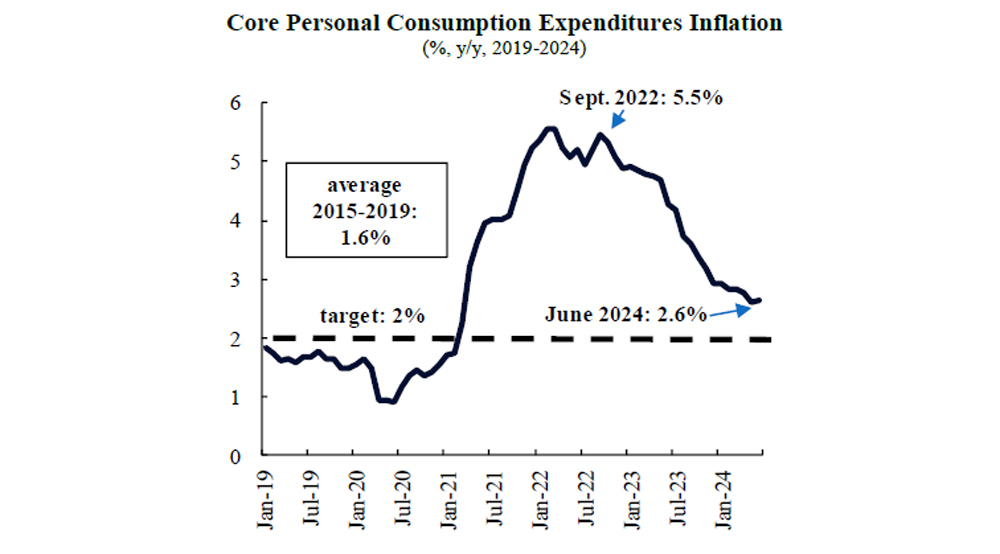
First, the disinflationary trend in the US is intact and could accelerate further over the coming quarters, reaching the Fed’s 2% target earlier than previously anticipated. The disinflationary trend has been grounded on supply chain normalization, a moderate slowdown in economic activity, and tighter monetary policy. Core Personal Consumption Expenditures (PCE) inflation, which excludes volatile prices such as energy and food, fell to a new low of 2.6% in June, the slowest pace in more than three years. Importantly, shelter inflation, the main component sustaining core inflation, is set to decelerate further in the coming months, as moderating rental prices are gradually incorporated into new contracts. This will help to cover the proverbial “last mile” gap between the running inflation rate and the inflation target, giving the reassurance that the Fed needs to modify its course.
Second, softening labour markets suggest not only a lack of more structural price pressures from wages, but also even a potential sharp deceleration of economic activity.


Doha, Qatar: The Qatar Stock Exchange (QSE) closed this week down 1.99 percent, losing 213.34 points to settle at 10,485 points, driven by pressure fr...

Doha, Qatar: Qatar s real estate sector has witnessed positive momentum in February this year as the total deal value climbed to QR2.709bn showing inv...

Paris, France: Air France KLM said Thursday it is raising long haul ticket prices due to soaring jet fuel prices caused by the Middle East conflict....

Doha, Qatar: The Minister of State for Energy Affairs, H E Saad Sherida Al Kaabi, met yesterday with the Director General for Energy at the European C...

Doha, Qatar: The Minister of State for Energy Affairs HE Eng. Saad bin Sherida Al Kaabi, met today with the Director General for Energy at the Europea...

Doha, Qatar: Following the completion of the legally required quorum, representing (76.81%), Barwa Real Estate Group held the meeting of the Company s...

Doha, Qatar: Active trading and strong investor participation marked the last week at the Qatar Stock Exchange (QSE) as the market remained open and o...

Doha, Qatar: Oil prices spiked to nearly $120 per barrel before falling back slightly on Monday as Iran continued its attacks on several Arab countrie...

Doha, Qatar: Shares in Qatar stock market ended the week on a positive note as shares registered strong gains. The Qatar Stock Exchange (QSE) Index ha...

Dooha, Qatar: Vodafone Qatar held its Ordinary General Assembly Meeting virtually on Sunday, March 1, 2026 chaired by Vodafone Qatar Chief Executive O...

Doha, Qatar: Mwani Qatar recorded significant growth in its operational performance during February on a year on year basis, driven by an increase in...

Doha, Qatar: The year 2025 delivered an apparent contradiction at the heart of the global economy. On the one hand, global trade volumes surprised to...