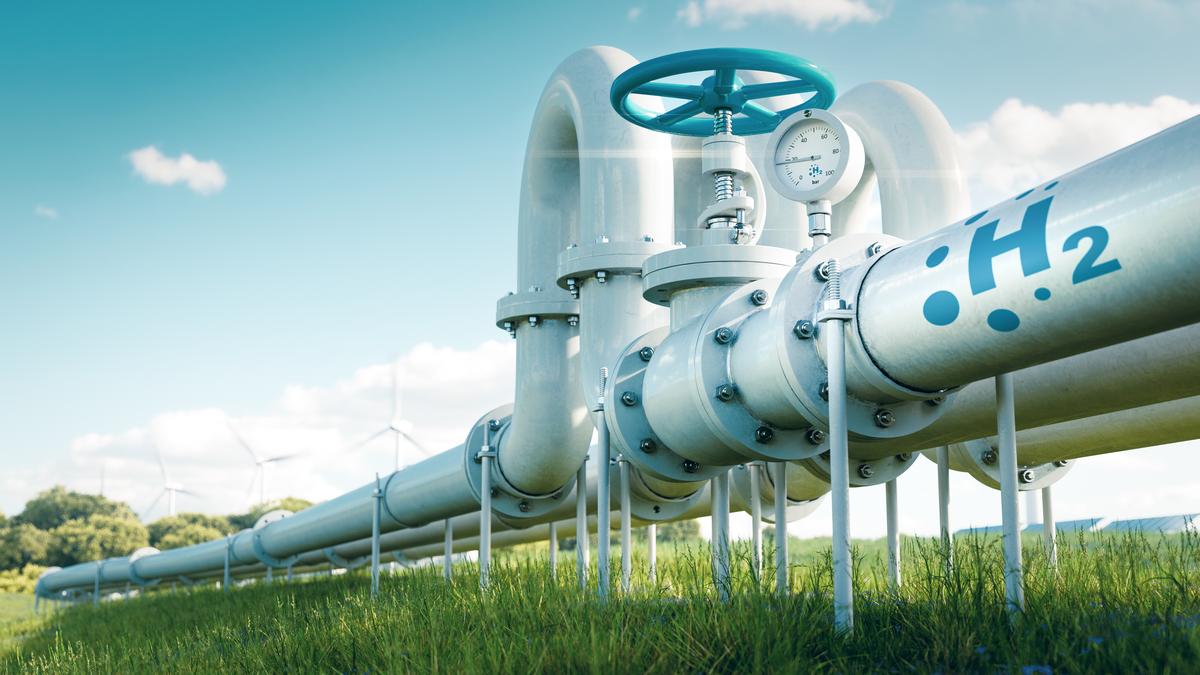
How can India tap its natural hydrogen potential? | Explained
The Hindu
Exploring India's natural hydrogen potential for energy independence and net-zero emissions by 2070.
The story so far: For India, an economy in growth mode with aspirations for energy independence and a pledge to reach net-zero emissions by 2070, the exploitation and use of natural hydrogen offers a potentially game-changing opportunity. In an increasingly volatile world where national sovereignty, economic stability, and energy security become inseparable, tapping into this naturally occurring commodity could go a long way toward enhancing India’s strategic autonomy.
India’s hydrogen demand was projected to grow from six million tonnes per year (Mt/year) in 2020 to over 50 Mt/year by 2070 to support its net-zero target. A preliminary study, by some members of academia referencing model predictions of global geologic hydrogen resources, arrives at a value of 3,475 million tonnes of natural hydrogen potential in India. If these estimates were to be true, we may not even need to engage in the process of manufacturing hydrogen anymore but rather pursue the quest of finding and producing naturally occurring hydrogen that would help decarbonise our economy faster at a lower cost.
On the heels of the recent findings of natural hydrogen reserves in the Andamans, stakeholders need to come up with directional estimates to bring attention of policy makers and investors to the overall potential of natural hydrogen in India. A comprehensive geological study is essential, considering critical factors such as the quality, extent, thickness, accessibility, and hydrocarbon generation potential of the source rock; presence and effectiveness of seals and traps; size and viability of hydrocarbon accumulations; potential losses during migration; and the accessibility of the area for exploration and development.
Natural hydrogen exploitation and exploration is no easy feat. It has technical, logistical, economical, and safety-related challenges. Accurately locating and quantifying underground hydrogen reserves is the primary challenge. Unlike oil and gas, for which well-established exploration techniques exist, natural hydrogen exploration is still evolving. Additionally, efficient and cost-effective extraction technology for natural hydrogen is key. While modifying current gas industry practices associated with well drilling and extraction facilities, one must consider hydrogen’s specific properties, including its small molecular size and high diffusivity. Studies into extraction solutions for lowest cost hydrogen are in progress.
Hydrogen extraction also involves specific safety issues as opposed to hydrocarbons because of its high diffusivity and reactivity. Mitigation measures involve the study and application of hydrogen-resistant materials such as metal coatings and advanced alloys, cement additives to make it more resistant to hydrogen, and rubber fillers to avoid degradation.
A key component of the Indian Solar PV mission’s growth was the German Agency for International Cooperation-National Institute of Wind Energy funded Solar Radiation Resource Assessment (SRRA) Project under the National Solar Mission that commissioned 121 SRRA stations along with four Advanced Monitoring Stations (AMS). Natural hydrogen agencies can formulate a similar public private partnership to assist in the identification of potential geographical deposits by using a mixture of advanced petrophysical characterisation, gravity, and magneto telluric methods in addition to the geophysical methods being employed currently. Magneto telluric surveys, like the AusLAMP and USArray programs, use a network of instruments to collect data over a wide area to create a 3D model of the subsurface resistivity structure; an approach that could be replicated across the entirety of the country to produce a Natural Hydrogen Deposit map for India.
The U.S. ARPA-E’s newly funded projects take exploring the potential of geologic hydrogen beyond locating and extracting trapped geologic hydrogen towards the possibility that hydrogen can be produced intentionally, by drilling and flowing water into rock and then transporting the hydrogen to the surface for collection. Another approach involves injecting water with dissolved carbon dioxide into iron-containing rocks that could potentially lead to carbon sequestration as limestone while simultaneously producing hydrogen.


The Thane police have arrested two co-founders of cryptocurrency exchange platform CoinDCX in connection with an alleged fraud of Rs 71.6 lakh, officials said

Meta Chief Executive Mark Zuckerberg is building a CEO agent to help him do his job, the Wall Street Journal reported

Insurance penetration and density are often misunderstood and do not reveal how many families are insured or whether they would be financially secure if the main earning member were to die. The real issue is not reach but adequacy, as households may have life insurance but not enough cover to replace lost income, leaving them financially vulnerable.

Five top firms lose ₹1 lakh crore in market value, with HDFC Bank experiencing the largest decline of ₹56,124.48 crore.

L&T confirms 95% of its West Asia project sites are safe, while addressing logistics challenges amid ongoing regional conflicts.

Mines Ministry to auction 19 critical mineral blocks on March 23, expanding strategic resources for clean energy and technology sectors.

Mines Ministry to auction 19 critical mineral blocks on March 23, expanding strategic resources for clean energy and technology sectors.

Five top firms lose ₹1 lakh crore in market value, with HDFC Bank experiencing the largest decline of ₹56,124.48 crore.

HDFC Bank terminates three senior officials over client onboarding issues at its DIFC branch amid ethical concerns following chairman's resignation.

Air India CEO warns of potential flight cuts and reduced travel demand due to rising fuel costs amid ongoing Gulf conflict.

Options are widely used by retail traders to speculate on the value of the stock for immediate gains and such behaviour in large scale can distort the market

India achieves 1 billion tonne coal production for the second consecutive year, ensuring stable energy supply and economic growth.

Generic drugmakers in India launch affordable Semaglutide versions, targeting a $1 billion diabetes and weight loss market.