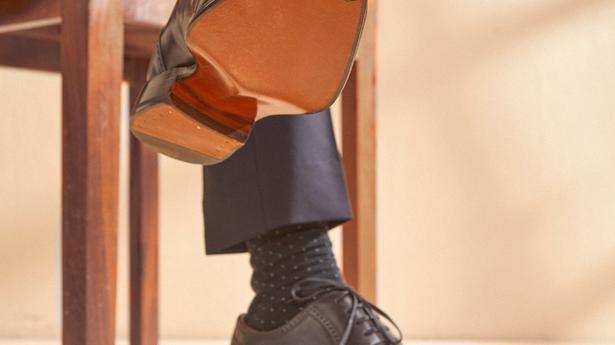
How Bridlen is using its Indo-Japanese collaboration to craft Goodyear welted shoes in Chennai
The Hindu
Bridlen, a family owned business from Chennai, the city, on its their Indo-Japanese collaboration to craft Goodyear welted shoes
Leather shoes, made to order, that fit like a glove, and look like a dream. That is a rare luxury in a market dominated by e-commerce, where even designer brands are churning out collections by the season. For the true shoe connoisseur, only a customised product, can fashion a sartorial statement. So following slow food and slow fashion, now there’s a focus on slow manufacturing. At Bridlen, a shoemaking enterprise in Chennai that started in 1986, making Goodyear welted shoes the old-school way is a rich legacy that has continued into the 21st Century.
Started by the late K Mohamed Hasan, who began his career in shoemaking with solely creating uppers , he then turned his eye to create not just custom shoes, but footwear that would please, whom he considered the most discerning customers — the Japanese. As a first-generation shoemaker with clients in the UK, France, Italy, Germany, Switzerland, Spain and Portugal, he found a friend in Jose Maria Watanabe, a Japanese shoemaker with four decades of experience in the business. What started as a unique friendship, then turned into a partnership that coalesced the best of Japanese design and Indian craftsmanship.
Following the untimely demise of its founder in 2019, Bridlen is now managed by his son, Mohamed Affan Kolandaiveedu. Affan explains why their Goodyear welt design is a cut above the standard, “ We don’t attach a cotton rib to the insole. We take a channel on a much thicker insole and stitch the welt to that. This is what separates us from most other brands at our price point or even a few brackets above. A search on the authorities of the classic shoe world from Simon Crompton at Permanent Style or Jesper of shoegazing.com have singled out this feature as a point of strength, something that you don’t normally find on factory made shoes,” explains Affan.
The story of Bridlen is fashioned by an Indian team guided by Watanabe. A Goodyear welted shoemaker based in Spain, he worked with a European partner, and was looking for a manufacturing capacity closer to Japan, when he heard about a small factory in India and came to visit. “Watanabe and Hasan really hit it off with their philosophy for quality, ethics in business and demeanour that they decided to do something together even though the original plan to move the Spanish production to India did not work,” states Affan.
Watanabe looked to pass on his skills, to Indian craftsmen who were serious about preserving the trade. “My project with Affan Shoes was the production of a finished shoe, something they had never experienced before, and at the same time it was a quality standard that was accepted worldwide.” Explaining how his mentor acclimatised to the new workspace, he adds, “Watanabe took great pains in the early days to get along with the workforce in our factory. He learnt a bit of Tamil and taught basic Japanese to some of the staff and their children on weekends. He would spend half the year in Chennai, and loved to partake in social gatherings, our festivals, and cultural practices.”
Watanabe has continued his association with Bridlen, even during the pandemic. Until three days before the first lockdown came into effect in March 2020, Watanabe was in Chennai, and managed to get one of the last scheduled flights out of New Delhi to Tokyo. “We were in touch with him at least once or twice a week through video calls,“ says Affan, adding how the pandemic forced Bridlen to look at doing fittings remotely. The brand took to e-consultations where a potential client could book a video consultation to understand fitting. For clients who ordered a pair of Goodyear welted shoes online, a pair of fit-trial shoes would be shipped to them, to ensure the sizing was right before making it in their preferred style/colour. “This gave clients a much needed boost in confidence to try a new brand and to speak with someone from the team about the intricacies of wearing them, the break-in period, shoe care etc,” states Affan. Post lockdown, the styling at the brand has pivoted as well, from classic to casual classics, bringing sustainable Goodyear construction to a wider variety of footwear styles: chukka boots, derbies, or semi-formal loafers.
Watanabe, who is currently in Tokyo, says working in India has been a rewarding journey. “Even though we made small batch production runs, it was important for Watanabe that these shoes should be available to a wider audience in terms of affordability.”


Vaccination policies must prioritize saving human lives over individual choice amid rising vaccine skepticism, asserts scientist Dr. Virander Singh Chauhan.

Seven Indian fishermen from Rameswaram arrested by Sri Lankan Navy, sparking protests and calls for government intervention.

Kerala cyber police file a case against X for an AI video allegedly defaming PM Modi and the Election Commission.

iKure and Izawa Co. partner to combat avoidable blindness by integrating innovative eye care technology into rural healthcare networks.

Thousand Lights MLA from the DMK N. Ezhilan, in an interview to The Hindu, observes that any popular personality entering politics will attract the limelight. But only a structured party machinery combined with popularity can ensure success. In this interview, he speaks about his tenure as first-time MLA from Thousand Lights Assembly constituency in Chennai, Vijay’s political entry shaping the 2026 elections, redressal of key grievances and more.

Abhishek Banerjee challenges BJP's Suvendu Adhikari in Nandigram, pledging community health initiatives if Trinamool Congress wins.

Rising LPG shortages in Karnataka boost firewood demand, reviving an informal market as households and hotels seek alternatives.

Against the backdrop of intense poll activity, a 400-metre stretch of an arterial road in the outskirts of Chennai (technically in Madurapakkam panchayat under Tambaram assembly constituency) presents a salute to the idea of res publica, which underpins India’s system of governance, where citizens have a say, at least before a government is securely ensconced in the seat of power. A Republic Day initiative shines bright every night

Fadnavis claims zero FIR in Ajit Pawar crash is a defamation attempt by Karnataka against Maharashtra's investigation efforts.

Set to unfold as a one-day pop-up on April 5, the Easter Sadya brings together both vegetarian and non-vegetarian menus, offering a peek into the food traditions of the Syrian Christian (Nasrani) community. While the traditional Sadya is often associated with dishes such as sambar, avial, and rice, this version expands to include community-specific festive dishes.

BJP nominates mother of R.G. Kar victim Abhaya to contest from Panihati in West Bengal Assembly elections.

Veteran Malayalam actor-director E.A. Rajendran passes away at 71, leaving behind a rich legacy in the film industry.

Dakshina Kannada Zilla Panchayat has rolled out digital mode of water bill generation and collection in 23 gram panchayats on a pilot basis for the first time in Karnataka. This is set to be extended to the remaining 200 panchayats shortly, according to the Zilla Panchayat Chief Executive Officer Narwade Vinayak Karbhari.