How a trade war could boost small-scale farming in southwestern Ontario
CBC
A southwestern Ontario farmer hopes the ongoing U.S.-Canada trade war encourages the country to look inward to keep itself fed, while making itself more resilient in the face of future crises.
It's a hope shared by some farmers with smaller operations, as they search for upsides in a situation that could have dire consequences for the Canadian economy — and agribusiness on a larger scale.
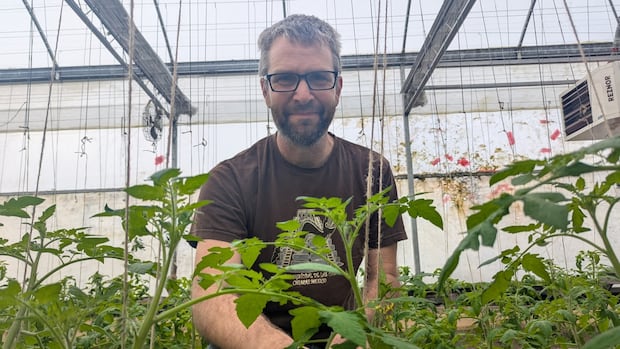
"I think it's really important that we know how to supply ourselves," said Chris DeVries, the owner of Common Ground Farm in St. Thomas, who believes "we could 100 per cent produce all the food we need."
The former engineer grows a wide range of vegetables year-round in a combination of fields, greenhouses and hoop houses, taking his harvest to farmers' markets in London and Kitchener. Common Ground also runs a delivery service in London and St. Thomas.
A number of industries across Canada have already started cutting back as tariff threats from U.S. President Donald Trump — and a resulting lack of certainty — loom.
Although the agricultural sector, which exported roughly $40 billion in products to the U.S. in 2023, isn't immune to those effects, it continues to push forward to keep people fed. U.S. tariffs are expected to give a devastating blow to southwestern Ontario's greenhouse growing industry along with farming.
For DeVries, little has changed recently.
"It's only really viable for me to sell to local customers," he said. "Otherwise I'd have to be far bigger."
With that, he expects to see growing interest in Canadian produce, and moving forward hopes to see more of the sector shift toward producing with the domestic market in mind.
"The system we have has meant that it's often more efficient for us to grow [and export] cash crops like corn and soybeans here, and for us to get our produce from somewhere else," DeVries said. "But I think this might be a time where we consider, well, is that always the right answer?"
One challenge DeVries acknowledges is that certain products can't be feasibly grown year-round, or at all, in Canada.
"We've become used to having everything we want whenever we want. Eating seasonally is a little different than eating whatever is available whenever," he said.
According to Ethan Wallace, a vice president with the Ontario Federation of Agriculture (OFA), the idea of a trade war helping small-scale farmers has merit.
"The farm to table marketers, the farmers with the roadside stands, the small and medium-sized producers that the market direct to consumer, are the ones that stand to gain the most out of out of all of this," Wallace said. "As consumers decide to buy local, they're looking for those people."


Saskatoon city hall administration is planning to "refresh" the funding strategy for the proposed $1.2-billion downtown arena district amid a lack of commitments from higher levels of government.

A report of fraud tied to a walleye derby is under investigation after Montreal Lake Cree Nation said a participant allegedly violated derby rules and was asked to leave the fishing area.

An Edmonton architectural firm says it is in talks with the provincial government to potentially redevelop the former Royal Alberta Museum.

Does junior football have a future in Prince George?

People are descending upon the city for the dozens of events and live music performances this week as the Juno Awards are set to take place Sunday at Hamilton's TD Coliseum.

For nearly two decades, Amanda Loewen's world ended where the pavement did.

The notion that home ownership guarantees financial security in old age is being challenged by a recent survey.

The family of Nash Prystie has identified him as the man who died in an Ontario Provincial Police (OPP) shooting earlier this month north of Kenora, and is calling for more and quicker help for people with mental health challenges.

Playoff action in the Ontario Hockey League gets underway Thursday night for Guelph and Friday in Kitchener.

UPEI wants its faculty to sign on to an updated version of its sexual assault and discrimination policy, but the union that represents the school's academic staff says it wants the policies to be part of its collective agreement.

In Texas this week for a global energy conference, the federal natural resources minister is proclaiming "Canada is back" and ready to bolster its energy sector and grow exports.

Members of Parliament last year went on the fewest sponsored international trips in the last 15 years, excluding the height of the COVID-19 pandemic.

Ontario is running out of time to beef up rules that would crack down on negligent and misbehaving municipal politicians ahead of the next civic election, some experts and opposition critics warn.