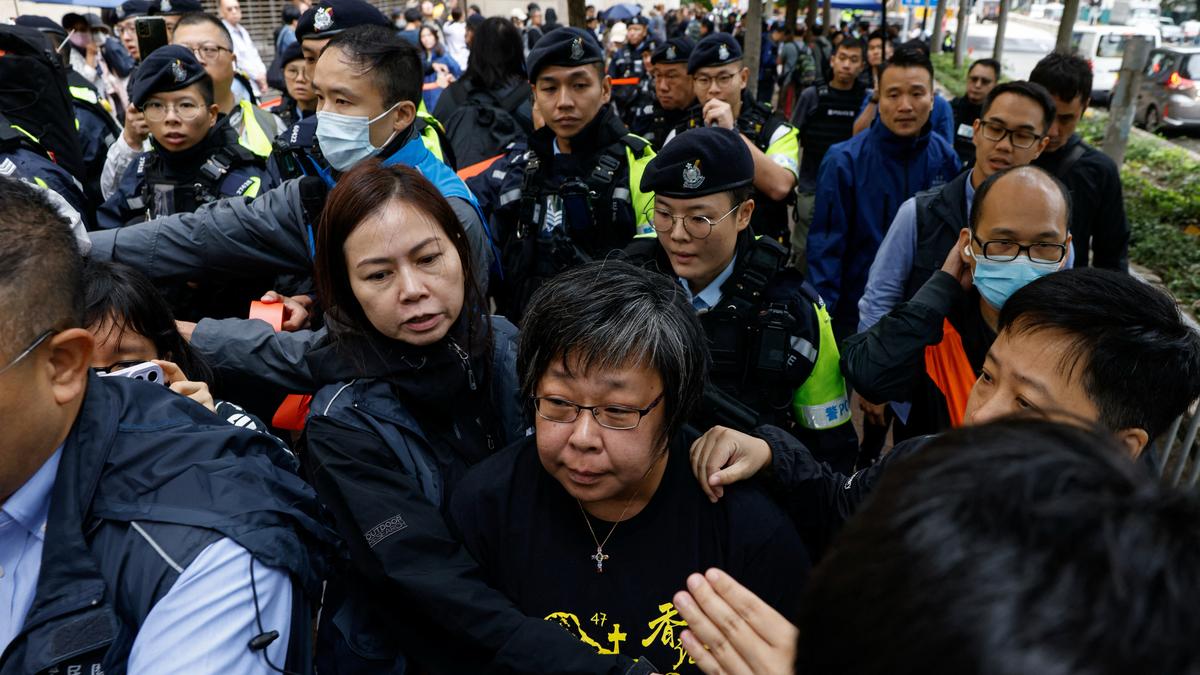
Hong Kong activists get 10 years prison in biggest national security case
The Hindu
Dozens of activists sentenced to prison in Hong Kong's national security case under Beijing's law, crushing pro-democracy movement.
Dozens of prominent activists were sentenced to up to 10 years in prison on Tuesday (November 19, 2024) in Hong Kong’s biggest national security case under a sweeping law imposed by Beijing that crushed a once-thriving pro-democracy movement.
The defendants were prosecuted in 2021 for their roles in an unofficial primary election under the 2020 national security law. They were accused of attempting to paralyze Hong Kong’s government and force the city’s leader to resign by aiming to win a legislative majority and using it to block government budgets indiscriminately.
The 45 convicted received prison terms ranging from four years and two months to 10 years. Legal scholar Benny Tai was given the longest sentence.
They either pleaded guilty to or were found guilty of conspiracy to commit subversion by three government-approved judges. The judges said in the verdict that the activists’ plans to effect change through the election would have undermined the government’s authority and created a constitutional crisis. Two of the 47 original defendants were acquitted.
Mr. Tai, who had written an article outlining "ten steps to mutual destruction" is widely seen as the organizer behind the unofficial primary. In a judgment uploaded online, the judges wrote that Mr. Tai essentially “advocated for a revolution” by publishing a series of articles over a period of months that traced his thinking, even though in his mitigation letter Mr. Tai said the steps were “never intended to be used as blueprint for any political action.”
Some defendants had claimed that the scheme to secure a majority of seats in the legislature would never have materialized, though the judges rejected this reasoning, stating that “all the participants had put in every endeavor to make it a success."
In the judgment, the judges highlighted that a great deal of time, resources and money had been put into the organization of the primary election, and rejected the idea that the scheme had been “doomed to fail.”


Trump postpones military strikes on Iranian power plants for five days amid escalating tensions and ongoing diplomatic discussions.

Shorts News:Watch: NATO chief: 22-nation group forming to secure Strait of Hormuz

Saudi Aramco reduces crude supply to Asia for April, citing disruptions from the Iran-Israel conflict affecting trade routes.

Tencent launched a tool on Sunday to integrate its WeChat messaging platform with the OpenClaw agent

An Air Canada flight collided with a Port Authority vehicle at LaGuardia Airport, causing significant damage and police response.

Saudi Arabia and the UAE face missile attacks, with casualties reported and air defenses engaged amid escalating regional tensions.

Slovenia's parliamentary election results show a tight race between liberals and populists, signaling potential political instability ahead.

IEA chief warns of a potential energy crisis worse than the 1970s, with 11 million barrels lost daily amid regional conflicts.

Cuba begins restoring power after a nationwide grid collapse, affecting thousands amid an ongoing energy crisis and blackouts.

The Hindu LIVE updates on March 23 2026 on Iran-Israel war. Iran faces deadline of US President Donald Trump warning to open Strait of Hormuz

Brazil's Lula condemns renewed colonialism and U.S. interference in developing nations at a summit in Colombia.

Saudi Arabia expels Iranian military staff amid escalating tensions and ongoing missile attacks during the U.S.-Israeli war on Iran.

Russia claims control of Potapivka village in Ukraine's Sumy region amid ongoing military efforts to establish a buffer zone.